Grade A on a honey label is a processing grade, and what it certifies is cleanliness, not character. It tells you the honey was free of off flavors and aromas, free of visible foreign matter and damage from overheating, reasonably clear, and handled within the limits the standard sets. It cannot tell you what the honey tastes like, because flavor comes from the flowers the bees worked. It cannot tell you how fast the jar will crystallize either, because that speed is set by the glucose-to-fructose ratio in the nectar, which follows those same flowers. Botanical source and stated origin are the two label facts that answer those two questions. The letter answers neither.
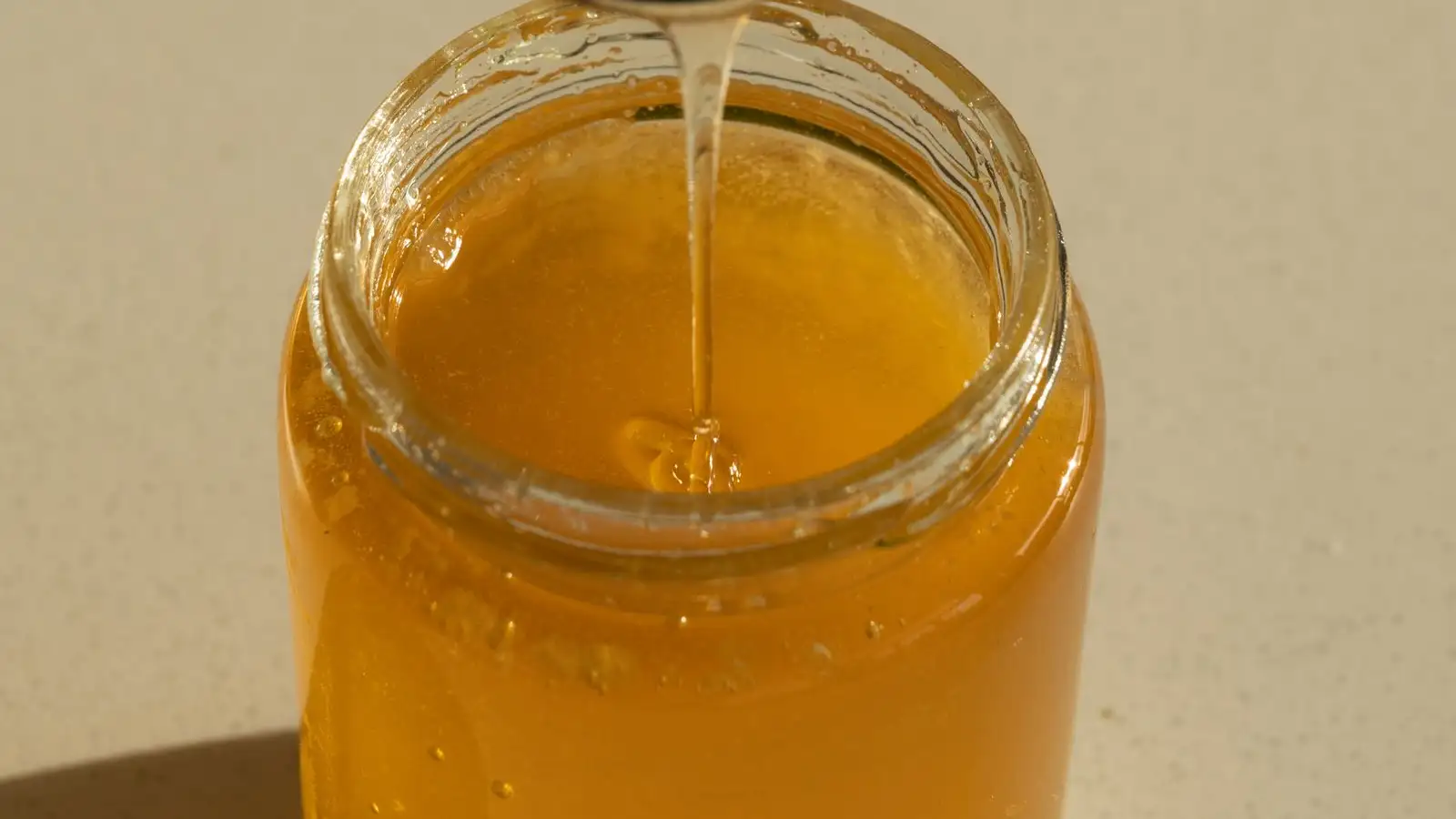
There are four jars lined up on my kitchen counter right now, and every one of them says Grade A. It's a cold Saturday, the window light is flat and gray, and I pulled them all down from the same shelf because a friend had asked me why one of her jars had turned to grit while another stayed pourable year after year. The answer isn't printed on the front of any of these labels. It's the difference between the jars themselves.
Two of them pour. I tilt the first and it runs down the inside of the glass in a thin amber ribbon and settles without a trace. The second does the same, a little slower, heavier. The third doesn't pour at all. It has gone the color and texture of wet brown sugar, and when you push a spoon into it, it doesn't give, it shears. The sound is a dry scrape, like a spoon in a cup of sand. The fourth is caught halfway: liquid on top, a solid pale block at the bottom, and when you tilt it the liquid slides around the crystals in a slow ring, the way water moves around a stone.
Then I taste them. The first is thin and clean with a faint green edge, something like the skin of a green apple, and the flavor lifts off the tongue fast. The second is darker and heavier, malty at the front, a little bitter at the back, the taste of molasses and damp leaves. The third is quiet — pleasant, sweet, gone in two seconds, a flavor you'd call honey if someone blindfolded you and nothing more specific than that. The fourth tastes like the second but softer.
Four jars. Four Grade A labels. The letter told me none of it.
What the letter is actually measuring
The USDA grade is about defects. Grading looks at flavor and aroma, absence of defects, and clarity, and Grade A means the honey came through clean on all three: no scorched or fermented notes, no specks, no haze. That is real information. It tells you the honey was handled well and that the jar in your hand isn't going to taste like a mistake. What it doesn't do is describe. "No off flavors" is not the same statement as floral, or buttery, or bitter at the back of the throat. A honey can be impeccably clean and completely forgettable, and plenty of it is. The grade is a floor, not a personality.
Somewhere along the way, shoppers folded the grade and the varietal name into one phrase — Grade A Clover, Grade A Wildflower — and started reading the A as if it modified the noun after it. It doesn't. The A is a statement about processing. The clover is a statement about where the nectar came from. Two unrelated claims printed next to each other, which is exactly why they get merged.
Why one jar sets and the other doesn't
Honey is a supersaturated sugar solution: more sugar dissolved in the water than the water could normally hold. Left alone, it wants to come back out of solution, and the sugar that comes out first is glucose. Fructose stays liquid far longer. So the glucose-to-fructose ratio of the nectar is the main thing deciding how long a jar stays clear.
Honeys that lean glucose-heavy set fast. Clover, alfalfa, dandelion, star thistle — those are the ones I've watched lock up first, sometimes within a couple of months of coming home. Honeys that lean fructose-heavy stay pourable for months, occasionally years: acacia, tupelo, sage, black locust. None of that is a quality difference in either direction. A jar that sets on you is not failing. It is behaving exactly the way its sugar profile says it should.
I can feel that ratio in the jars on my counter. The third one, the one that sheared under the spoon, will be a solid block by spring. The first one will still ribbon in August.
There are other forces working on the same jar, and this is where it gets less tidy. Cold speeds crystallization up; a warm cupboard slows it down. Mine live above the stove, which is why mine set later than the same honey kept in a cool cellar. Tiny particles — pollen grains, bits of wax, and the fine crystals left behind once a jar has set — give the glucose something to build on, which is why heavy filtration slows the process and why a jar that has already crystallized will crystallize again faster the next time. And the same named varietal from two different yards in two different years can set at noticeably different speeds, because the bees didn't read the label. Treat all of it as a leaning, not a schedule.
The two things on the label that actually predict something
If you want to know what's in the jar, read the botanical source and the stated origin. A honey labeled with a specific bloom — clover, buckwheat, tupelo, mesquite, sourwood — is telling you which nectar dominated, and that one word carries more about flavor and set time than the grade letter ever will. A honey labeled wildflower is telling you almost nothing, because wildflower isn't a source; it's a description of whatever happened to be blooming within foraging range that season. It can be lovely. It just isn't predictive.
Origin works the same way. A jar that names a specific region is pointing at a specific set of blooms: a tupelo grove along a river bottom, a hillside of sage, an orange grove. A label that says Product of the USA or blend of domestic and imported honeys is telling you about supply chains, not about flavor. Even a named state isn't a guarantee — one county's wildflower is not the next county's.
The test I use is simple. Take two jars with the same grade letter and different bloom names, and you get two honeys you would never mistake for each other. One is bright and acidic; one tastes like caramel and tree bark; one is so mild it vanishes into a slice of buttered bread. The letter on all of them is identical.
Where this shows up at the mixing bowl
In baking, the grade is irrelevant and three other things are not. Moisture matters: honey carries water, and a wetter honey changes how a batter sets and how the crust browns, so the same recipe made with two different jars can come out two different ways. Flavor intensity matters: buckwheat will push its way through whole wheat and spice, while a mild clover disappears entirely, and swapping one for the other at the same measurement is not a neutral move in a strongly flavored recipe. Sugar profile matters too: fructose-heavy honeys taste sweeter by weight, brown faster in the oven, and hold moisture in a baked good longer, while glucose-heavy honeys can go grainy in a cold batter and leave a texture you can feel on the tongue.
None of those three properties sits inside the grading criteria. You find them by reading the source and the origin, and then by tasting.
What I do with a new jar
I keep a small jar of anything new in the cupboard, never the refrigerator, and I watch it. If it sets by six weeks, it's a spreader. That's the one I want on toast, where the crystals hold it in place and it doesn't run off the crust. Once it sets, I warm it only partially, so it stays thick and grainy instead of sliding back to syrup. If it's still pouring at six months, it's a drizzler, and that's the jar that goes over yogurt or into a drink.
The word creamed or spun on a label is worth knowing too. That's crystallization done on purpose, ground fine and controlled — the identical transformation that ruins someone's morning when it happens on its own. Same jar of sugar, just managed.
The letter on the front is a reasonable thing to want. It means the honey was handled well. It just isn't a description of what's inside. For that, you have to look past the A to the flower and the place.