Swapping sugar for organic honey mid-recipe changes three things you can measure: how much water is in the bowl, how much sweetness each gram carries, and how fast the surface browns. The organic seal changes none of them. Every adjustment that follows — pulling back the added liquid, dropping the oven temperature, adding a quarter teaspoon of baking soda, sometimes adding a little leavening to cover for lost aeration — traces back to honey's water content and its ratio of fructose to glucose. Those numbers move with variety and harvest. Two jars of the same variety at the same moisture behave identically in a batter, whether or not either one carries a certification.
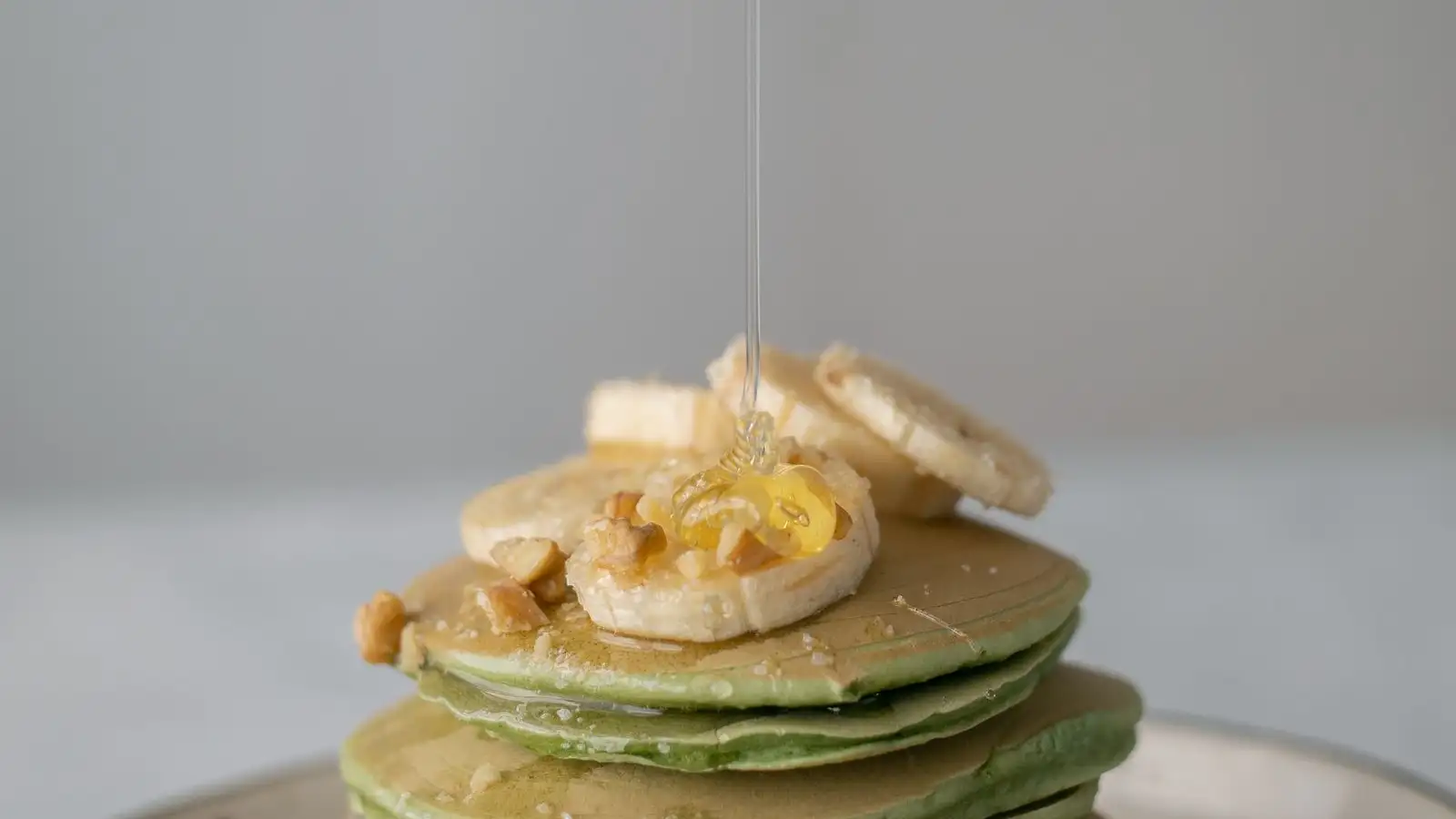
I keep a scale within arm's reach of the mixing bowl, and this swap is the reason. You know the moment: butter already creamed, flour half measured, and the sugar canister turns up empty except for a dusting in the corner. There's a jar of honey on the shelf. You tilt it over the bowl and nothing pours — it folds over itself in a slow, heavy ribbon, a much denser thing than what came out of the canister.
If the honey has gone grainy and opaque since fall, it goes in anyway. Those crystals dissolve once they hit the batter and the oven. What crystallized honey does badly is travel through a measuring cup; a third of it stays behind on the glass no matter how long you let it drain. So the scale makes the call. A cup of granulated sugar weighs about 200 grams. A cup of honey weighs roughly 336. Same volume, two-thirds more mass, and a good chunk of that extra mass is water rather than sugar.
That is the first number, and it is the one that ruins batches.
Water is the adjustment, not the sweetness
Honey runs somewhere around 15 to 19 percent water by weight depending on the lot. Granulated sugar is under half a percent. So each cup of honey you pour in is arriving with roughly 50 to 65 grams of water the recipe never planned for, and that water shows up immediately in the texture of the dough.
Where does the spread come from? Variety first. Honeys from dry, slow-secreting floral sources — sage, tupelo — tend to come in on the low end. Wildflower lots can run wetter, and a wet season can push moisture up across the board. How the beekeeper handles capping and extraction moves the number too. This is the part that gets flattened when people talk about honey as though it were one ingredient. It isn't. It's a range.
So the standard instruction — reduce the other liquid in the recipe by a quarter cup for every cup of honey — is a starting point, not a law. If you're working with a honey that pours like thin syrup, pull back more. If it's stiff and slow, pull back less. You're balancing against the actual jar in front of you, not against a rule.
Sweetness rides the same variation
Honey's sugars are mostly fructose and glucose, already split apart rather than bonded into sucrose the way table sugar is. Fructose tastes sweeter than sucrose; glucose tastes less sweet. Honey that leans fructose-heavy — tupelo and acacia are the usual examples — reads noticeably sweeter than a clover or alfalfa honey that carries more glucose.
That's why three-quarters of a cup of honey per cup of sugar is a rough estimate. With a bold, fructose-forward honey, you might go a little under. With a milder one, a little over. And because honey is hygroscopic, it keeps pulling moisture from the air after baking, which is why honey cakes stay soft for days and why overdoing it turns the crumb gummy instead of tender.
What I actually do at the counter
Weigh the honey, always. Around 336 grams per cup. A scale sidesteps the cling problem entirely, crystallized or not, and it's the only way to be repeatable when you're substituting by feel.
Swap 1 cup of sugar for about 3/4 cup of honey, then take out a quarter cup of whatever other liquid the recipe calls for — milk, water, buttermilk, juice. Taste-test the batter is not advice I'd give; instead, judge by the bowl. If the mixture looks like pancake batter when it should look like cookie dough, you've got a wet honey and you need to trim a little more liquid or add a spoonful of flour.
Add a quarter teaspoon of baking soda per cup of honey. Honey is acidic, and the soda nudges the pH back toward where the recipe expects it. Some recipes want a little more; lean batters with very dark honey usually do.
Drop the oven temperature by 25 degrees Fahrenheit. Honey's glucose and fructose are reducing sugars, already in the form that reacts with proteins under heat, so browning starts earlier than it would with sucrose. Same reason the crust of a honey quick bread goes deep brown while the middle is still pale.
And expect less lift from creaming. Beating butter with granulated sugar works because the hard crystal edges cut pockets of air into the fat. Honey is a syrup; it dissolves. You lose some of that aeration, so plan on a slightly denser crumb, or add a quarter teaspoon of extra baking powder, or switch to a method that doesn't depend on creaming — melt the butter, whisk the wet ingredients together, fold in the dry.
If you're baking yeast bread, honey is fermentable, so the yeast will feed on it fine. The dough will still slacken from the added water, meaning you'll work in more flour, which is its own adjustment to track. Don't lose the thread: extra flour means a stiffer dough and a slightly different crumb, and that all started with a moisture number.
Where the batter tells you first
Cookies are the tell. The dough looks looser than you expect, the scoops spread wider in the oven, and the edges brown before the centers set. Pull them a minute early and let them finish on the sheet.
Cakes and muffins come out with a soft, damp crumb and a darker top. Loaves of quick bread get a thick, dark crust and stay moist for days. If a cake sinks in the middle, the usual cause is too much liquid for the leavening to carry, not the honey being organic or not.
Why the certification never enters the math
This is the part I wish more people separated out. Organic certification is about how hives are managed and what the bees forage on and how the honey is handled after extraction. It says nothing about how much water is in the jar or whether the fructose outweighs the glucose. Those are set by floral source, weather, and the beekeeper's timing — the same forces whether the honey is certified or not.
A certified organic clover honey and a conventional clover honey from the same region in the same season can land within a percentage point or two of each other on moisture. Put them in identical batters and they behave the same way: same spread, same browning, same crumb. If you taste a difference, or see a difference in the bowl, you're almost certainly comparing two different varieties or two different harvests. The seal is a separate conversation from the mixing bowl, and mixing the two up is what makes people think honey substitution is unpredictable.
Read the variety name instead. Smell it. Tip the jar and watch how fast it moves — runny honey carries more water, stiff honey carries less. That's the information the recipe actually needs.
When I don't make the swap
Sugar is sometimes structure, not just sweetness, and honey can't do that job.
Candy and caramel are the clearest case. Fructose makes it hard to hit a precise stage without scorching, and the window between soft-ball and burnt is narrow.
Meringues and anything that depends on sugar stabilizing whipped egg whites: honey is a syrup and won't build that structure the same way.
Shortbread and other low-moisture, high-butter recipes where the sugar is holding the architecture together. You can swap, and you'll get a cookie, but it won't be shortbread.
And any cake that relies entirely on creaming for its lift, with no chemical leavener to fall back on. There, the swap costs you height that no adjustment gets back.
The label on the jar is a question about how the honey was produced. The honey in the bowl is a question about water, sugar ratio, and heat. Keep them apart and the substitution stops feeling like guesswork — you're just adjusting a recipe to the liquid you actually have.