Two jars can sit within a point of each other on a moisture meter, carry nearly the same sugar numbers on a lab sheet, and still pour like two different substances. The body you feel on the spoon comes from the whole nectar blend — the fructose-to-glucose ratio, the protein and colloid load carried over from the flowers, the filtration and warming the honey went through before bottling, and the temperature of the room you are standing in. Clover honey usually draws from one dominant bloom, so those variables barely move from batch to batch and the pour stays heavy and slow. Wildflower is a blend that changes with whatever the bees worked that month, so its body wanders: a fast, thin thread one season, a syrup-heavy rope the next, with an identical label on both jars.
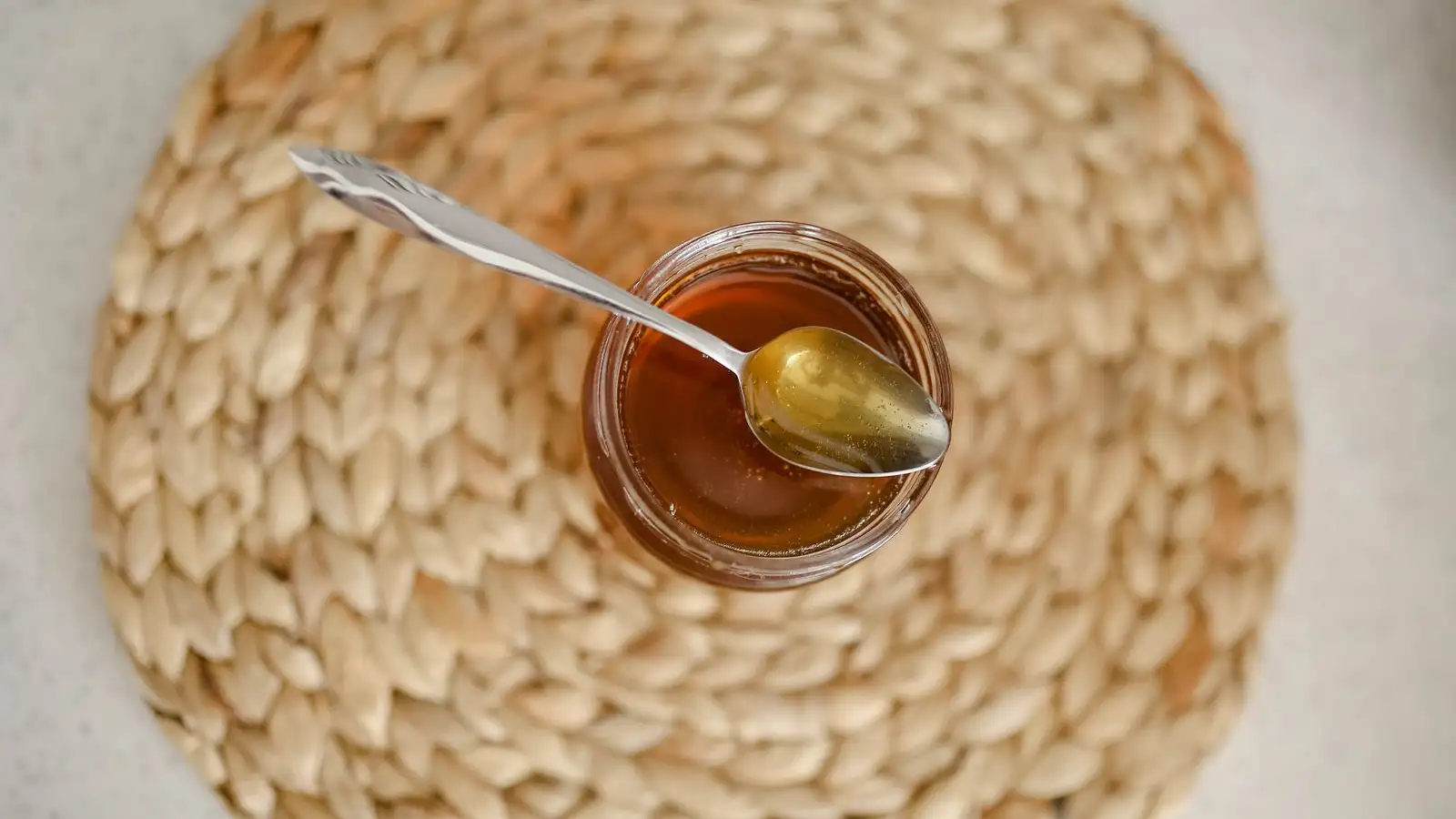
I keep two squat jars on the counter, four inches apart, and I run this test without exactly deciding to. Spoon into the clover, lift, and the honey leaves in a slow rope that folds back over itself twice before it breaks. Same spoon, same room, same afternoon, into the wildflower: it comes off in a fast thread, beads at the tip, and drops. Both jars read within a point of each other on the refractometer in the utensil drawer. So the display isn't what's doing the work.
Viscosity Is a Sum, Not a Setting
Mouthfeel in liquid honey is viscosity, and viscosity is a stack.
Water content sits at the top. Water is the lubricant between sugar molecules; take a little out and everything drags. A honey that reads a point lower on moisture pours noticeably slower — you can see it in the ribbon, not just feel it on the tongue.
Sugar composition sits just under it. Honey is mostly fructose and glucose in a ratio that shifts with the nectar. That ratio changes how tightly the sugar network holds together and how readily it grabs water, and it's a big part of why two honeys at the same moisture can still feel different in the mouth. Fructose stays more fluid and more soluble; glucose is the one that thickens the pour and eventually crystallizes.
Then the colloids: proteins, wax fragments, pollen grains, trace solids. They are a small share of the weight and a large share of the body. A honey with a heavier suspended load feels rounder and more coating on the tongue.
And temperature sits on top of all of it, which I'll come back to, because it's the variable that fools people most.
Notice what isn't on that list: monofloral versus polyfloral. That's a statement about where the nectar came from, not a physical property. It only matters because it predicts how much the other variables move.
Why a Single-Source Jar Holds Its Body
Clover, alfalfa, basswood, tupelo — when a beekeeper sets supers for one of these, the colony is working a narrow window and a narrow menu. The nectar coming in is close to uniform, so the fructose-to-glucose ratio lands in a consistent band, the colloid load lands in a consistent band, and the finished honey pours in a predictable way. Clover in particular tends to come in with a sugar balance and a solids load that reads heavy: the spoon comes up loaded, and the honey hangs.
Two things can undo that. Fine filtration strips out the larger suspended material and much of the pollen, and a filtered single-source honey can pour distinctly lighter than the same honey filtered less aggressively. Heavy warming before bottling does something similar — it thins the honey for the filling line, and some of the structure doesn't come all the way back. So the nectar source tells you the flower side of the story. It doesn't tell you what happened in the bottling room.
Wildflower Is a Recipe That Keeps Changing
Wildflower isn't a flavor. It's a category for whatever the bees found. A spring wildflower from a mixed meadow — dandelion, fruit blossom, early maple — can be light and quick. A late-summer wildflower heavy on goldenrod and aster can pour almost like the clover. Same beekeeper, same yard, six weeks apart, and the two jars don't behave like relatives.
That's the real difference, and it isn't a defect. A single-source honey gives you a body you can plan around. A wildflower gives you a body that's a snapshot of one season. If you bought wildflower in June and liked how it coated a spoon, buying wildflower again in October is a different purchase, even from the same label.
Large packers blend wildflower to hit a flavor target rather than a body target, so the texture drifts in its own way, usually landing somewhere in the middle. Predictable, but not the same kind of predictable as a single-source jar.
Temperature Moves More Than the Label Does
Put a jar of clover in the fridge overnight and it pours like cold molasses, slow and reluctant, with a heavy, almost waxy feel. Set that same jar in a warm kitchen for a day and it runs off the spoon in a thin stream. Nothing about the honey changed. Temperature changes the internal friction of the sugar solution, and it does it fast.
This is the mistake I see most when people compare two honeys. The jar from the back of the pantry is cool; the jar that just came home in a warm car isn't. Ten degrees of difference will make a heavy honey look thin and a thin honey look heavy.
When I actually want to compare two jars, I set both on the counter overnight so they're at the same temperature. If I need a stubborn jar to move, I stand it in a bowl of warm water — not boiling — for a few minutes and swirl. It loosens, pours, and thickens right back up as it cools. That part is reversible.
Crystals Are a Separate Axis
Crystallized honey often gets described as thick, and that's where a lot of confusion starts. Set honey isn't more viscous. It's a different texture entirely, a semi-solid built out of sugar crystals, and its mouthfeel depends on crystal size, not on how the liquid version poured.
Fine crystals, the kind you get in a stirred, creamed-style honey, feel smooth and spreadable, close to soft butter. Coarse crystals feel gritty, and you can roll them between your tongue and the roof of your mouth. Same jar, different crystal size, completely different experience.
Glucose is the sugar that crystallizes, so honeys with a larger glucose share set faster and harder. Clover sets in a matter of months in my cupboard. Tupelo, which runs fructose-heavy, can sit liquid for years. Meanwhile a thin, fast-pouring wildflower can crystallize into a firm, creamy block, and a heavy clover can set into a gritty one. Body and crystallization are two separate questions. Ask them separately.
In a Vinaigrette, Body Is Mechanical
This is where the difference stops being cosmetic.
I build dressing in a shallow bowl: honey first, then sherry vinegar, a little mustard, then oil in a thin stream while I whisk. With a heavy clover, the honey dissolves into the vinegar and gives the base enough body that the oil breaks into small droplets and stays there. The dressing coats the back of a spoon, and it clings to arugula instead of sliding off. With a thin wildflower, the same whisking gives me bigger droplets and a looser dressing. It disperses fast and coats lightly, and by the time the bowl is empty the oil is already pooling at the bottom.
Neither result is wrong. If I'm dressing delicate lettuces and want a light touch, the thin jar does exactly what I want. If I want a dressing that holds together for ten minutes on the table, I reach for the heavy jar, or I bump up the mustard in the thin one to make up the difference. Knowing which jar does which saves me from re-whisking at the table.
Reading the Jar Before You Buy
You can get most of this without any equipment.
Tilt the jar and watch the rope. A slow rope that folds on itself and sits on the surface before it sinks means heavy body. A fast thread that breaks early and disappears into the surface means light body.
Turn the jar upside down and watch the bubble climb. Slow bubble, heavy. Quick bubble, light.
Do the spoon lift at room temperature, both jars at the same temperature.
If you're buying from a beekeeper at a market, ask what the main flow was and when it was pulled. A wildflower from a July extraction and a wildflower from a September extraction are two different products, and the person who harvested them knows exactly which is which.
Keep one caveat in your pocket, though: none of this is stable enough to be a rule. I've had wildflower that poured like cold syrup and clover that ran like water after heavy filtration. The pour tells you about this jar, this season, this temperature. It's information, not a score.