Monofloral honey tastes focused because nearly all the nectar behind it comes from one flower species, so its aromatic compounds arrive in a narrow band and the flavor reads as a single signature held steady from the first sniff through the finish. Polyfloral honey tastes layered because the colony draws from several plant families at once, and their compounds stack in sequence: something floral up front, fruit in the middle, a woody or resinous edge that only shows up late. The honey flavor wheel is what makes that distinction sayable, because it splits aroma, basic taste, and mouthfeel into three separate vocabularies, so "focused" and "layered" become descriptions of structure rather than stand-ins for praise.
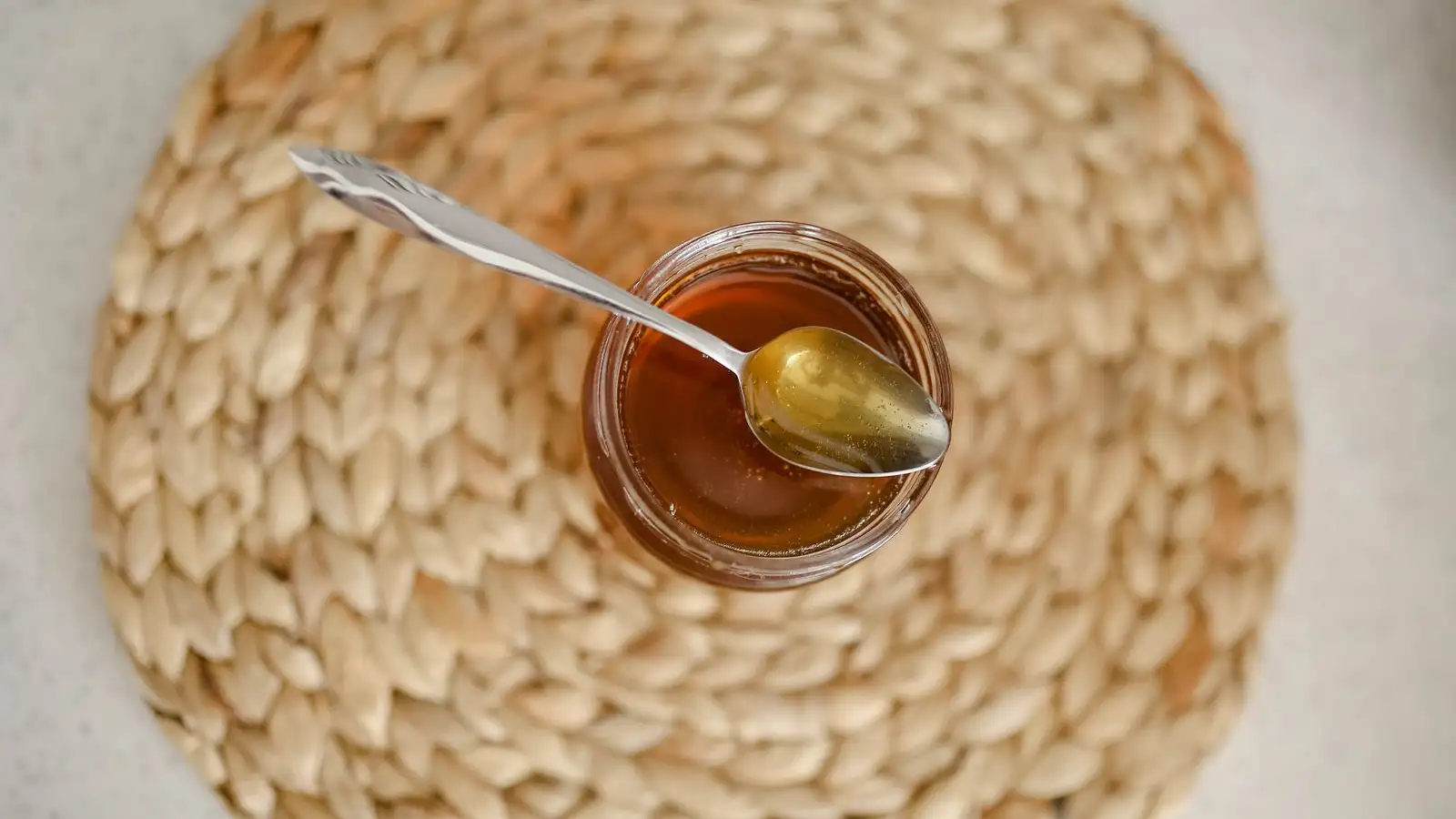
I keep my jars on the bottom shelf of a cabinet that never gets direct sun, lids marked in pencil with the month and the year. Not because I am organized, but because a jar I opened in March and a jar from the same farm stand opened in June will not smell the same, and I want to know which one is in my hand. Pull two down with me. Set them on the counter an hour before you open them so both are at room temperature. That hour is not fussiness. A cold jar smells like almost nothing, and the first thing people do when a honey reads flat is blame the honey instead of the thermometer.
Unscrew the first lid and smell it twice. The first pass is the loud one, the one that hits you before you have decided anything. The second pass, a few seconds later, is where the quieter notes surface. Then do the same with the second jar. If the setup is fair, one of them gives you the same word on both passes, and the other gives you two different words. That is the whole difference between focused and layered, and you can feel it in your nose before you can explain it.
What Focused Really Means in the Glass
Focused is not the same as strong, and this is where most descriptions of monofloral honey go crooked. A focused honey is narrow, not necessarily loud. Clover from a good season can be soft and still completely consistent from start to finish, and a pungent polyfloral can be intense while still moving around. Intensity and complexity are two separate dials. When someone tells me a single-source honey is "simple," I usually find they tasted it at the wrong temperature or on a carrier that was doing its own talking.
The other thing focus does not mean is uniformity across jars. Same flower, different soil, different rainfall, different week of harvest, and the honey shifts. What stays is the recognizable signature. What moves is the volume and the edges. I have had two buckwheats from the same region that were clearly the same family of flavor and still clearly different honeys, one more malty and one more sharply savory. Calling both "buckwheat" is honest about the botanical source and silent about everything else.
The Wheel Gives You Three Dials, Not One
Aroma, taste, mouthfeel
The flavor wheel groups descriptors into families you can actually point at: floral, fruity, woody, spicy, caramel. Under floral you might write orange blossom, clover, linden. Under fruity, citrus peel or dried fig. Woody covers cedar-ish and bark-like impressions; spicy covers the cinnamon and clove-like register; caramel covers brown sugar and molasses.
That wheel is doing a second job, though, and it is the more useful one. It forces you to say whether a word belongs to aroma, to basic taste, or to mouthfeel. Aroma is what the nose gets before and during the bite, including the retronasal aroma that comes back up the throat after you swallow. Basic taste in honey is mostly sweet with a small acidic lift, and bitterness usually sits far under the surface. Mouthfeel is viscosity, the faint prickle of crystallization, astringency, and the warmth some honeys leave at the back of the mouth.
Buckwheat is the standard exception people bring up, and it earns the mention. It carries a malty, savory, almost molasses-bitter cast that reads as bitterness rather than just darkness. In a blind lineup, that is a descriptor that will separate a jar from a polyfloral blend without any help from the label.
The dial most people skip: time
Here is the part of the wheel that gets left out of most explanations, and it is the part that actually answers this question. Every descriptor on that wheel is a static word. What separates a monofloral from a polyfloral is not which words you use. It is when each word shows up.
So I write my notes in four columns: nose, front, middle, finish. A focused honey gives me one word repeated down all four. A layered honey gives me a different word in each column, and the transition between them is the thing I am trying to describe. "Layered" is not a synonym for "more stuff." It means the descriptor changes along the tasting arc, and the wheel is only useful if you are marking where the change happens.
Why Polyfloral Moves and Monofloral Holds
The cause is botanical, not magical. A colony working one bloom is gathering nectar that came through largely the same set of biosynthetic pathways, so the volatile compounds the nose reads as orange peel, as cut hay, as resin come from a closely related group. The result is a narrow aromatic band, repeated.
A colony working a mixed landscape is drawing from several plant families, each contributing its own set of compounds. Blooms hand off to each other across weeks. A bee tends to stay faithful to one patch on a given foraging trip, which means the hive is not blending everything evenly at once; it is accumulating a record of the season in layers. That is why a polyfloral can be genuinely complex and also genuinely unpredictable. The jar from May and the jar from July are different honeys wearing the same label, and neither is wrong.
The Two Things That Wreck the Comparison
Temperature first. Warming honey above typical serving temperature drives off the volatile compounds, and once those are gone, a focused monofloral and a layered polyfloral collapse toward the same generic sweetness. If a jar has crystallized, stand it in a bowl of warm water, around body temperature, stir, and take it out the moment it turns fluid. A simmering pot or a microwave on high will flatten everything in it.
Carrier second, and this one has a tradeoff worth naming. Plain yogurt and plain bread are the usual neutral options, but neither is perfectly neutral. Yogurt brings its own lactic tang, which will read as sharpness against a dark, malty honey, and bread brings a wheat sweetness that can blunt a bitter edge. Pick one, and keep it identical across every jar you are comparing. Switching carriers mid-session is how people end up concluding that a honey changed when the bread did.
Setting a Fair Table
Same temperature on every jar. Same glass shape for every sample, because a narrow glass concentrates volatiles and a wide storage jar with an old rim does the opposite. Same spoon material, and if metal reads to you as a metallic tang, use wood or plastic and remove the variable entirely. Small amounts, no more than a half teaspoon each. Label the jars A and B and have someone else do the labeling if you can. Reset your nose between samples by smelling the back of your own hand or your sleeve. Stop at three or four honeys, because past that your palate is mostly memory.
Do that, and you are not tasting "better" and "worse." You are tasting how narrowly the nectar was drawn and how many plant families it crossed.
What the Label Cannot Carry
"Wildflower" is a marketing word, not a botanical one. It tells you nothing about which families are in the jar. "Monofloral" is a labeling threshold, and the thresholds vary by country and by whether the test is pollen-based or based on a marker compound. A minority of nectar from other plants is normal and allowed under most of those standards. So two jars with the same variety name can sit ten degrees apart on the same shelf.
That is why I name what I perceive before I read the label. Descriptor first, label second. If my word matches the label, fine. If it does not, I have learned something about the year, the field, or the way that producer handles harvest, and I would rather have that information than a clean confirmation.