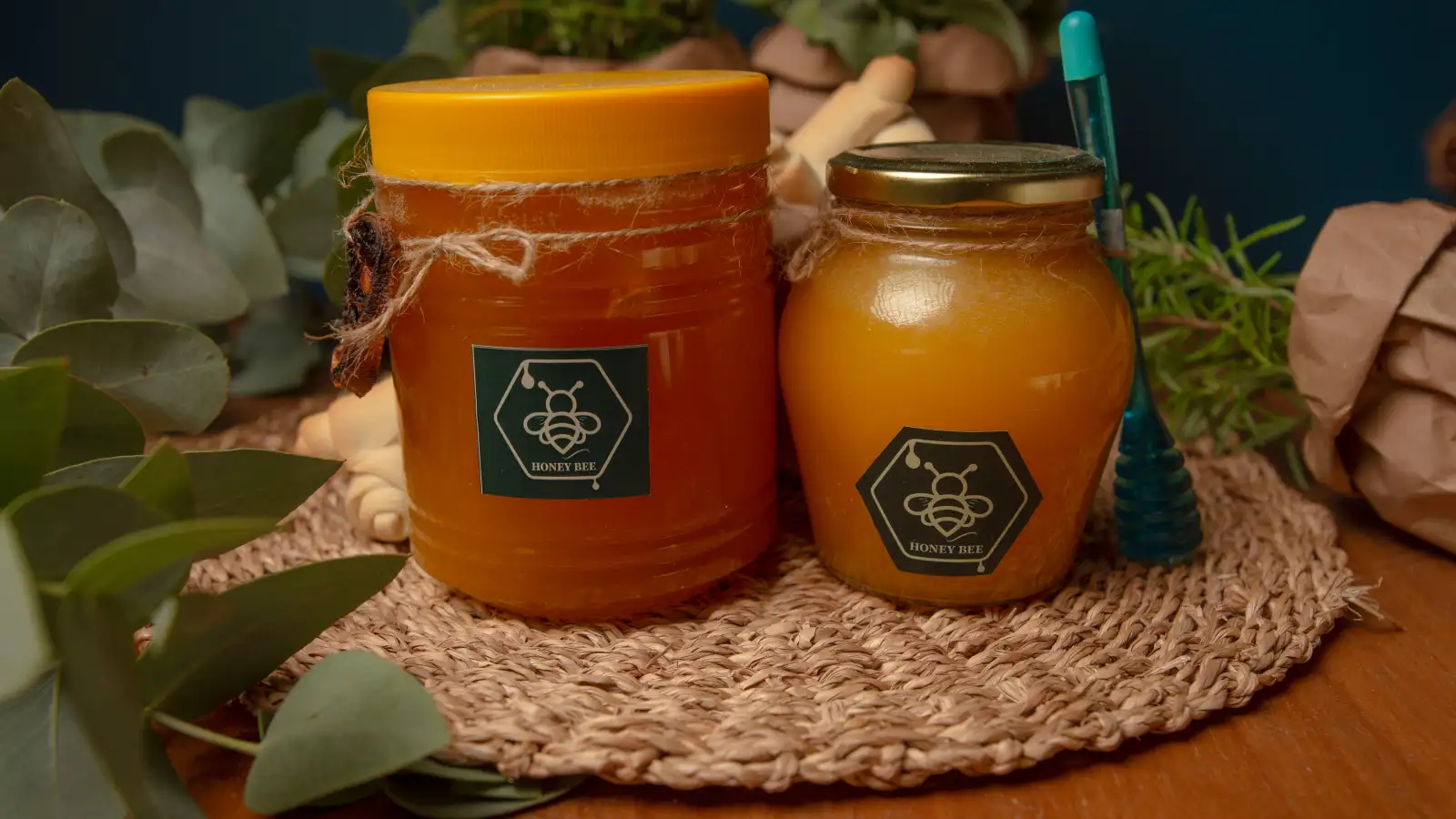
An organic certifier inspecting a honey operation is checking a management process, not the honey itself. The inspector verifies how the hives are kept and whether the land the bees forage on carries an acceptable risk of prohibited substances — and that verification runs through a written organic system plan, feed and treatment records, equipment and storage practices, and a defined radius of land drawn around each apiary. Nothing in that visit measures flavor, color, moisture, or varietal purity. The seal and the quality assumptions buyers attach to it are two separate things, and holding both in your head at once is what keeps the label from lying to you.
I found that out on a wet spring morning, standing in my own driveway with a stranger who had a printed satellite photo in a plastic sleeve before she had asked to see a single hive. I had spent the previous month thinking about bees. She spent the first hour thinking about my neighbors.
She unfolded the map across the tailgate, put a finger on the dot marking my three hives, and drew a circle around it with a dry-erase marker. That circle was the entire conversation. Inside it: a hayfield, a patch of hardwoods, two houses, a drainage ditch, and a strip of county right-of-way. Then the questions, in the order she asked them. What is on the far side of that tree line. Who mows the right-of-way, and what do they use on it. Has that hayfield been sprayed in the last three years, and can you show me that in writing. Does the golf course two properties over run its own applications, or does a contractor. Is any of that land yours, or do you have standing to say anything about it at all.
The circle is the certification
That is forage-land risk assessment, and it is almost never what people picture when they imagine an organic honey inspection. The radius is not a magic number. Certifiers work with their own defined distance, and it varies — often landing somewhere in the range of a couple of miles, sometimes tighter where the beekeeper owns the surrounding land, sometimes wider across open country with few landmarks to anchor to. What matters is not the mileage. What matters is that a boundary got drawn, that someone asked what could be applied inside it, and that the answer got written down and signed.
You cannot control your neighbors. That is the part I had to sit with. Certification does not require you to control them either. It requires you to know what they are doing, document what you can verify, hold buffers, and — when the answer is unacceptable — move the yard. I know beekeepers who keep signed letters from neighboring farmers in the file and refresh them every season. I know one who shifted a yard a quarter mile because the parcel next door changed hands and went into orchard. Neither of those is a loophole being exploited. That is the system working the way it was designed.
The hive inspection comes after the map, and honestly it is the easier half. Frames pulled and looked at. Brood pattern read. Queen assessed. A walk through the shed to see what is on the shelf, because the shelf is evidence. Anything off the allowed treatment list, and some of those substances take the hives out of certification for a set period — sometimes years. What you fed during the dearth matters too: the syrup has to be organic sugar, and the dates and amounts go in the log. Even the wax foundation gets a question, because wax holds onto things, and if you bought sheets from an unknown source you may be asked to account for where they came from.
The paperwork is the product
Here is the thing I did not understand until I sat through it. The records are not a formality wrapped around the real work. The records are the certification. An organic system plan describes what you will do before you do it. Feed logs, treatment logs, equipment cleaning, extraction and storage, containers, cleaning agents, no commingling with non-organic honey in the same tank or the same room. Then the counting: how much honey went in, how much came out, where the difference went. That volume reconciliation is not busywork. It is how a certifier catches honey that arrived from somewhere it should not have.
The inspection recurs, and the plan gets updated annually, because a beekeeping operation is not a static object. Yards move. Forage changes. Owners change. And the program builds in unannounced inspections for a portion of certified operations each year, which means the file has to be true on a Tuesday in July when nobody is expecting a truck in the driveway.
What the inspection never does
It does not put your honey in a lab and return a verdict on quality. Residue sampling can happen — a certifier may pull a honey sample to check for prohibited substances — but that is a compliance question, not a purity contest, and it is not what the seal is promising. Nothing in the process grades your honey, names its varietal, measures its moisture, or predicts how it will behave in six months.
The seal is a verified process claim about production. That is all it is. It is a real thing, hard-won, and frequently misunderstood by roughly the width of that dry-erase circle.
Organic, raw, unfiltered, local — four unrelated claims
I sell a little honey at a market table, and this is where the confusion gets visible. Someone picks up a jar, sees the green seal, and asks whether it is raw. Organic says nothing about raw. Someone else asks whether it is unfiltered. Organic says nothing about filtration. Someone asks if it is a single-source clover — organic says nothing about varietal naming, and a certified jar can be a blend of three flows from two counties.
Two jars can both be certified organic and behave completely differently on your shelf. The one with higher moisture may ferment. The one high in glucose — clover, canola, dandelion — will crystallize in weeks. The one high in fructose — tupelo, acacia, sage — may stay liquid for a year. I check moisture with a refractometer at extraction because it tells me how the honey will keep, and that number has no relationship whatsoever to the seal on the lid. Crystallization is a sugar ratio, not a flaw, and not a certification question either way.
I have watched people buy the certified jar over the uncertified one assuming it will taste better. There is no mechanism in the process that would make that true. The certification inspected the hives and the land. It did not taste anything.
Imported honey walks the same path, on paper
Honey entering the United States under an organic claim has to meet the same program requirements as honey produced here, and it has to be certified by an accredited certifying agent. Same organic system plan logic, same land risk questions, same record-keeping. What changes is where the eyes are. The physical inspection happens in the country of origin, and what travels is the documentation plus whatever sampling and traceability checks the importer and certifier layer on top. That is a genuine limitation worth knowing when you are holding a jar with a foreign origin line and a seal on it. The standard is the same. The physical proximity of the inspector to the apiary is not.
Where it stays uncertain even when everything is done right
A drought year rewrites forage. Bees range onto whatever is blooming, and what is blooming shifts. A neighbor changes crops. A highway department sprays a right-of-way in a month nobody expected. The certification does not eliminate that uncertainty, and it does not claim to. It forces the question to be asked on a schedule instead of never — which is a meaningful difference, and still not a guarantee about any particular jar.
When someone at the table asks me if my honey is organic, I answer the label question straight, then I answer the question they were actually asking. Usually it is about crystallizing, or whether it is raw, or where the bees were. Those are good questions with real answers. They are just not the questions the certifier was there to ask.