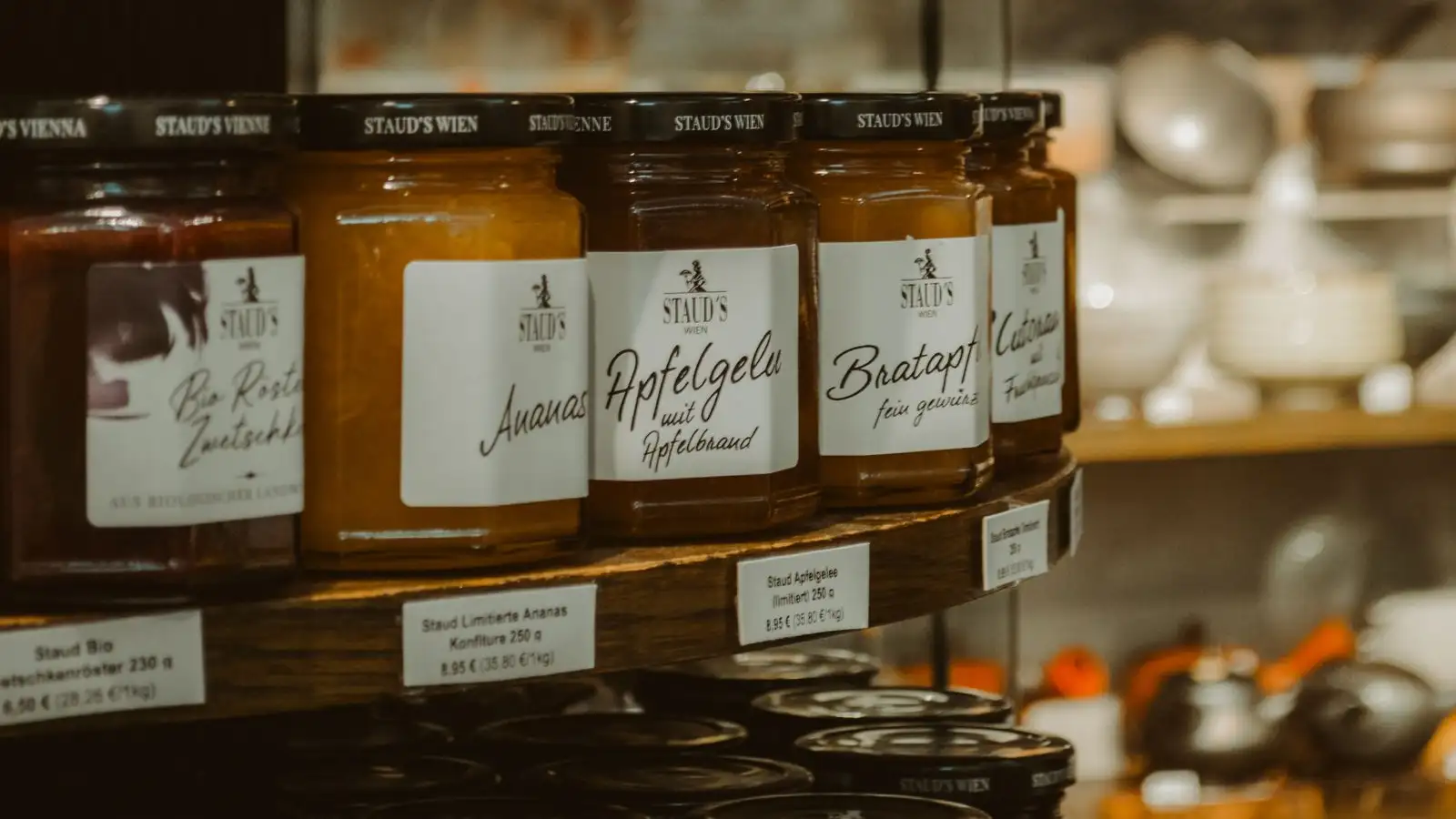
The label on a jar of honey tells a baker almost nothing. The two things that most reliably predict what a jar will do in a batter, how much water is in it and whether the honey is liquid or crystallized, are the two things retail labels almost never print. So the practical move is to read the front for the only two facts it gives honestly, net weight and the varietal or blend name, and then read the rest of the jar with your hands and a scale.
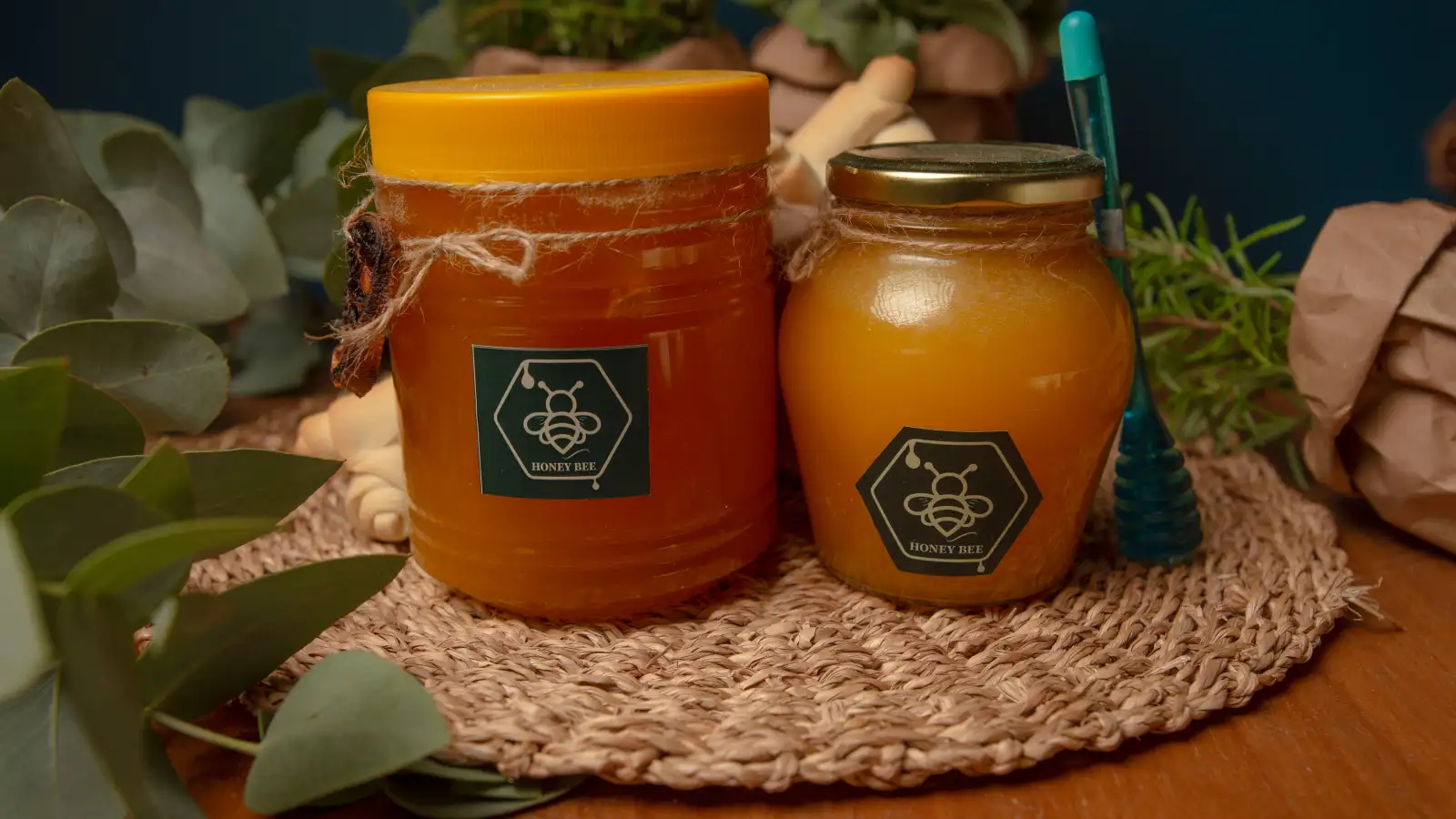
I keep a cheap gram scale on the counter and a row of honey jars on the shelf above it, and at this point I look at those jars the way I look at a bag of flour: not what is this, but what will this do. That shift is the whole skill. The label was written for a shopper deciding what to buy. The recipe was written for someone holding a generic honey that does not actually exist.
The one number on the label that measures anything
Look past the front of the jar to the small type and find the net weight. Then read the metric figure. Honey is sold by weight and used by volume, and that mismatch is where most of the confusion starts. Honey runs about 1.4 grams per milliliter, so a 12-ounce jar, which is 340 grams, is a hair over one cup. When a recipe calls for a cup of honey and the label says 340 g, the jar just answered a question the recipe never asked out loud.
Once you have that, the label's silence about water content gets easier to live with, because you can do the arithmetic yourself. Honey is typically somewhere between 17 and 20 percent water, and the spread between those two ends is smaller than people expect. A cup of honey weighs around 340 grams, so the difference between a 17 percent jar and a 20 percent jar is roughly 10 grams of water, about two teaspoons. In a sturdy batter that evaporates as a rounding error. In a delicate sponge or a meringue it can show up in the texture. Neither number is on the jar, and neither one is the thing that usually wrecks the bake.
The thing that usually wrecks the bake is simpler: honey is a liquid carrying its own water. One cup of honey holds about 60 grams of water, and a quarter cup of water is about 59 grams. That is why the standard instruction to pull a quarter cup of liquid out of the recipe is not folklore. It is the water the honey brought with it, and it scales with how much honey you actually got into the bowl.
The jar never tells you its state
Honey sets up when its glucose decides to come out of solution, and how fast that happens depends on the nectar source and on how the honey was handled. The varietal name on the front is the only clue the label gives you about that timeline. A honey from a source high in glucose can go solid in the pantry in a matter of weeks, while another jar on the same shelf stays pourable for a year. That is not a quality difference. It is chemistry, and it is the single most useful piece of information you can infer from the front of the jar.
What the jar will not tell you is what state it is in right now. Some do, by accident, if they are in clear plastic you can hold to a window.
This matters in the kitchen more than people admit. A liquid honey pours into a measuring cup, levels with a straight edge, and leaves a thin film behind. A crystallized honey has to be scooped and packed, and it packs denser. On my scale, a level tablespoon of pourable honey from a jar came in around 21 grams. The same tablespoon packed with the crystallized honey from that same jar went past 24. That is a double-digit swing in how much sweetener you just put in the bowl, and the label on both jars was identical.
Crystallized honey also mixes differently. It does not disperse into a cold batter; it sits there in grains and shows up in the crumb of a pale cake. Warming the jar in a bowl of warm water and stirring until it goes clear solves it. Do not boil it and do not microwave it in long bursts, because you are trying to melt crystals, not cook the honey. If you are in a hurry, a few short bursts with stirring between them will do it.
Raw, pure, and Grade A describe a process
Here is where I stopped trusting the front of the jar. Pure honey is a legal minimum, not a specification, and it says nothing about behavior in a batter. The USDA grade shield is about clarity and absence of defects, not about how a honey performs at 350 degrees. I have never once found it predictive in the bowl.
Raw and pasteurized are the same story from a different angle. Pasteurized honey has been warmed enough to dissolve existing crystals and slow their return, which makes it more consistent from jar to jar and slower to set. Raw honey was not treated that way, so it crystallizes on its own schedule. Unfiltered honey carries pollen and tiny wax flecks, and those flecks do two things: they act as seeds that speed up crystallization, and they never dissolve, so in a fine white crumb they can read as specks.
None of that makes raw worse or pasteurized better. It is a trade between consistency and character, and the label only tells you which side of the trade you bought. If you want a jar that behaves the same way next month as it does today, the word pasteurized is doing more work for you than anything else printed there.
What the swap actually changes in the oven
Honey is hygroscopic, meaning it pulls and holds moisture, and it browns faster than granulated sugar because its fructose caramelizes at a lower temperature. In practice that means two adjustments when you sub it in. Drop the oven temperature by about 25 degrees, and start checking for doneness earlier than the recipe says. If the top is coloring before the middle is set, tent it with foil.
The other quiet variable is acidity. Honey is acidic, and in a recipe leavened with baking soda rather than baking powder, that acidity can shift how much lift you get. Recipes written around sugar do not account for it.
The ratio comes from your measuring cup, not the label
Honey is sweeter than granulated sugar by volume, and the usual swap is three quarters of a cup of honey for one cup of sugar. That number is not arbitrary. Three quarters of a cup of honey weighs about 250 grams, and roughly 80 percent of honey is sugar, which lands within a few grams of the 200 grams of sugar in a cup of granulated. The ratio is a sugar-mass calculation.
Which means it only holds if your three quarters of a cup actually weighs 250 grams. Whether it does depends on whether the honey poured or packed, whether you scraped the cup, and whether you used a dry cup or a liquid one. A cup of honey clinging to the sides is a tablespoon or two that never made it into the bowl, and no label is going to warn you about that.
Reading the jar with your hands
Tilt the jar and watch what it does. A low-water honey moves slowly, folds over on itself, and ribbons off a spoon into a mound that holds its shape for a beat before it flattens. A wetter honey spreads out almost immediately and will not hold a mound at all. That tilt test tells you more in three seconds than the entire back label.
Then weigh a level tablespoon and remember the number for that jar. If it comes in near 21 grams, you are holding a pourable honey and a measuring cup will get you close. If it comes in above 23, you are holding a set honey, and you should either warm it back to liquid or expect to add more by weight to hit the same sweetness. If the jar has been open a while and the bottom is grainy, you already know the answer without lifting a finger.
The label will keep talking about flowers and sunshine and mountain meadows. The three things your batter actually cares about, how much water came with the honey, what state it is in, and how you measured it, are yours to supply. It takes about a minute on the counter, and it happens before the flour comes out of the bag.