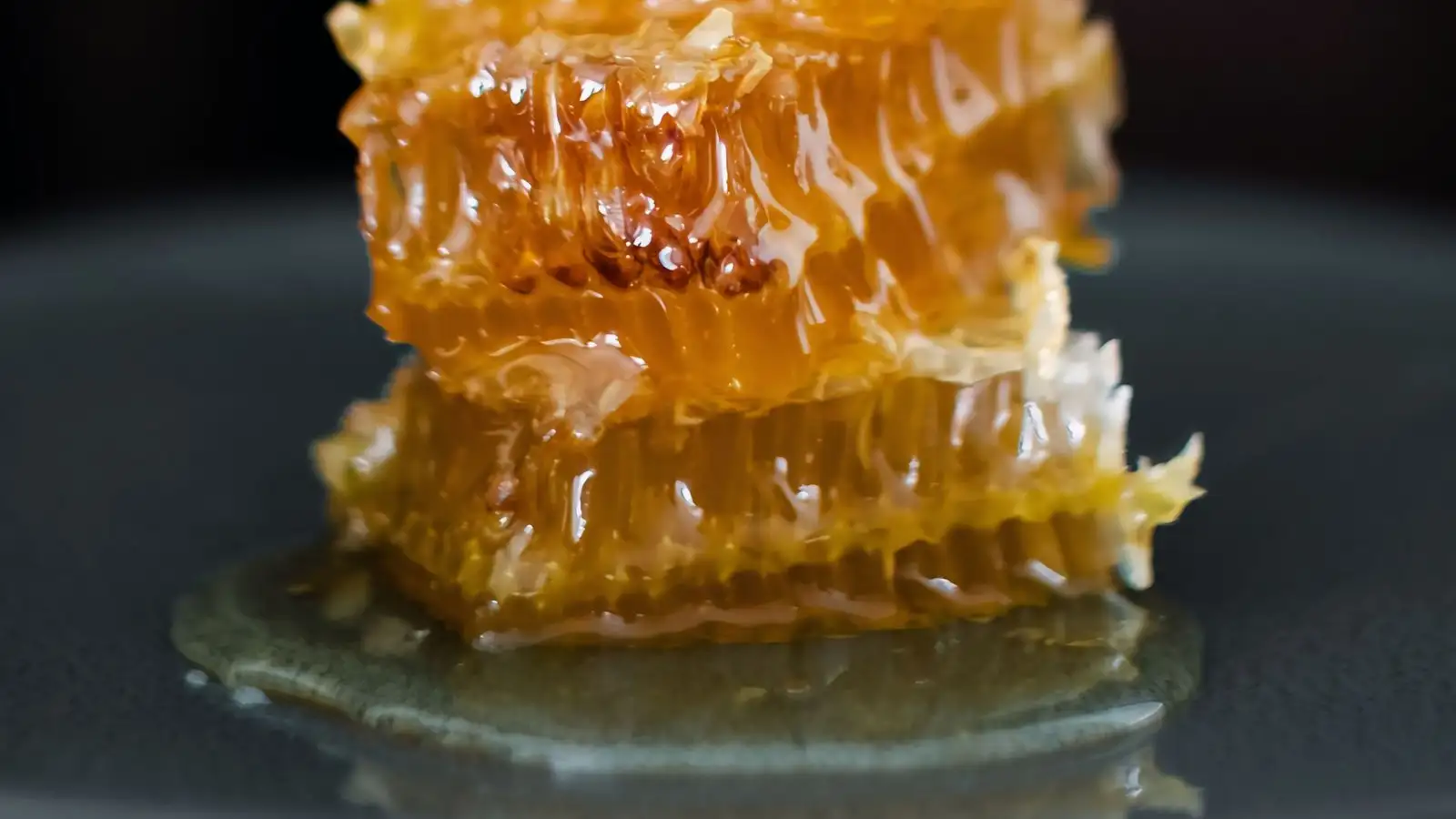
How long honey lasts is decided by the vessel, not the shelf. A lid that seats, a rim wiped and dried before it closes, and a spoon that goes in dry will do more for a jar of honey than any storage location, any date printed on the label, or any amount of careful handling after the fact. Honey is hygroscopic: it pulls moisture out of the air around it, and most table honey sits at only 15 to 18 percent water by weight, which leaves very little room to absorb more before the texture at the surface begins to change. The container is the only thing standing between a thick, stable jar and a thinned, grainy top layer.
There's a jar in my cabinet that taught me this the slow way. I unscrewed the lid last week and heard it before I saw anything: that tacky ripping sound a lid makes when dried honey has glued it down instead of a seal sitting clean. Underneath was the ring. A brown circle of it, maybe a sixteenth of an inch wide, right where the lid meets the glass, with a little grit of crystallized sugar caught in it like sand. The honey in the middle still looked fine that day. It won't in another month.
I've kept honey in the same kitchen for years. Same cabinet, same shelf, same dust. The jars that went sideways on me — sideways meaning thinned at the top, sluggish underneath, no longer able to throw a clean ribbon off a spoon — were never the ones I'd stored in the wrong spot. They were the ones where the lid never really sat right. Or where I got lazy with the rim for a few weeks. Or where I went through a stretch of keeping honey in a squeeze bottle because it looked tidier on the counter.
After a while I stopped thinking about honey storage as a shelf question at all. It's a container question. Everything that happens to a jar of honey happens first at the surface, and the surface is exactly what the container controls.
The number that decides everything after it
Honey is mostly sugar with a little water in it, and most table honey lands somewhere between 15 and 18 percent water. That ratio is why it's thick, why it pours slowly, why it keeps for years in a cabinet without anything particularly dramatic happening to it. It's a concentrated sugar solution, and sugar holds the small amount of water it has quite tightly.
That tightness is the whole mechanism. Introduce water into that system — even a little, even just at the top — and you change the balance. Not into something unsafe; into something different. Thinner. Faster. The top layer loses the dense weight that makes honey honey and starts behaving more like syrup.
Every texture problem I've had with a jar of honey started as water at the surface. Not in the middle. At the top, where it meets the air.
The only surface that matters
Dip a wet spoon into a jar and you've added a few drops of water to the one place where it does the most work. The amount is nothing — compared to the jar, it's a rounding error — but it lands on the top layer, which is the part of the honey sitting closest to the headspace and the least protected by the mass of sugar below it.
Same with the rim. A ring of honey left on the glass dries on top and stays tacky underneath, and that tackiness does two things I care about. It keeps the lid from seating all the way, so there's a hairline gap every time you close the jar. And it catches things — dust, a stray crumb, a fleck of crystallized sugar off the spoon — and any crystal sitting in that ring is a template for the crystals that will work their way down through the jar over the next few months.
Leave a jar open on the counter, or close it with a lid that doesn't really seal, and at ordinary kitchen humidity the top layer will start to loosen inside a few weeks. It doesn't happen overnight. It happens while you're not looking, which is why it feels sudden when you finally notice.
The wipe-and-dry step is where people quit early. A damp cloth lifts the sticky ring off the threads; that's why you use one. But if you close the lid on a rim that's still wet, you've put a film of water exactly where the honey surface will meet it. Dry it. Paper towel, clean cloth, the corner of your shirt. It takes five seconds.
Why a half-empty jar is not the problem
I used to worry about the headspace — the pocket of air above the honey in a jar I'd been working through for months. I don't anymore.
In a jar with a real seal, that air is a closed system. It's a small volume, and the honey pulls the moisture out of it until that pocket of air is actually drier than the air in the room. Then it just sits there. A jar that's down to its last inch and sealed properly is in no more trouble than a full one.
Exchange is the problem, not headspace. Air moving in and out is what carries moisture in. A jar with a good lid and a lot of air is fine. A jar with a bad lid and no air pocket at all still loses.
And a squeeze bottle breathes
This is the part that took me too long to see. A squeeze bottle isn't just a container with a narrow opening — it's a bellows. Every time you squeeze, honey goes out and air comes in through the nozzle. Then you let go and some of that air goes back out. Then you squeeze again.
Over a few months of daily use, that's hundreds of small exchanges with room air, right into the space above the honey. It's also why the nozzle gets that hard, crystallized plug — residue there dries and seeds crystals, and eventually you're fighting the cap every morning. And a bottle is hard to scrape. When I do use one, the last of the honey goes in the trash, because getting it out isn't worth the trouble.
A wide-mouth jar is easier on all three counts. You can see the surface. You can get a spoon in, and a spatula when it's nearly empty. You can wipe the rim.
What glass and plastic actually do over a year
Glass is inert. It doesn't take on the smell of the cabinet, it wipes clean, and it lets you look at the top of the honey without opening anything, which is most of the diagnostics I do. Plastic is lighter and you can squeeze it, which is real. It's also slightly permeable over long storage — the outside world diffuses through the wall slowly, both moisture and whatever aroma is nearby, so a jar of honey sitting in plastic next to a bag of coffee for six months will not taste like it did in month one.
That's a material difference, not a verdict. A plastic jar with a seal that seats and a rim wiped dry will hold up fine for the year or two it takes to eat it, and the material itself won't be the thing that ruins it. The seal is doing most of the work either way.
Temperature swings open the door a crack
A jar that warms and cools — a windowsill, the shelf above the stove, the car on the way home from the farm stand — expands and contracts the air above the honey. The contraction pulls outside air in through any gap that exists. If the lid is marginal, a temperature swing is a pump.
So the practical version is: pick a spot that doesn't swing much, and don't ask the spot to make up for a lid that isn't sealing.
The sixty seconds before the lid goes back on
This is the whole routine, and it's short.
Dry spoon, every time. Not the one that just came out of the dishwasher, not the one you stirred your tea with. If you're pulling from a jar with a knife, make sure the knife is dry and doesn't have butter on it.
Wipe the rim and the threads with a damp cloth after every use, then dry them. Not once a month — after every use, while the residue is still soft and easy to lift.
Close it until it stops, then check that the lid is sitting flat rather than cocked. A lid that's a quarter turn from seated looks closed and isn't.
I keep mine in glass because I want to see what's happening in there, and I keep it in a wide-mouth jar because I want to get the last of it out. Those are my two reasons, not rules.
And every few weeks, before you dip, tilt the jar and watch a drop move across the surface. When honey is right, that drop creeps. When the top has taken on water, it runs. That's a two-second check, and it tells you more than the date on the bottom of the jar.
What the container can't fix
Once the top layer has thinned, stirring doesn't rescue it. Stirring moves the water down into the rest of the jar and raises the moisture of the whole thing, so instead of one thin layer you have a uniformly thinner honey that behaves worse in everything. If the surface has gone runny, spoon that layer off into a small jar and use it first — salad dressings, marinades, glazes, anywhere you wanted thin honey anyway. Leave the dense honey below alone.
Crystallization is a different problem and I want to keep them separate. A jar that has gone solid is not a jar that has taken on water. Crystals are sugar coming out of solution; the water content is basically unchanged. A warm water bath will bring those crystals back. It will not remove water that's already in there, and warming a jar with a loose lid just moves more air around.
Also, no seal is perfect. A screw lid, even a good one, has a marginal seal, and a jar of honey sitting through a humid summer will drift a little over a year no matter what you do. Honeys differ too — some are naturally thin at the same water content, some crystallize in a month no matter how well you treat them, and a dry-climate kitchen is gentler than a coastal one. The point isn't to build a perfect barrier. It's to stop handing the jar extra moisture every time you open it.
The rest is the container's job. Not the shelf's.