A warm water bath held at roughly 100 to 110°F is the right way to re-liquefy crystallized honey. Set the jar in a pot of water at that temperature, keep the lid loose so steam can escape, and give it 20 to 45 minutes depending on jar size and how firm the crystals have set. Stir once or twice so the crystals that have settled at the bottom dissolve instead of re-seeding the jar. A microwave gets there in a fraction of the time, and that speed is the problem: it heats unevenly, scorches the honey at the shoulders of the jar, and pushes the floral top notes out with the steam before the center has even softened. The jar you rescue in ninety seconds tastes like a lesser honey than the one you put in.
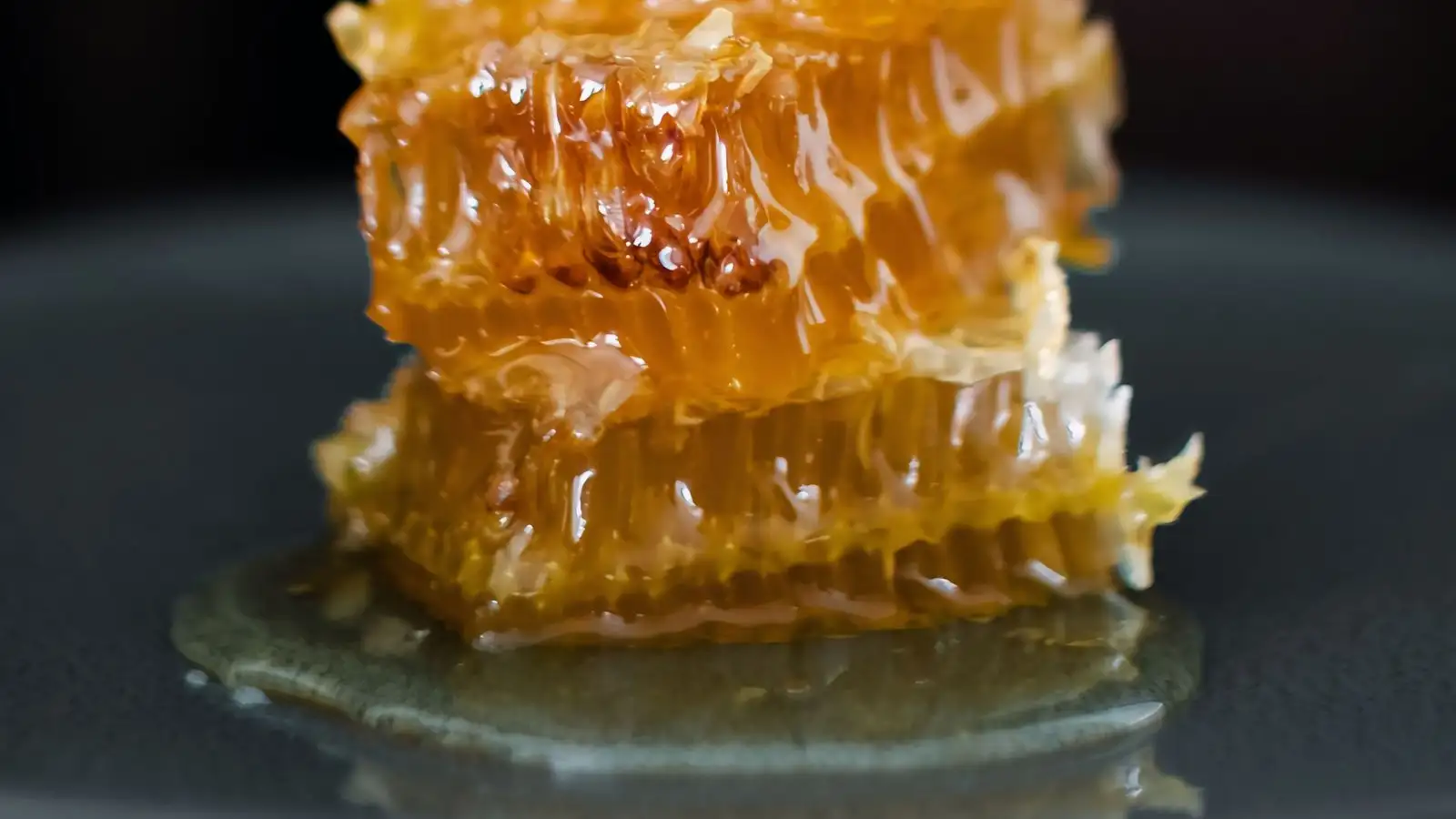
I'm thinking of a quart of clover honey that went solid sometime in February. I never catch it happening. One week it pours; a few weeks later I tip the jar and nothing moves, and what's in there is a hard, grainy block with a thin layer of liquid riding on top like a puddle on a parking lot.
Out comes the widest pot I own, because a jar should stand up in the water without leaning against the side. Water goes in up to the honey line, not over the rim. A folded dish towel on the bottom of the pot keeps the glass off hot metal, and the jar goes in while the water is still warming rather than into a pot that's already rolling.
Then the thermometer, which is the one piece of equipment I refuse to skip. A cheap dial thermometer clipped to the rim tells me more than any timer. I want the water sitting between 100 and 110 degrees. If the reading climbs toward 120, the burner goes off and a splash of hot tap water brings the whole pot back down. A simmer is not faster. A simmer is how you end up with honey that tastes like nothing.
The lid sits on loose — resting, not tightened — so steam can escape instead of building pressure under the cap. That loose lid is also why the jar needs to come out and get sealed properly once it has cooled, because honey left open in a steamy kitchen will draw that moisture back in and thin out the texture you just worked for.
Check it at twenty minutes, and stir
A pint of soft-set honey is often done in twenty minutes. A quart that's been brick-solid since winter is closer to forty, sometimes forty-five. I check by tilting the jar: if the top runs, it comes out and gets stirred. A clean spoon, slow circles, lifting from the bottom, because the dense crystals settle down there and they will sit in a lazy lump while the top looks perfect. Hold the jar up to the light. If I can see grit in the last inch, I stir more. Leaving that layer behind is the most common reason a jar goes solid again within a couple of weeks — those fine crystals act as seed and the whole jar granulates around them.
Why the microwave behaves so differently
Microwave energy lands in water, and honey isn't evenly wet. It runs roughly one part water to five parts sugars, and that water is not in the same place everywhere in a crystallized jar. There's a wetter liquid layer on top, wetter pockets around the crystals, and a dense solid mass through the middle. So the energy goes where the water is: the top layer, the shoulders, the corners. The center stays a brick.
The failures stack. You hit it for thirty seconds, stir, hit it again. By the third round the top layer is genuinely hot while the middle is still solid, and the whole time steam is lifting off the surface and carrying aroma with it. You can't temperature-check it while it spins, and you can't touch-check it either, because the glass stays cool while the honey inside is well past where you wanted it. What comes out is liquid and uniform and dull — the floral edge gone, a faint cooked note at the back. Same honey, same jar, less of it.
A water bath cannot do that. Water at 105 degrees cannot push the jar above 105 degrees, no matter how long you leave it there or how thoroughly you forget about it. The bath is self-limiting. The microwave isn't, and no amount of pulsing and stirring changes that; it only narrows the margin you're working inside. I'll use the microwave when the honey is going into a batch of granola where nobody will notice. For anything I plan to eat off a spoon, the pot wins.
Warm the portion, not the whole jar
This is the habit that changed how much honey I keep around. Every warming cycle costs a little aroma, and that cost doesn't come back. So if I need two tablespoons for toast and tea, I scoop those two tablespoons into a small ramekin and float the ramekin in the water bath. Eight minutes, done, and the quart stays crystalline and untouched in the cupboard.
Crystallized honey isn't damaged honey. It's the same honey with its sugars arranged differently; it just doesn't pour. That means there's no reason to liquefy a whole jar because you want one drizzle. Keep the bulk as it is, warm what you're using, and you get the full aroma of the jar on the day you open it rather than a fraction of it spread thin across six reheatings.
If a jar has been cycled three or four times over a winter, I notice. It still tastes like honey. It just doesn't taste like much else.
The same trick, run backwards
Here's the part that ties it together. That seed layer I keep telling you to stir away? You can use it on purpose.
Creamed honey is liquefied honey seeded with a small amount of finely crystallized honey and then held cool. The fine crystals spread through the liquid and set it into that smooth, spreadable, opaque paste. I take a jar of liquid honey, stir in a tablespoon of good creamed honey from a store jar, put the lid on, and leave it in the coolest cupboard in the house — somewhere in the fifties if the weather cooperates — stirring once a day for about a week. Cool and slow gives finer crystals; warm and rushed gives you something gritty. It's the same crystal behavior that ruins a hurried re-liquefying job, aimed in a useful direction.
So the water bath and the creamed jar are two ends of one idea. Crystals form on seed and settle out of cool stillness; they dissolve in steady, gentle warmth and disappear with a stir. The microwave skips the patience and takes the aroma as payment. I'd rather wait the twenty minutes.