Crystallized honey is not spoiled. The solid part is glucose that has dropped out of a supersaturated sugar solution while the fructose stays liquid, and it happens on a schedule set by the honey's own sugar ratio, its storage temperature, and a few invisible seed crystals. To tell a jar that is merely set from one that has actually gone bad, stop judging by texture and check three things instead: pressure, smell, and taste. Clean on all three means keep it, or warm it back to liquid in a water bath at 104 to 120 degrees Fahrenheit. A hiss when you open it, bubbles through the glass, or a sour, alcoholic smell means fermentation, and that jar is done.
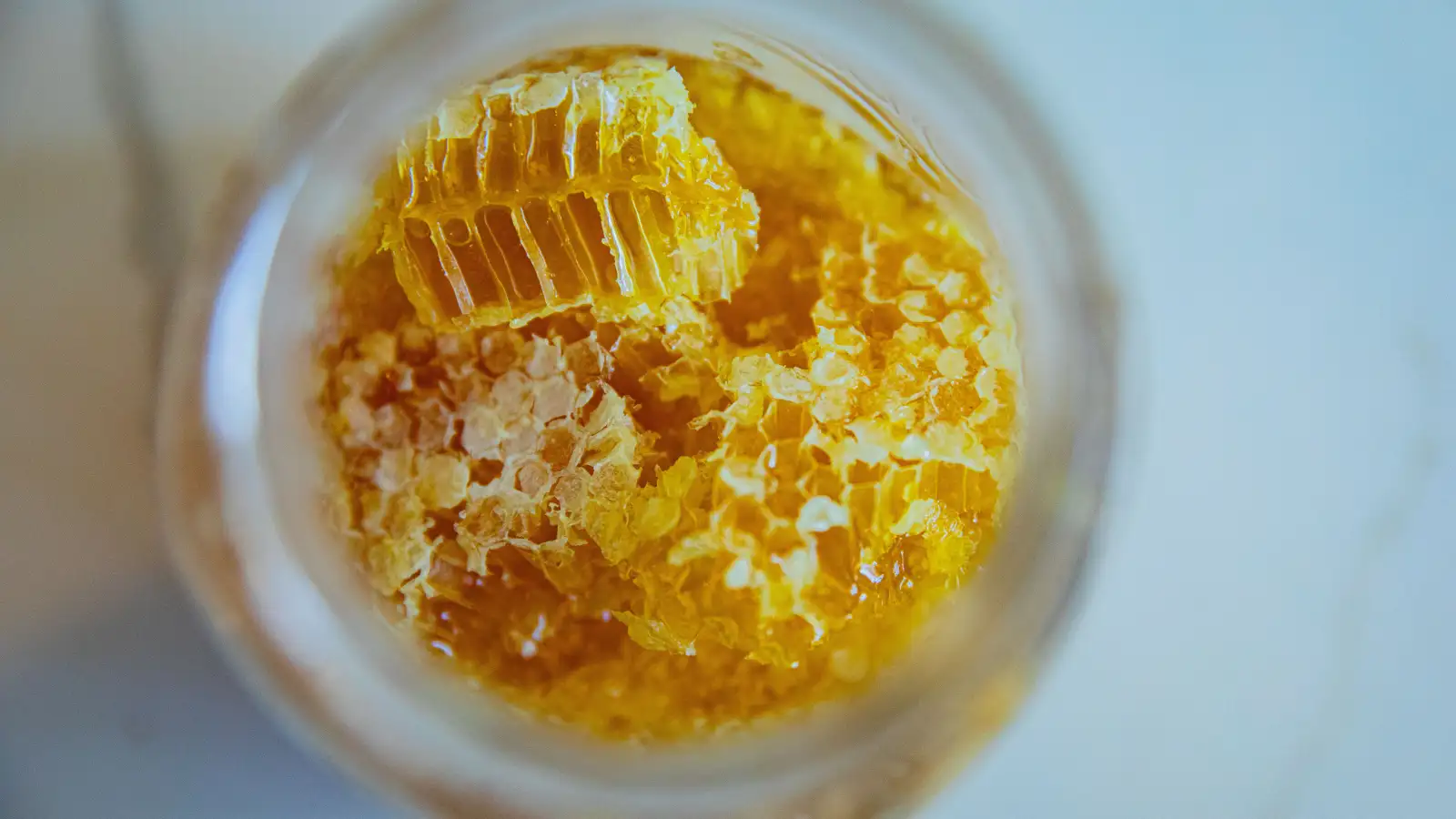
I have a jar of clover honey on the counter right now that sat in the back of the cabinet since October. I tip it and nothing sloshes. I turn it over and the whole block slides down to the lid in one piece, pale and grainy where it touched the glass, with a thin layer of darker liquid riding on top. I open it anyway. The lid gives a small sticky pop, and what comes up is honey, sweet and waxy with a faint floral edge and nothing sharp behind it. That smell settles the question in about two seconds. Everything after it is logistics.
What is actually happening in there
Honey is a supersaturated sugar solution, mostly glucose and fructose with a little water holding the whole thing together. Glucose is the less cooperative of the two sugars. When the solution gets pushed, glucose lets go first and forms crystals, while fructose stays liquid and keeps most of the water bound up around it. So the solid is almost pure glucose, and the liquid you see on top of a half-set jar is mostly fructose. That liquid is wetter than the honey you bought. Remember that part, because it comes back later.
The timing is not random. Two jars on the same shelf can behave like completely different products. A honey with a lot of glucose relative to fructose, which is clover, canola, alfalfa, dandelion, sets up fast, sometimes in a couple of months. A honey tilted the other way, acacia, tupelo, sage, black locust, most of the dark wildflower jars, can sit liquid for years. Supermarket blends land wherever the packer's mix lands. I have bought the same brand twice and had one jar stay clear through summer and the next one go solid by Thanksgiving.
Temperature does the rest. Around 57 degrees Fahrenheit is the sweet spot for crystal formation, and I happen to keep honey on a shelf against a cold exterior wall, which is why my kitchen runs about a month ahead of everyone else's. Below 50 degrees the process slows down, but it does not stop. That is the whole reason the refrigerator is the wrong move. Cold slows crystallization without preventing it, and pulling a jar in and out of the fridge gets condensation on the rim, which is the one thing you actually do not want near your honey.
Then there are seed crystals. You cannot see them: a speck of pollen, a fleck of dust, a sliver of crystal left behind in the seam of the jar from the last batch. Once one crystal exists, it recruits the rest. That is why honey usually sets from the bottom up, and why a jar you have already melted once seems to go solid again faster the second time. The micro crystals hiding in the threads and corners never fully dissolved.
The check I run before I keep, warm, or dump
Three questions, in this order, because the first one is fastest.
Pressure. Unscrew the lid. Fermenting honey makes gas, and gas has to go somewhere. You get a hiss, or a lid that bulges, or the button on a commercial lid popped up when it should be flat. Normal honey does not do that, not even honey that is rock solid. A lid that resists and then gives with a small crack is usually just dried honey gluing the threads, so run the lid under warm water and move on.
Bubbles. Hold the jar up to a window. Crystallized honey looks uniform, grainy, and opaque, the same all the way through. Fermenting honey has pockets. Foam, a band of fine bubbles that keeps rearranging itself when you tilt the jar, a cloudy streak that looks different from the even crystal haze. If the bubbles move independently of the crystals, that is yeast doing its work.
Smell, then taste. Fermentation announces itself. Alcohol first, then bread dough, then something edging toward vinegar. Take a small taste off the end of a spoon, not a scoop. Real honey tastes like honey. A burn at the back of the throat, a sour note, or a fizzy tingle on your tongue is your answer.
If all three come back clean, you are in the keep column. Crystallized honey is perfectly fine to eat exactly as it is. It spreads on toast without running off the edge, it does not drip out of a biscuit, and it behaves in baking, though if a recipe wants liquid honey you will want to warm the measuring cup so it releases. There is no safety reason to fix it. Re-liquefying is a preference, not a repair.
Bringing it back to liquid without cooking it
Water bath, and a thermometer. Glass jar into a saucepan, water up to about the level of the honey inside, off the heat or on the lowest setting, and keep it between 104 and 120 degrees Fahrenheit. Above that you are not making the honey safer, you are cooking it. A delicate honey goes flat and dark and you can taste the difference.
Stir every five minutes or so. A pint takes twenty to thirty minutes. A quart can run forty-five. The crystals melt from the outside in, so the middle is always last, and stirring is what gets you there. I have done it in the microwave in thirty-second bursts when I was in a hurry, and it works if you stop and stir between bursts, but plastic jars and hot spots make it a worse bet than a pot of water. The oven is not an option. No home oven holds 110 degrees reliably.
Here is the part nobody likes. This is a reset, not a cure. The glucose-to-fructose ratio has not changed, the temperature swings in my kitchen have not changed, and the crystals in the jar's threads are still there ready to seed the next round. Expect the honey back in gear within a few weeks to a few months. That is fine. It is a two-minute job once a season, and in between you have a jar of spreadable honey.
The one move that turns a good jar into a bad one
Do not add water. It is the first instinct for a lot of people, a spoonful of hot water to loosen up a solid jar, and it is the actual danger here. Honey pulls moisture straight out of the air. Once enough water gets in, the wild yeasts that ride along in every jar can wake up and start fermenting it. Water is what fermentation needs. The crystals are not.
The same logic covers the spoon you licked going back into the jar, and a jar left open next to a boiling pot of pasta. It is also why a half-crystallized jar deserves a second look before you shrug at it. The solid portion is nearly pure glucose crystals, which means the liquid left on top is wetter than the honey was when you brought it home. That thin top layer is the part I actually sniff, and it is the part I taste first.
One more thing worth knowing: a spoonful of already-crystallized honey dropped into a fresh jar seeds it, which is exactly how creamed honey is made on purpose. Producers stir a fine seed into liquid honey at a controlled temperature until the crystals are small enough to feel creamy instead of gritty. It is the same physics, aimed. Which means if you want your expensive acacia honey to stay clear, use a clean spoon and do not let it touch the set jar next to it.
In all the years I have been buying honey from grocery aisles, farm stands, and roadside tables, I have thrown out exactly one jar, and it was the one that hissed. Every other solid jar was just glucose doing what glucose does. The crystals are almost never the story. The smell is the story, and the smell is free.