Swapping honey for sugar is a formula change, not a measurement swap, and the one-to-one trade is the myth that ruins the bake. For every cup of sugar you replace, the working adjustment is to pull about a quarter cup of liquid out of the recipe, whisk in about half a teaspoon of baking soda with the dry ingredients, drop the oven temperature 25°F, and expect a looser batter that colors sooner than the recipe says it will. Do all four and most recipes survive the swap. Skip them and you get cookies with burnt rims and raw middles, or a cake that domes hard in the oven and caves on the counter.
I still have the note from the night I learned that, scrawled sideways on a recipe card in handwriting I can barely read now.
The pan comes out at 350°F and looks almost right. The edges of each cookie are a deep, glossy brown; the middles are pale and puffed. You wait the two minutes the recipe asks for. You slide the spatula under the first one, lift, and it tears — the rim is crisp enough to snap, the center is wet batter. The smell should have told you sooner. Somewhere around minute nine it went from toffee to something darker, close to burnt sugar, and I told myself that was just what honey does in an oven. That was half right. It was what honey does in an oven at the wrong temperature.
Nothing in the recipe was broken. Honey did what honey does: it brought water, it brought acid, and it colored early. The fix wasn't better technique. It was rebalancing the formula.
The water isn't a rounding error
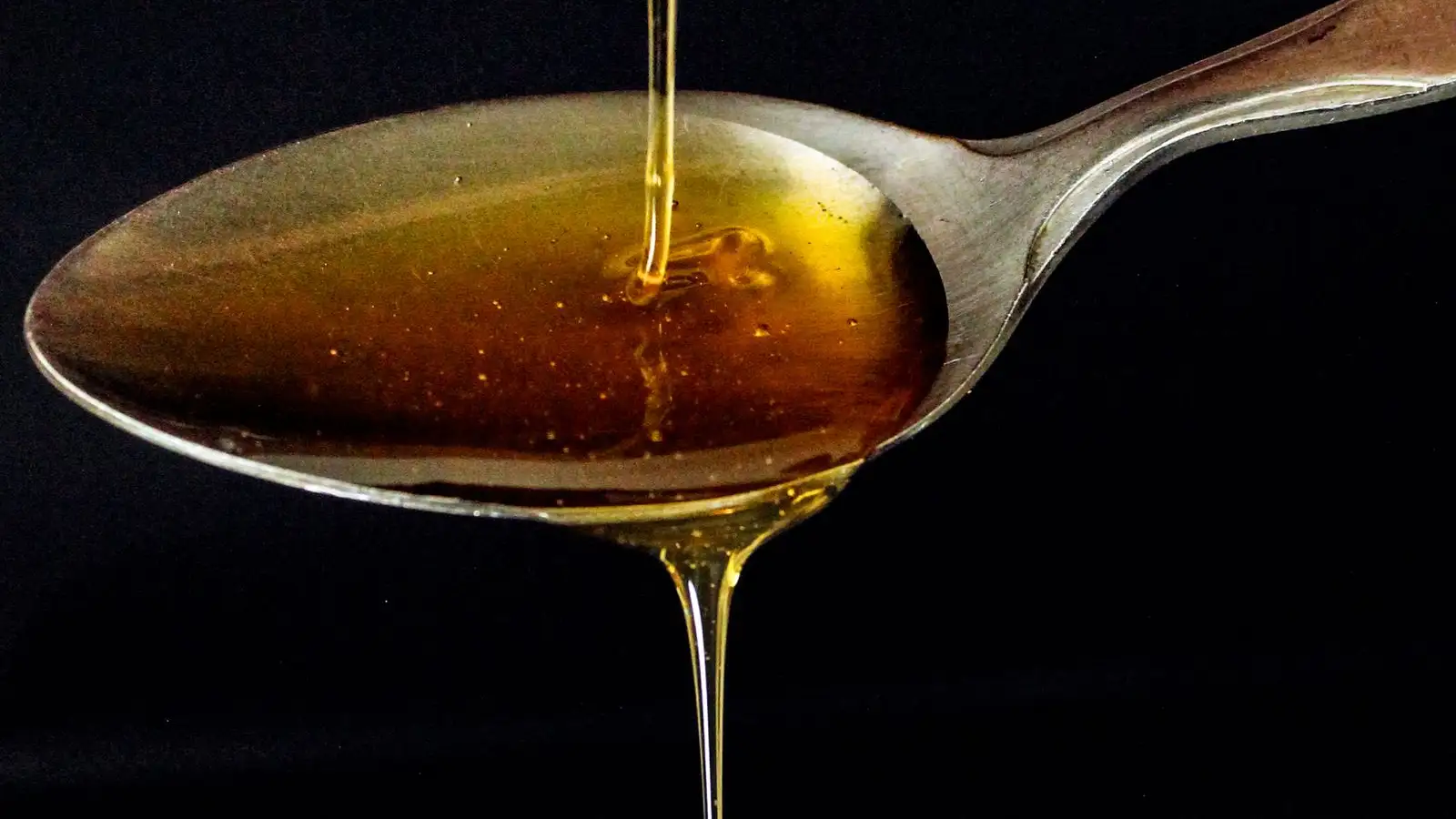
Honey is about 18 percent water by weight. A cup of it carries roughly a quarter cup of water that a cup of granulated sugar simply does not have. Sugar is dry; honey is a thick syrup, and that water lands in the batter whether you account for it or not.
You can feel it before you can explain it. The dough that should plop off the spoon pours. Cookies spread toward each other on the sheet. Muffins bake up with a dense, gummy line through the middle. Bread dough feels slack under your hand and keeps feeling slack no matter how long you knead.
The adjustment is one line: subtract about 1/4 cup of liquid per cup of honey, taken from whatever liquid the recipe already has — milk, water, buttermilk, juice, coffee. Not the eggs. Eggs are structure, and pulling one out to make room trades a texture problem for a worse one.
If the recipe doesn't have a quarter cup of liquid to give, that's your first real signal. Shortbread. Sablés. Macarons. A dry pastry crust. There's nowhere for the water to come from, so you end up chasing the honey with extra flour, which builds gluten and turns the dough tough. Those recipes don't take honey. Not with a clever tweak. They just don't.
There's a second problem buried in the first one, and it's the one people miss. In a butter-and-sugar recipe, creaming isn't just mixing. Sugar crystals cut into the butter and trap air, and that trapped air is a genuine part of the lift. Honey is liquid. It cannot cream. Pour it into butter and you get a smooth, sweet emulsion with almost no air in it, and nothing you do later puts that air back. That's why honey cakes so often come out dense even when the crumb is moist — and why the recipes that take honey best are the ones that lean on chemical leavening for their rise instead of on the creaming step.
Acid, soda, and a lift that fires early
Honey sits around pH 3.9. That's acidic enough to react with baking soda on contact, which means adding soda to a honey batter isn't only about flavor. It's lift, and it starts the second the batter gets wet.
The working number is 1/2 teaspoon of baking soda per cup of honey, whisked into the dry ingredients so it can't clump into a bitter pocket. If the recipe already leans hard on baking soda, back the addition down — you can taste the difference, a faint soapy edge at the back of the tongue that shows up when there's more soda than acid for it to meet.
Be honest about the timing, too. The honey-and-soda reaction fires fast and then it's spent. Honey batters tend to rise early and set late. They look proud in the oven and settle as they cool. If your layers keep collapsing, you usually aren't short on leavening. You're short on structure to hold the gas, which almost always traces back to a liquid subtraction that never happened.
The oven is running hot for honey, even when it isn't
Granulated sugar is sucrose. Honey's sugars are mostly glucose and fructose, and fructose browns at a lower temperature — both in the Maillard reaction with the proteins and in plain caramelization at the edges. The same 350°F that gives a pale-gold sugar cookie gives a mahogany honey cookie. On a long bake, the top is dark before the center is anywhere close to set.
Twenty-five degrees down is the working adjustment. It doesn't fix a wet batter, but it buys you the time you need for the inside to catch up to the outside.
A few things that help alongside it: line the pan with parchment instead of greasing it, so you can watch the bottom color through the paper. Start checking five to eight minutes before the recipe's time. And if the bake runs past twenty minutes or so, lay a sheet of foil loosely over the top once the crust is as dark as you want it and let the middle finish underneath.
One more variable: the honey itself. A dark, strongly flavored honey browns harder and tastes louder, which is fine in a spice cake and overwhelming in something delicate. If you're converting a light cake, use a light, mild honey and let the sugar's job get replaced quietly.
The adjustment, in the order I do it
- Measure the honey with a scale if you have one — a cup is right around 336 grams — or oil the measuring cup first so the honey slides out instead of leaving a quarter cup behind. If the jar has crystallized, set it in a bowl of warm water just until it pours. Warmer than that and you're driving off the aroma you wanted.
- Subtract 1/4 cup of liquid per cup of honey from the milk, water, buttermilk, juice, or coffee in the recipe. Never from the eggs.
- Whisk 1/2 teaspoon of baking soda per cup of honey into the dry ingredients so it disperses evenly.
- Set the oven 25°F lower than the recipe says, and check five to eight minutes early. Foil goes on if the top outpaces the middle.
It scales cleanly. Half a cup of honey means two tablespoons less liquid and a quarter teaspoon of soda. And if you'd rather use 3/4 cup of honey per cup of sugar because honey reads sweeter on the tongue and a full cup can taste almost perfumed, the same proportions shrink with it.
Then do the thing most people skip: bake one. One cookie on a small sheet, one muffin in a ramekin. Ten minutes of testing tells you more than any chart, because your oven, your flour, and your honey are all slightly different from mine.
When it goes wrong anyway
Cookies spreading into one sheet. Chill the dough for half an hour before it goes in. Cold fat spreads slower, and the rest gives you time to notice you under-subtracted the liquid. Honey is also hygroscopic — it pulls moisture out of the air and holds onto it — so honey cookies stay soft for days and stay spread-prone on the pan no matter how long they sit.
Tops that stay tacky. They'll stay tacky. That's the same hygroscopic behavior, and it doesn't bake off. Pull them when the edges are set and the centers are no longer wet. More time only burns the bottoms and leaves the tops exactly as sticky as they were.
A gummy line through the middle. Nine times out of ten the liquid wasn't reduced, or the soda was left out of the dry mix. Check both before you blame the honey.
A flat, dense cake. The creaming aeration is gone and it isn't coming back. You can add a little more leavening, but you'll be shifting the flavor balance to pay for a structural loss. If the cake matters, start from a recipe written for honey rather than converting one that wasn't.
Bread dough that won't firm up. Add flour a tablespoon at a time, then let the dough rest. Honey doughs hydrate slowly, and a dough that feels slack at minute five often tightens up after twenty. Wait before you add more flour — over-flouring a honey dough is far easier to do than under-flouring it. Expect the crust to color early, and tent the loaf if it does.
What I leave alone
Some recipes don't take honey and no adjustment saves them. Anything where whipped egg whites are the structure — angel food, chiffon, génoise, meringue — because the sugar is doing mechanical work inside the foam. Macarons, for the same reason. Candy and sugar work, because the crystallization behavior and the set temperature are entirely different animals. And any recipe where sugar's main job is creaming, caramelizing on top, or stabilizing rather than sweetening.
The rest of the time, the swap is easy once you stop thinking of it as a swap.
The second batch I made after that Tuesday went in at 325°F with a quarter cup less milk and a half teaspoon of soda whisked through the flour. Eight minutes, rotate, four more. They come out with pale centers and edges that hold a fingerprint without denting, and they stay that way for three days. I wrote three lines in the margin of the card — liquid minus 1/4 cup, soda plus 1/2 tsp, oven 325°F — and that's the recipe now. Margin notes are how this actually gets easier. The formula changes; the card remembers for you.