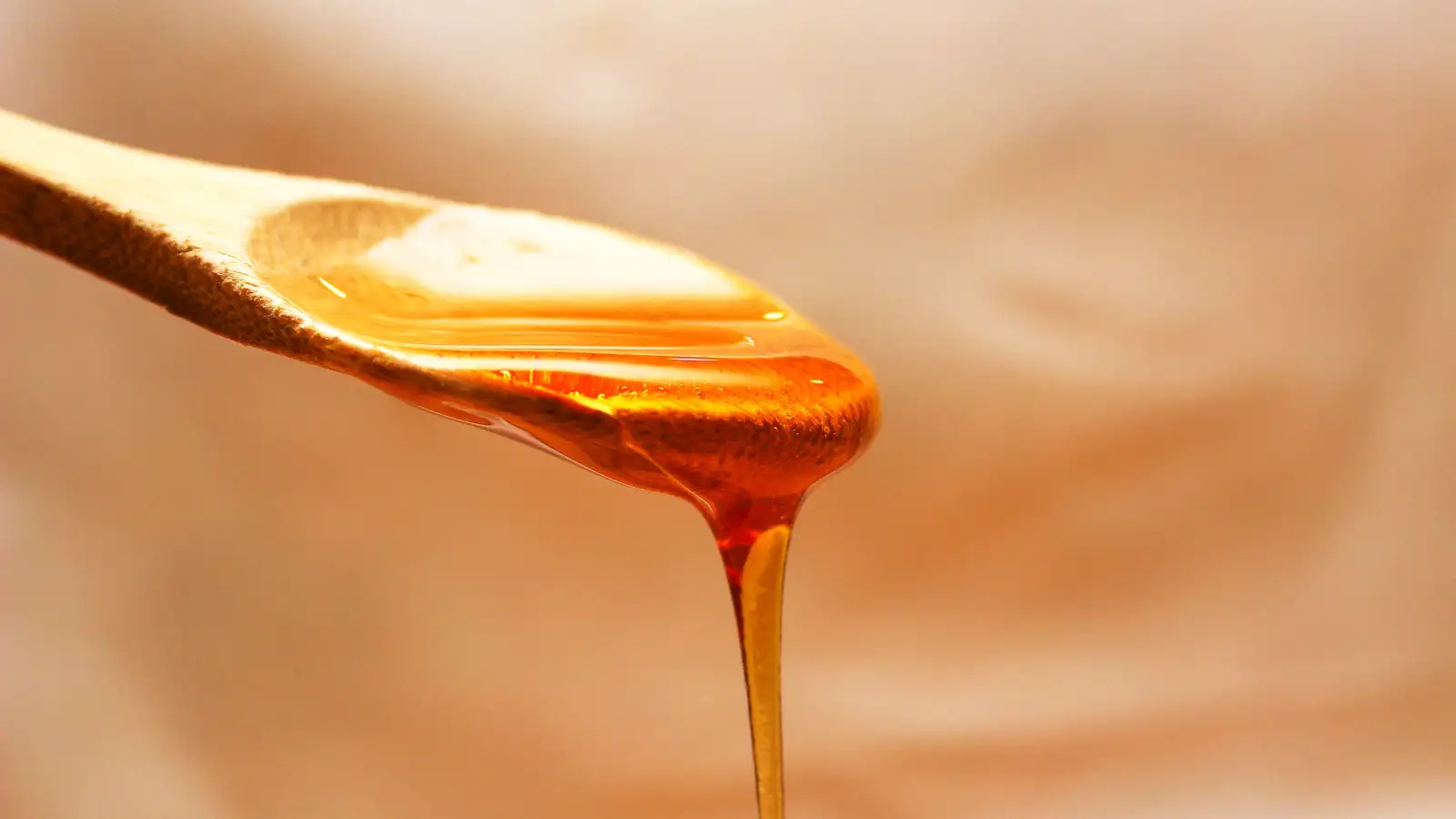
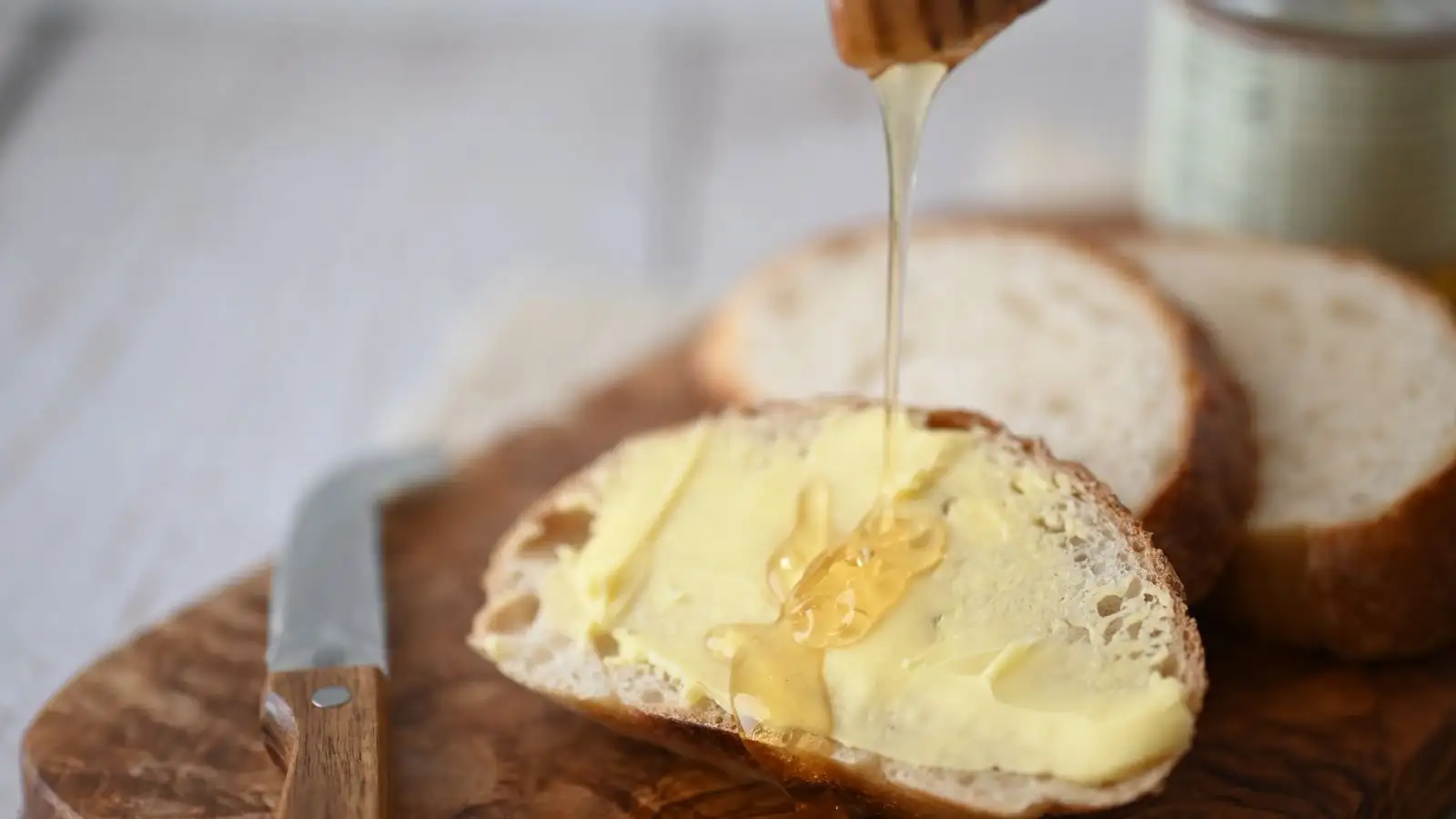
To put words to a single-source honey, describe it in a fixed order: aroma family first, then intensity, then finish. A honey built on one dominant nectar source concentrates a narrower set of aroma compounds than a blended jar does, so the vocabulary problem is smaller than it looks. You are not describing everything at once. You are locating one family, measuring how far it carries, and waiting to see what it leaves behind after you swallow.
I keep my jars on the shelf above the stove, which is a bad place in July and a good place in January, and I've gotten into the habit of doing five seconds of work before the spoon comes out. Lid off. Hold the jar a few inches under your nose, mouth closed, and breathe out slowly across the surface. You aren't really sniffing as much as pushing warm air over the honey and letting the aromatics come back up to you. That first pass is the cleanest read you'll get, because nothing else is in the way yet — no texture, no sweetness, no warmth from your mouth.
The trap is that most people skip that pass, go straight to the spoon, and then reach for words like sweet and weird and stop.
Five families, and the one that catches almost everyone
Nearly every honey aroma you meet is some blend of a handful of recognizable directions: citrus-like, floral, herbal, woody, spice-like. Almost nothing is purely one of them, but a single-source jar usually leans hard on one or two, and naming the lean is most of the sentence you're trying to write.
Citrus-like. Here's the trap. If a jar is labeled for a citrus tree, you'll expect the fruit, and what you usually get is the flower and the peel. The blossom and the fruit are built from different sets of compounds, and the bee collected the blossom. So orange-blossom types tend to read like orange flower water, candied peel, something waxy and perfumed — not like orange juice. That's not a defect and it isn't your nose failing. The useful words here are neroli, orange water, candied peel, lime leaf, waxy citrus skin. Not "orange."
Floral. Clover, honeysuckle, lilac, dried rose, chamomile, sometimes the powdery sweet smell of a florist's cooler. A check worth running: if the floral read tips into something that reminds you of scented soap or a candle, you've landed at the border between floral and waxy-perfumed. That border is real. Write "floral, leaning soapy" and keep moving.
Herbal. Cut grass, hay, sage, thyme, green tea, occasionally mint. Two things worth separating here. There's cool herbal — mint, fresh green stems — and dry herbal, which is hay and dried leaf and the smell of a field in August. If you write "herbal" and leave it there, you've said almost nothing. Write "dry herbal, like hay" instead.
Woody. Cedar, cut oak, bark, resin, pine, pencil shavings. Woody notes tend to arrive late, more often in the finish than at the top of the read, and this is the family people usually mean when they say a honey is "dark" — they mean flavor, not color.
Spice-like. Cinnamon, clove, anise, black pepper, ginger. Some of this isn't smell at all. Pepper and clove do part of their work as a warm, tingling sensation in the nose and at the back of the mouth, felt rather than smelled. That still belongs in your note — "peppery, warm" is honest — just don't file it as an aroma you could pick out blindfolded.
Intensity is two questions, not one
People treat intensity as "how strong is it," which doesn't get you anywhere, because it's unclear what's being measured. Split it and words show up fast.
First: how far does the aroma carry from the jar? Lid off, at arm's length, is there anything there, or do you have to put your nose in? Second: how long does it hold after you swallow? Does it die at the swallow, or does it keep going?
Three words are enough for the first question — faint, clear, pronounced — and they should be the same three words every time. The goal isn't precision, it's comparability. A note reading "clear, carried at arm's length" means something to you in six months. "Strong" doesn't.
Sweetness is a stage, not a flavor
Sweetness, acidity, and a light bitterness are perceived together, and the honey's own acidity is what keeps the sweetness from reading flat. If your honest note is "it just tastes sweet," you're probably looking at two fixable problems rather than a boring jar. One is temperature, which I'll get to. The other is that you're stopping at the loudest layer because it's the loudest.
Two words do a lot of work here: bright and flat. Bright means the acidity is doing its job and you can feel the sweetness sitting on top of something. Flat means it isn't, or that the honey is cold enough that the acidity isn't registering. Neither word is a verdict on quality. They're bench notes.
The answer is usually in the finish
Bitterness and astringency generally show up after the swallow, not in the first taste. That means the whole read depends on whether you wait. Most people don't. They taste, they get sweet plus maybe one aroma, they decide — and they've just described a fraction of the jar.
What waiting looks like: swallow, keep your mouth closed, breathe out slowly through your nose. The first few seconds are the top notes leaving. Somewhere after that the finish arrives. It can be clean, which just means it fades. It can be drying, which you'll feel on the sides of your tongue and the inside of your cheeks — that's astringency, the same sensation as a strong cup of tea. Or it can be bitter, sitting further back. Those are three different words for three different endings, and blurring them is the most common reason two people's notes about the same jar look like they tasted different honeys.
Length matters too. Short, medium, long is enough.
Dark and pale are different listening volumes
Darker honeys, buckwheat being the usual reference point, tend to carry stronger and more savory aromas — molasses, leather, wet earth, roasted notes. Pale honeys, acacia being the usual reference point, read delicate and mild: quieter top notes, shorter finish, a much smaller gap between the aroma and the sweetness.
The practical consequence is that a pale honey needs you closer to it. Hold the jar nearer. Give it more seconds. Taste a light honey at the same distance and volume you'd use on a dark one and everything comes back as "faint," and you'll decide the jar has nothing to say when you were simply listening at the wrong volume.
Cold honey has no vocabulary
Two physical things sit behind most cases of "I can't find the words."
The first is temperature. Chilling suppresses a honey's volatile aromatics and flattens the profile. A jar straight out of the fridge is close to undescribable — not because it's bad, but because most of what you'd describe has been turned down. If you're stuck, warm the jar before you doubt your palate.
The second is crystallization. Crystallized honey is not spoiled honey, and it isn't a different honey. Gentle warmth brings the volatiles back up: a jar set in a bowl of warm tap water and stirred now and then, or simply left in a warm room overnight. Go gently. Real heat drives off the very compounds you're trying to name, and once they're gone they don't come back. Keep graininess on its own line in your note, too, because crystal texture is a mouthfeel observation, not an aroma. Putting "grainy" in the aroma slot is how a good note turns into a confusing one.
The order, written down once
Aroma family first, one or two of them, no more. Then intensity, split into how far it carries and how long it holds. Then the turn — bright or flat, where the sweetness sits against the acidity. Then the finish: length, and whether it's clean, drying, or bitter. Anything left over goes on a final free line, because there's always something left over.
Do it in that order and two people tasting the same jar will produce notes that line up, even when they disagree about the honey itself. That's the point. The vocabulary isn't there to prove you have a good palate. It's there so a sentence about a jar means something to someone who wasn't in the room.
What this method can't do
It won't tell you which honey to buy, and it won't settle whether a jar is any good. Those are separate questions, and they belong to your own preferences rather than to a system.
It also can't turn a varietal name into a promise. A single-source label describes which nectar dominated the crop, and domination is all it is — bees don't check the label, and some other forage always gets in. That's why same-named honey from the same producer can read differently from one season to the next, and why your notes from last spring may not match the jar in front of you now. When that happens, the honest line is "this jar leans more herbal than what I wrote down before," not "I was wrong last time."