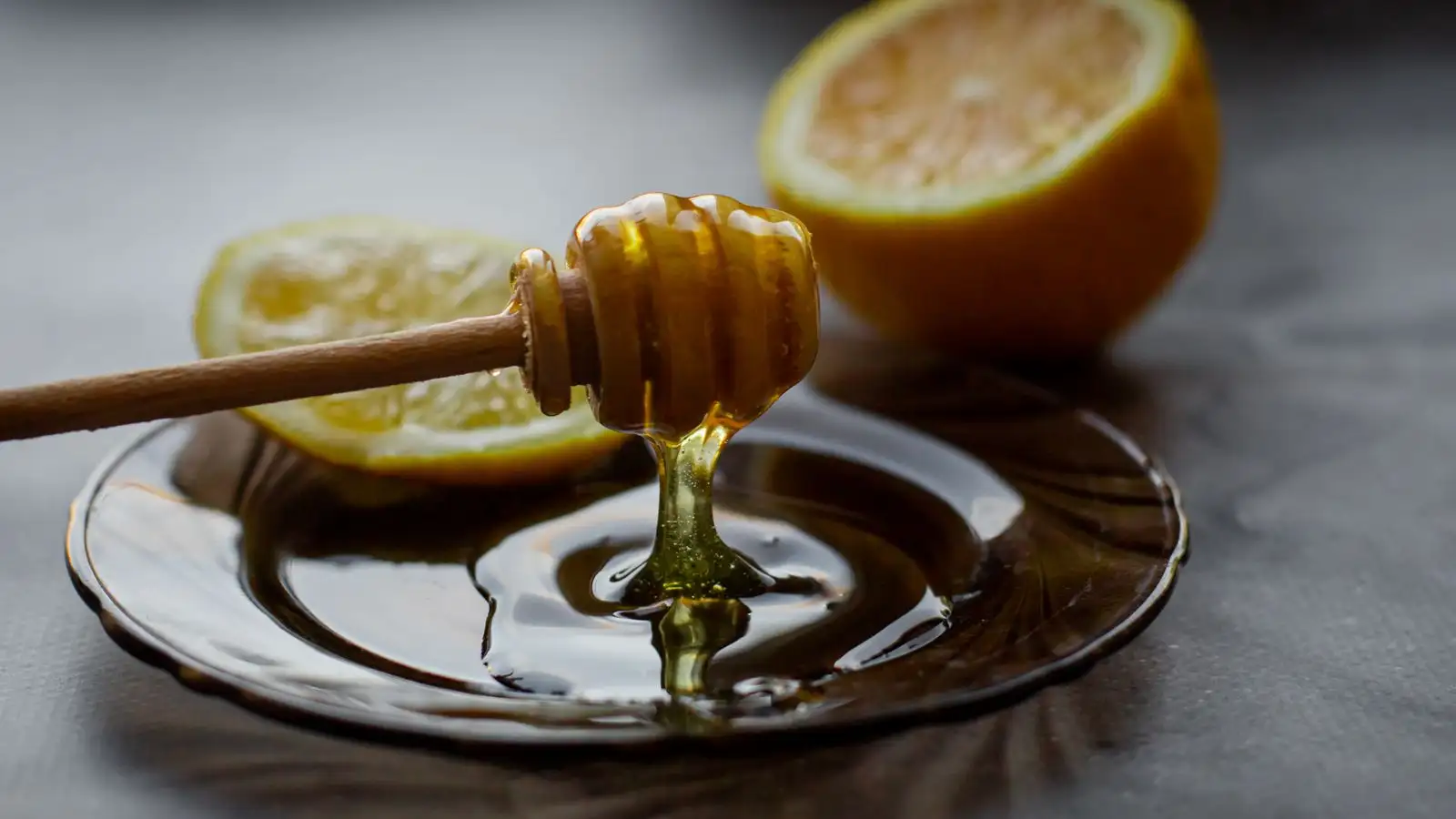
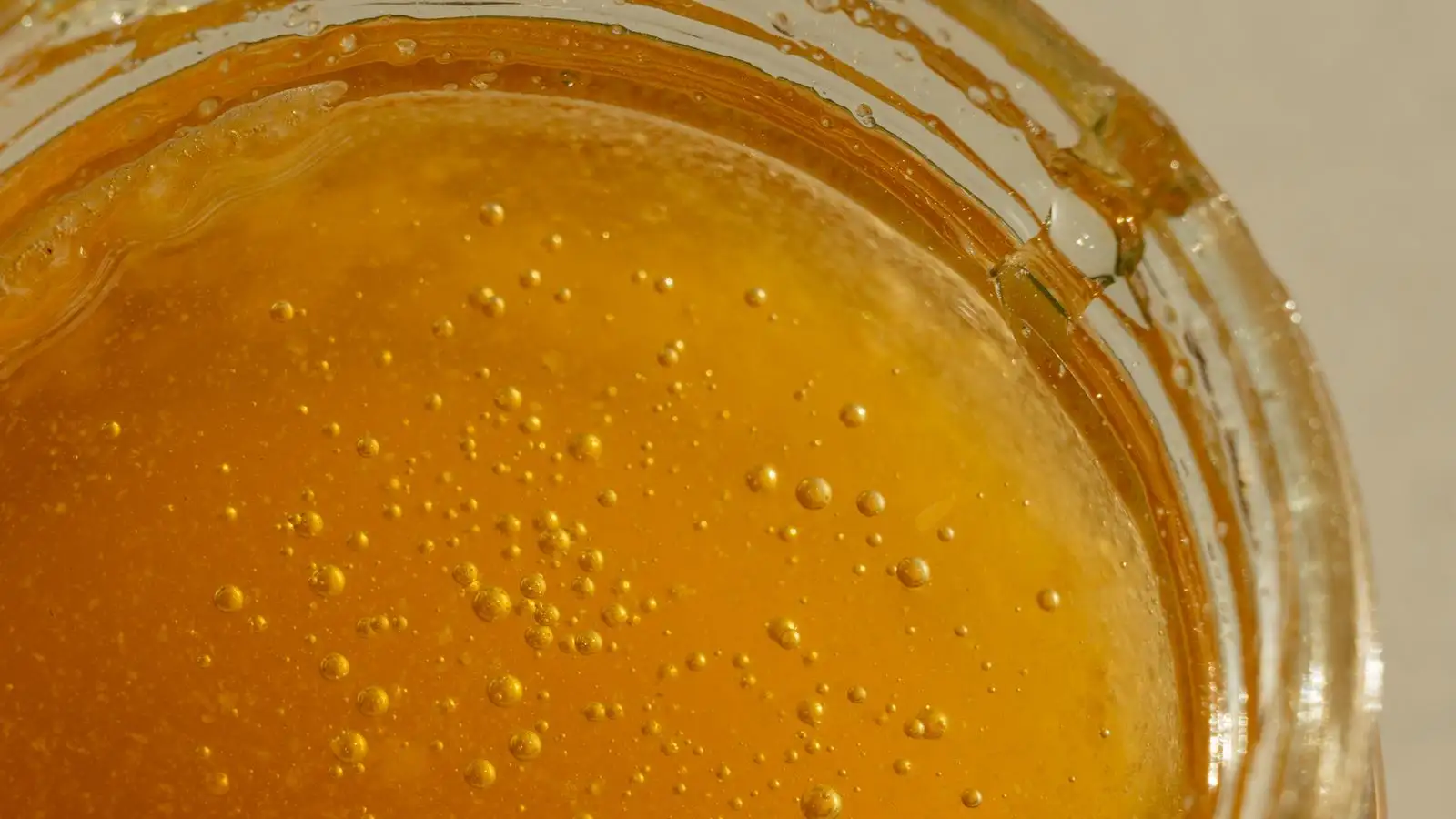
Raw honey will not stir into iced tea. It sinks to the bottom, flattens into a slick amber coin, and stays there no matter how long you work the spoon, because a cold liquid does not thin honey enough for it to break apart and disperse. The fix takes about two minutes: warm the honey until it pours, or whisk it into an equal volume of hot water to make a honey syrup. After that, the same spoonful blends into anything cold in seconds.
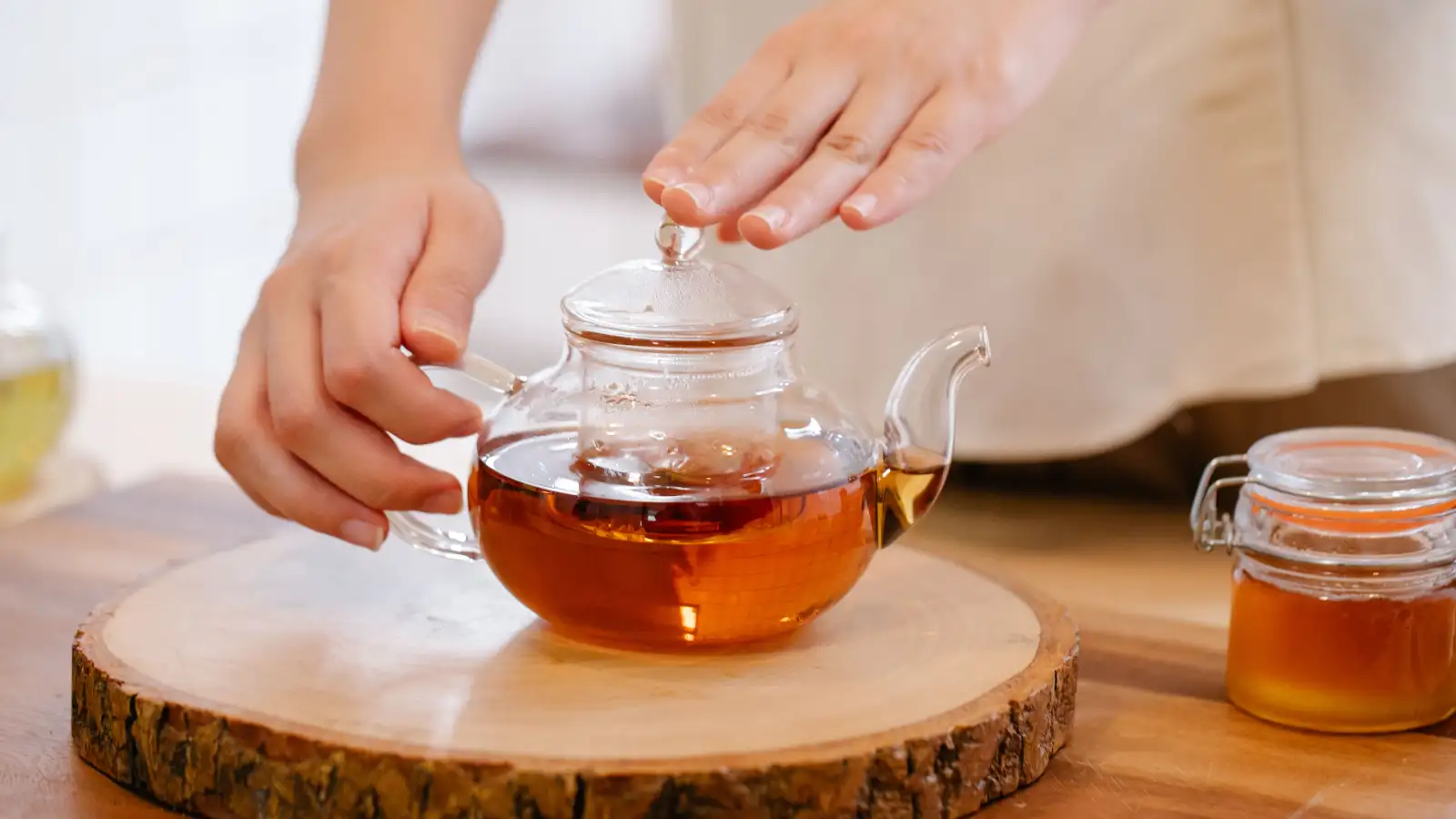
I have stood at the counter watching that coin refuse to move. Pint glass of iced tea sweating a ring onto the wood, long spoon, ice ticking against the side with every stir, and at the bottom a quarter-sized patch of honey that each pass of the spoon just shoved sideways. Sip from the top and the tea tastes thin, almost flat. Get near the bottom and it's syrup. That's the tell. If your drink is uneven, the honey didn't dissolve. It relocated.
What's actually happening in the glass
Honey is a supersaturated sugar solution. Roughly 80 percent sugar, somewhere around 17 or 18 percent water, the rest acids and aromatic compounds. There isn't much free water in there for anything else to move through, and the sugars are packed in tight. That low water content is exactly why honey sits in the pantry for years without spoiling, and it's exactly why it won't cooperate in a cold glass.
Warm it and the structure loosens. Viscosity drops, the honey flows, and water can finally get in and start pulling it apart. Chill it and the opposite happens. Honey that's already thick at room temperature gets thicker still. A glass of iced tea is basically a refrigerator you can drink from, and you're asking a dense, stubborn liquid to dissolve inside it. The spoon loses every time.
There's a second reason it fails, and it's the one people miss. Dissolving is a function of contact and time. Cold tea is mostly water with a little sugar already in it, and at 40 degrees with nothing but a lazy stir, the contact is brief and the motion is weak. Even if the honey were thin enough to break up, it would take far longer than anyone is willing to stand there stirring.
Warm the jar, and know where that stops helping
The blunt instrument is heat. Set the honey jar in a bowl of warm tap water, hot to the touch, somewhere around 100 to 110 degrees, and leave it for ten or fifteen minutes, giving it a stir partway through. It goes from a solid-looking mass to something that slides off a spoon. Same trick rescues honey that's gone grainy and crystallized.
A microwave can do it faster if you're careful. Glass jar only, ten-second bursts, stir between each one. Don't microwave the plastic squeeze bear, and don't walk away from it. Honey heats unevenly, and the middle can scorch before the outside even feels warm. I've scorched a batch that way, and the smell lingers in the kitchen for an hour.
Keep the heat moderate either way. Boiling honey drives off the floral top notes you paid for, so there's no upside to going hotter than you need.
Warming solves pouring and measuring. A warm spoon empties completely; cold honey leaves half of itself behind on the spoon. Weighing is the other way around that problem, since a gram is a gram whether the honey is stiff or runny.
What warming does not solve is dissolving. Warm honey stirred into a glass of ice water still sinks and streaks. It's better than cold honey, but it isn't clean, which is why the real answer is the next part.
The syrup: one part honey, one part hot water
Fill a jar with honey to whatever line you like, then add the same volume of hot water. Hot from the kettle, steaming but not at a rolling boil. Stir or shake until it goes from two layers to one, a cloudy amber that pours like thin maple syrup. Cool it, lid it, refrigerate it.
That's the whole method. One part honey, one part water, by volume.
What you've done is front-load the dissolving. Hot water is a far better solvent than iced tea, and a minute of stirring now does what ten minutes in a cold glass never will. Once the honey is already in solution, it stays in solution when it gets cold. The syrup comes out of the fridge thick and slow, but it pours, and it disappears into a drink with three or four turns of a spoon.
A squeeze bottle makes it easier still. So does a wide-mouth mason jar and a small ladle. Label it if you keep other syrups around, because honey syrup and simple syrup look nearly identical in the fridge door.
Ratios are adjustable. Some bars use a richer mix, three parts honey to one part water, for more honey flavor and more body in the drink. It's closer to straight honey, so it pours more slowly and it's more likely to throw crystals in the cold. I keep the one-to-one around because it works in everything and doesn't need a second thought.
What the dilution costs you
Nothing here is free. Once you add water you've given up the two things that made honey convenient in the first place: concentration and shelf stability.
Concentration first. A tablespoon of honey syrup is not a tablespoon of honey. You're getting roughly half the honey and water you didn't especially want in the drink. That's the price of mixability, and it's usually worth paying, but it means you use more volume than a recipe written for straight honey would suggest.
It's still sweet. Honey weighs about 1.4 times what the same volume of water does, so a syrup made one-to-one by volume carries more sugar than a one-to-one sugar syrup does, and honey's sugars read sweeter on the tongue anyway. If you're swapping honey syrup into a drink you already know, start with about two-thirds of the simple syrup amount and taste from there.
Shelf stability next. Honey keeps because it barely has any water in it; mold and bacteria can't get a foothold. Add an equal volume of water and you've raised the water activity enough that it becomes a perishable item. Refrigerated, a jar of honey syrup is good for a few weeks, call it three or four, and I've pushed one to a month without any change in smell or taste. Past that, look at it and smell it. If it's fizzy, smells like alcohol, or has anything growing on top, dump it. It isn't worth the gamble to save two dollars of honey.
Two other things happen in the fridge. The syrup thickens, which is fine. And a heavy honey can start throwing crystals at the bottom of the jar, which is also fine. A warm-water bath brings it right back.
Picking the honey, and leaning on acid
In a cold drink there's no oven muting anything, so the honey you choose is right there in the glass at full strength. Clover, orange blossom, acacia, alfalfa, most wildflower: these blend into the background and let the tea or the spirit lead. Buckwheat does the opposite. It's dark, malty, almost molasses-like, and it will take over a delicate mix without asking. Great in cold brew or a whiskey drink. Wrong in anything you want to taste light.
Honey is also acidic, hovering around pH 4 thanks to gluconic acid and a few others. That's a real difference from simple syrup, which is neutral and only adds sweetness. Honey syrup adds a faint tart edge that reads as brightness, which is why the classic honey cocktails are built the way they are. A Bee's Knees is gin, lemon, and honey syrup. A Gold Rush is bourbon, lemon, and honey syrup. Both pair a generous pour of citrus with the honey instead of treating it as a neutral sweetener, and both would taste muddled if you dropped plain sugar syrup in instead.
That's your guideline for anything you invent. If the honey is going in, so is some lemon or lime. Somewhere around half an ounce of honey syrup to three-quarters of an ounce of fresh citrus is the neighborhood most of these drinks live in. Taste from there.
In practice
Iced tea: two barspoons of honey syrup per 12 ounces, stirred while the tea is still tepid if you can, over ice if you can't. Cold brew: it disappears into coffee faster than sugar syrup and rounds off the bitter edge, so start with a barspoon and add. Lemonade: honey syrup and fresh lemon are already balanced against each other, so you're mostly deciding how sweet you want it.
For a single drink and no jar of syrup, the shortcut is the same idea in miniature. Put the honey in the bottom of the glass, add an ounce or two of hot water from the kettle, or hot tea, or coffee straight from the pot, and stir until it's uniform. Then build the rest of the drink on top and finish with ice. You're not heating the drink. You're dissolving the honey before the cold gets there.
One thing to skip: don't stir honey syrup into a drink that's already carbonated. It foams, and you'll knock most of the fizz out of the glass. Sweeten first, then top with seltzer.
And on ice cubes, honey syrup frozen into cubes is a neat trick, but it's a slow-release sweetener. The drink gets sweeter as the cube melts, which is either exactly what you want at the end of a long iced coffee or an unpleasant surprise in a cocktail you were carefully balancing. I keep the cubes for cold brew and leave them out of everything else.
Stirring harder is not a technique. Dissolving the honey before it meets the cold is.