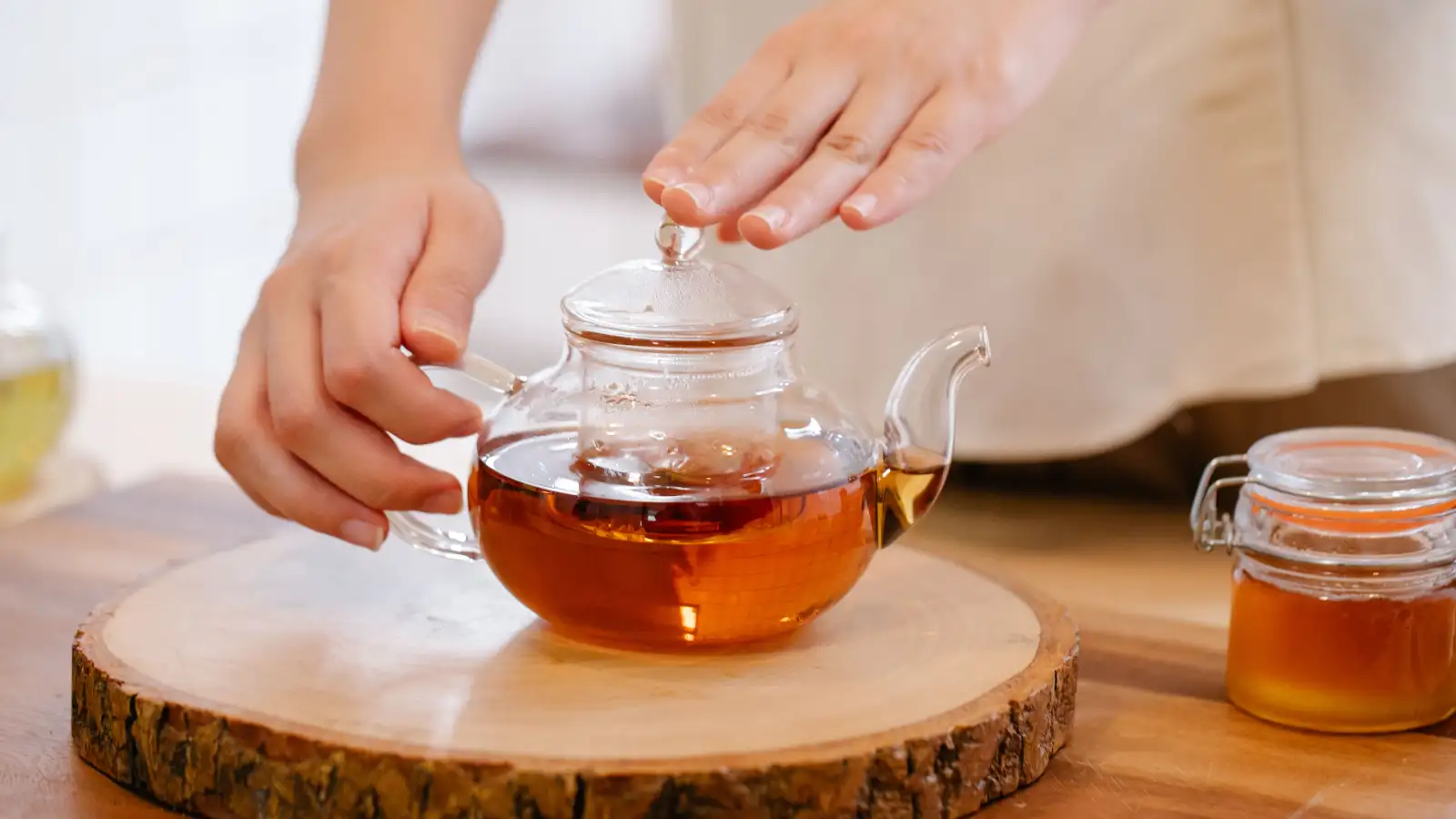
A crystallized jar of raw honey comes back to liquid in a water bath held between 95 and 110°F, and holding that band matters far more than the heat itself: the jar stays in the warm water for as long as it takes, sometimes an hour or more for a full pound, rather than being pushed hotter to finish faster. Crystals dissolve slowly, not instantly, and above that band the volatile compounds that carry a varietal honey's aroma begin to break down. Rush it and the honey will still go liquid. It just comes back tasting like a sweeter, flatter version of what was in the jar.
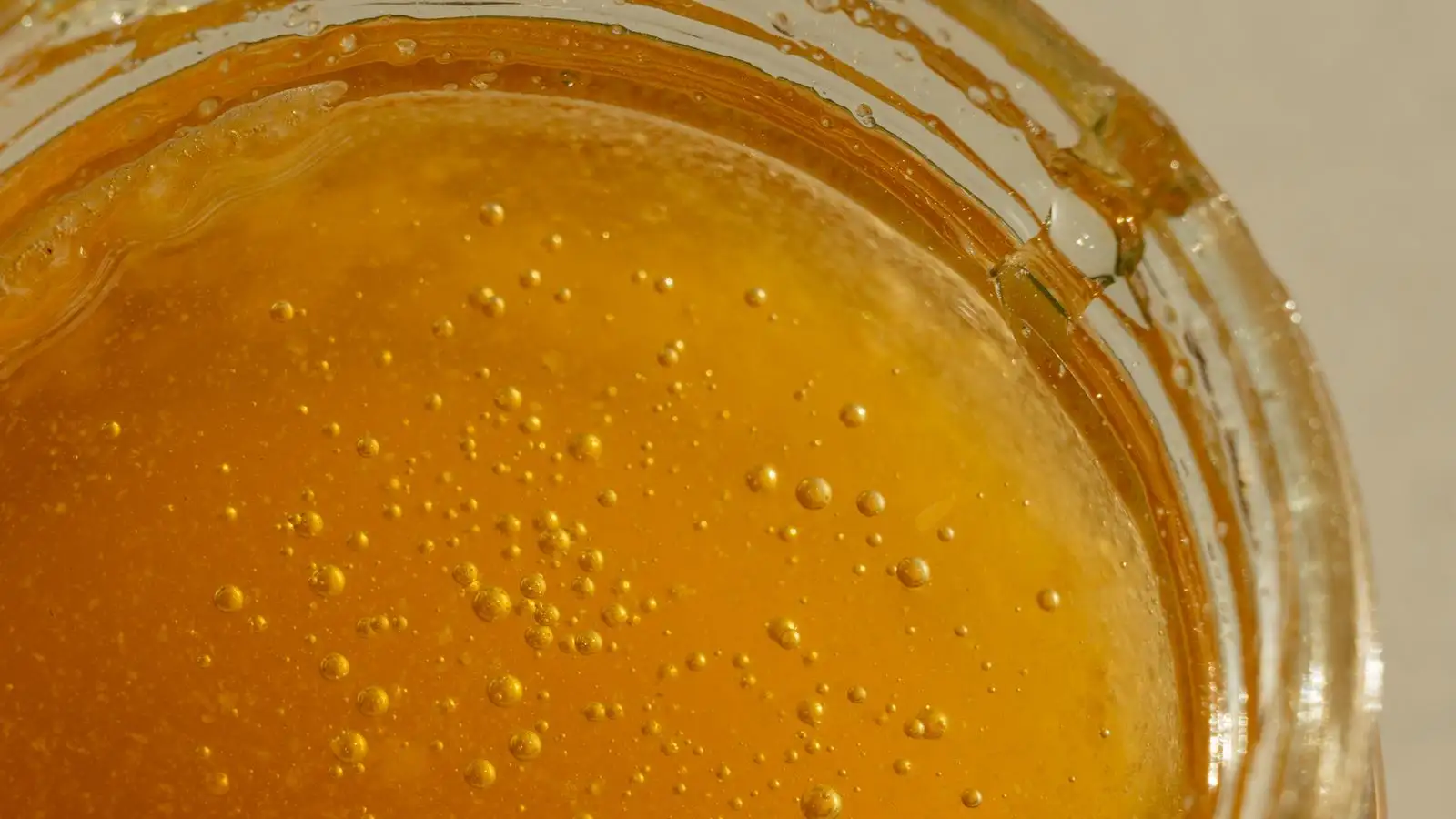
I keep one wide stockpot for this and nothing else. Not because the pot needs to be special, but because it's the right shape: wide enough that water can move all the way around the jar, deep enough that the level reaches the honey inside without climbing past the lid ring. That depth matters more than people expect. A small saucepan loses its heat the second you cut the flame, so you end up standing there nursing the burner. A bigger pot holds a stable pool of water that keeps working after you turn the stove off, and that's the whole trick. You are not cooking. You are parking the jar in a warm place that happens to be liquid.
Set the jar on a folded dish towel or a canning ring in the bottom so the glass isn't sitting directly on hot metal. Loosen the lid. Not off, just loose, so pressure can equalize and so you can get a spoon handle in there without fighting it.
Reading the water, not the honey
Clip a candy or instant-read thermometer to the side of the pot so the probe hangs in the water and doesn't touch the bottom. You want the water, and you want it to sit somewhere around 100°F. If you have no thermometer, this is the one piece of gear worth buying for the job. Touch is a terrible judge at this range. Water at 105°F feels barely warm to a fingertip, and water at 130°F feels like a nice bath, and the difference between those two is the difference between honey that comes back whole and honey that comes back dull.
Here's the part that took me a while to internalize: the water reads warmer than the honey. Glass and dense honey are both heat sinks, and honey is a genuinely poor conductor. When the water says 105, the honey at the center of the jar might be at 85. That's not a problem. That's the process. You are not trying to get the honey to 105; you are trying to keep the outside of it from ever going much past it while the warmth creeps inward.
Bring the pot up to temperature on low, then kill the flame and let the jar sit. Check the water every fifteen or twenty minutes and add a splash of hot tap water if it has drifted down toward 90. If it climbs above 110, pull the jar out and let the pot cool before it goes back in.
Stirring is what shortens this from three hours to one
A jar of set honey warmed only from the outside softens at the perimeter and stays a brick in the middle for a very long time. Push a butter knife or the handle of a wooden spoon down the inside wall, lift, come back in a different spot. Don't whip it, don't aerate it, just keep moving the warm honey from the edge into the center and the cold honey out toward the glass. Every stir cuts real time off the job.
Judging progress by eye is easier than it sounds, because crystallized honey is opaque and liquid honey is clear. Hold the jar up against a window or a lamp and you can see exactly where you are: a dark solid core with a translucent ring around it, then a shrinking core, then nothing. When the whole jar passes light evenly, you're close.
The bottom of the jar is the part that ruins it
This is the mistake I made for years. The jar looks clear from the side, you call it done, you put it back in the cabinet. Two weeks later it's solid again, and it went solid faster than it did the first time.
What you left behind was a layer of fine crystals settling at the bottom that never fully dissolved. Those act as seed. Tilt the jar, look straight down through the glass at the base, and stir that last inch specifically. If you see any haze or grit when you tilt it, it goes back in the water. A gritty, coarse-grained jar from a honey that set hard takes longer than a jar that went smooth and creamy, simply because bigger crystals have less surface area for the warm water to work on.
What I don't do anymore
The microwave. I used it for years in thirty-second bursts, and it always produced the same result: one band of honey near the jar wall that got hot enough to smell cooked and slightly bitter, and a center that was still solid. Microwaves heat unevenly by nature, and honey's density makes it worse. There's also the practical matter of a metal lid, and of plastic honey bears that soften and slump before the honey inside does.
A sunny windowsill is the other one people reach for. It's uncontrolled. Direct summer sun through glass can push well past 110°F, and the temperature swings all day and all night, which is both slow and unpredictable. Not worth it.
An oven on "warm" is a coin flip. On a lot of ranges, warm means 140 to 170°F, which is above where you want to be. If your oven has a bread proof setting, that's usually around 100°F and works well, but put a thermometer in there and confirm it before you trust a jar to it.
What does work, if you happen to own it: a sous-vide circulator set to 100°F is essentially a purpose-built honey warmer that holds within a degree and needs no attention. A food dehydrator with an adjustable thermostat at 100°F, jar lid off, does the same thing. Neither is required. They just remove the babysitting.
It will set again, and sooner
Re-liquefied honey tends to crystallize faster than it did the first time, and there's no way around it. You never get every last seed crystal out, and the ones that remain give the glucose somewhere to start. Some of it is also just the honey. Clover, alfalfa, and canola set quickly on their own; tupelo, acacia, and black locust can stay liquid for years.
So the honest tradeoff is this. If you want that particular jar, you'll do this again in a few months, and it'll take less time because you'll know what you're doing. If you'd rather not repeat the ritual, decant what you'll use over the next few weeks into a smaller jar and re-warm only that, leaving the big one alone. Re-warming a half-cup takes fifteen minutes. Re-warming a quart takes an afternoon.
And a last thing worth saying, because it's the reason I stopped rushing: if all you need is honey to spread on toast or stir into yogurt, you don't need clear liquid. You need soft enough to scoop, which happens around 90°F and takes a fraction of the time. Save the full clear-out for when you're pouring, drizzling, or measuring, or moving honey into a different jar for keeps.
The point of holding it low and slow is that nothing in the jar changes except the arrangement of the sugar. Same honey, same source, same aroma. You're just undoing a physical accident and letting it come back as itself.