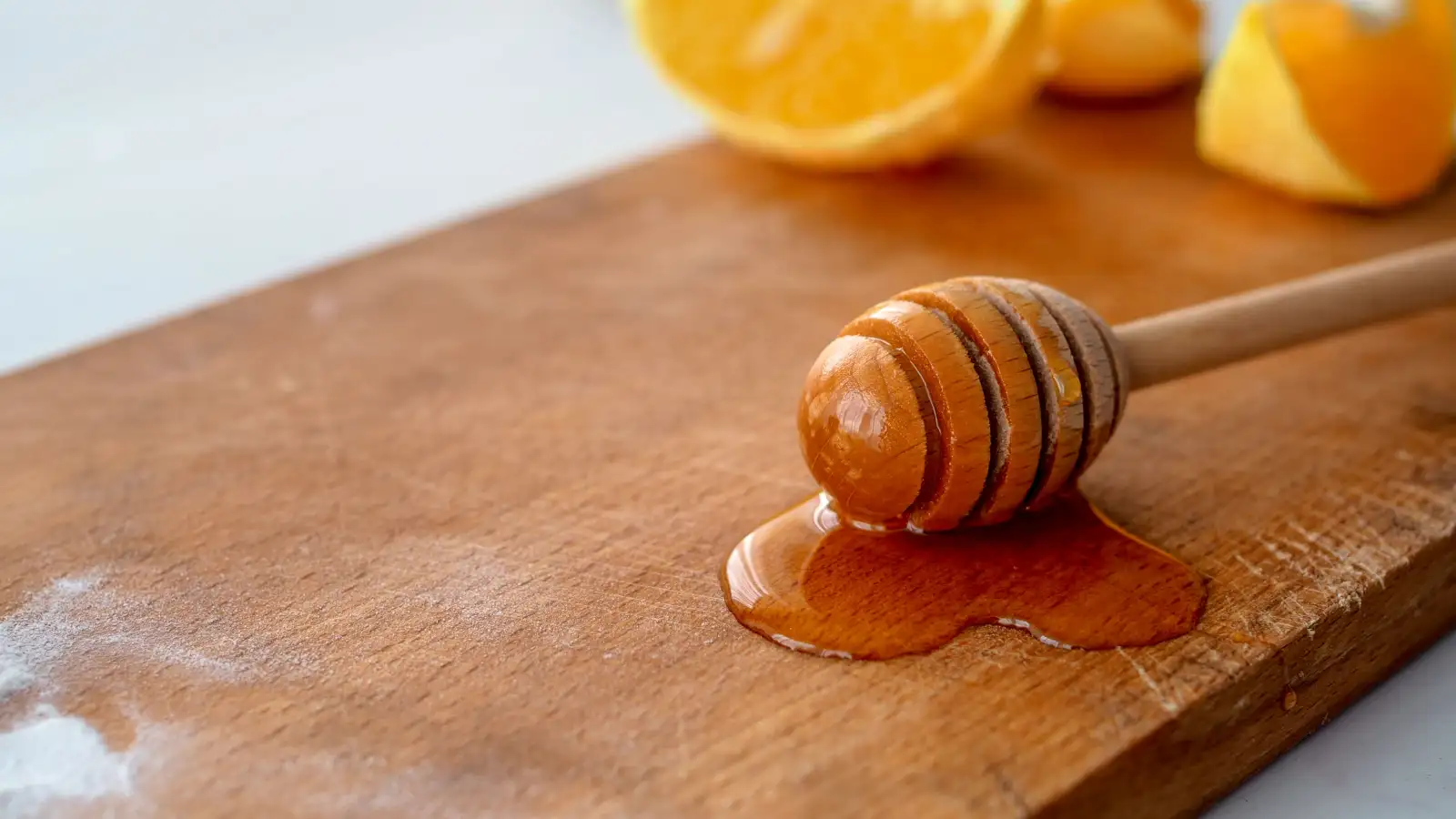
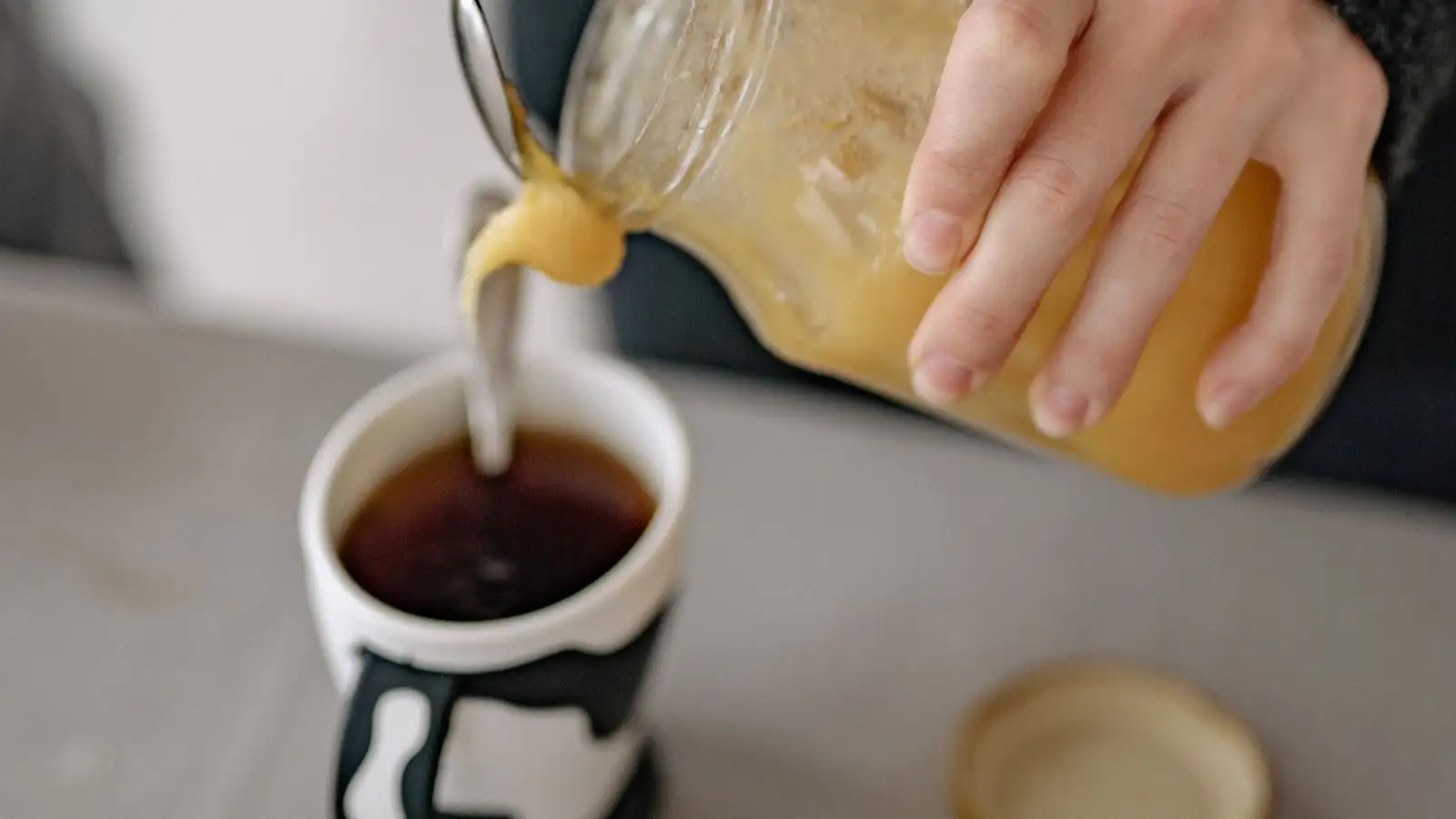
Set the jar in a pot of water you have checked at 100 to 110°F, stir it every few minutes, and lift it out when the last of the grain has cleared. That is the whole method, and the ceiling on the temperature is the part people get wrong: boiled, or run through a microwave on high, honey goes past the point where its aroma and its pale color survive, and neither one comes back. The larger point is that a solid jar usually doesn't need the bath at all. Crystallized honey is the same honey with its sugars reorganized; in a batter or a dough it can go in exactly as it sits, and the mixing does the melting.
The jar sitting on my counter
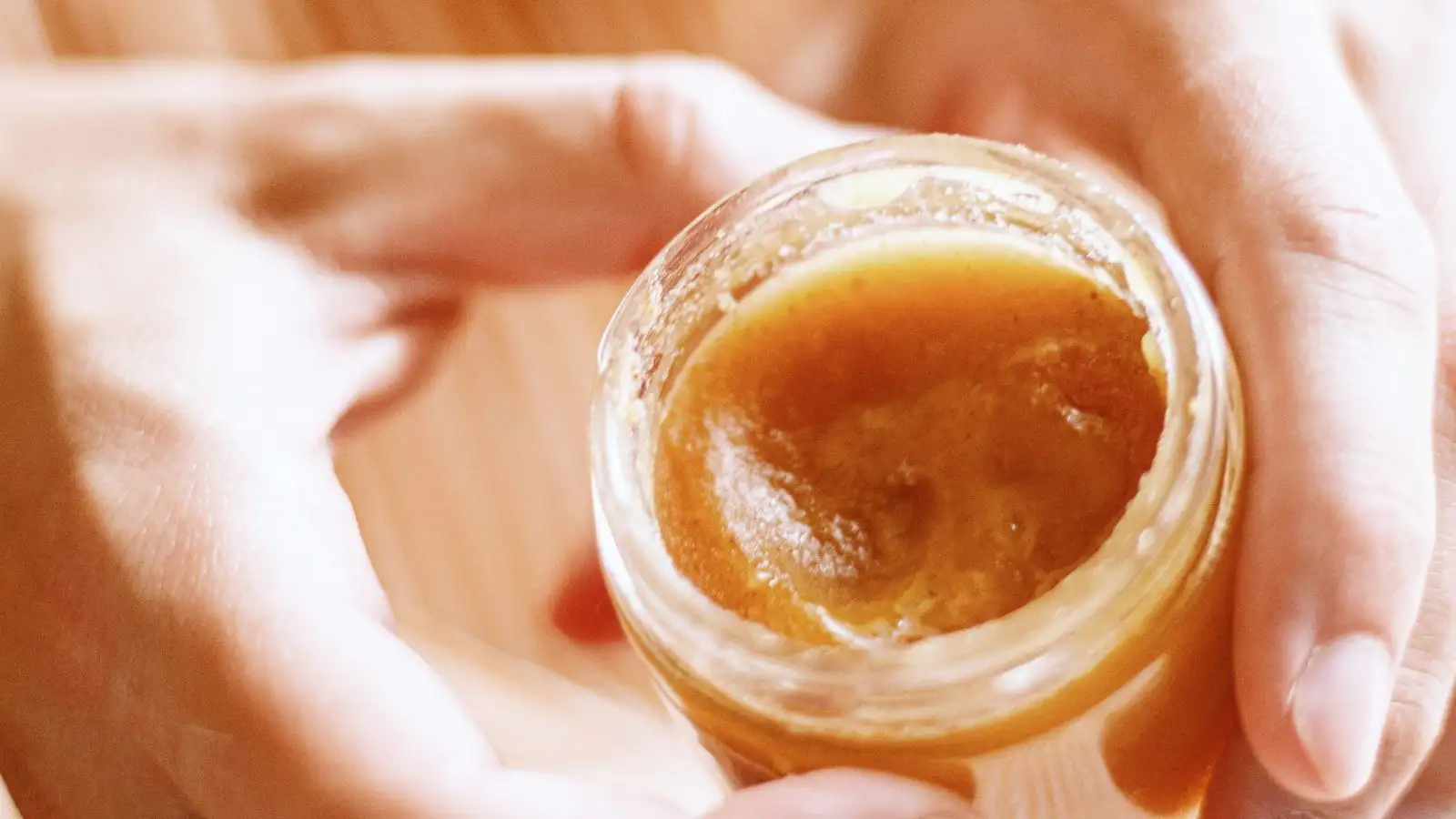
I keep a quart of clover honey on the counter next to the stove, and it went solid this winter the way it always does, from the bottom up — first a pale grainy layer an inch deep, then more of it, until the wooden spoon I leave standing in the jar stopped falling over. Right now I'm making cornbread and the recipe wants a half cup. I don't reach for a pot.
Here's what it looks like from where I'm standing. I tip the jar and spoon the honey out; it comes away in thick, dull ribbons, closer to cold shortening than to syrup. I pack it into a dry metal measuring cup and level the top with the back of a knife. By weight nothing changes — the crystals are the same sugars sitting closer together, not water that walked off — so a recipe written in grams doesn't care what state the jar is in. Volume is close enough if you pack the cup instead of pouring into it. The clumps go in with the cornmeal and the buttermilk, get beaten for twenty seconds, and the grain is gone before the batter is smooth. Nothing was sacrificed. The honey dissolved in the thing it was meant to sweeten.
That covers most of what I cook. Cakes, quick breads, muffins, a pot of beans, a marinade, tea. The one adjustment is the packing, and after a few jars your wrist knows what a packed half cup feels like.
When the bath is actually doing work
The bath isn't superstition. It's for the recipes where honey has a job beyond sweetening — where it has to move. A glaze for a ham, or for a tray of roasted carrots that gets brushed at the end. A drizzle over yogurt. Anything stirred into a cold drink, where a lump sinks and sits at the bottom of the glass instead of dissolving. And any time the honey is going into beaten eggs, because a gloppy spoonful won't distribute evenly through them no matter how hard you whisk.
The mechanics are dull and they matter. Water in the pot comes up to about the level of the honey inside the jar, no higher. A folded dish towel or a trivet goes under the jar so it isn't resting on bare metal. The heat stays low — if the water is steaming, or too warm to hold a finger in, you're already above where you want to be. I keep an instant-read thermometer in the water, cut the burner when it reads 110, and nudge it back on when it falls to 100. A quart jar doesn't need a rolling bath. It needs a patient one.
Then you stir. A chopstick or a butter knife down the side to the bottom of the jar, once every five or ten minutes. The crystals against the base are the ones that need to move; a jar left untouched heats its outside and keeps its middle grainy for an hour. Solid-to-the-spoon honey takes something like twenty to forty minutes this way. A soft-set jar is much quicker. If the water cools off and you have to start again, you've lost time and nothing else.
What heat costs you
I did the wrong thing once, early on, with a jar of something floral I'd gone out of my way to find. Small pot, water, burner on high, and I walked away to do something else. I came back to a boil.
The honey was still honey. Still sweet. But the smell coming off it was cooked — caramel-ish, closer to pancake syrup than to the blossom that had been in it, and the color had gone from pale straw to a dull amber that stayed dull amber. Heat that melts a crystal doesn't stop there; the aroma compounds in honey are volatile, and the same warmth that frees the sugar drives those off. Boiling doesn't just speed the process up. It changes where you end up.
A microwave on high does the same thing faster and less evenly. I've pulled jars out with a scorched pocket in the middle and crystals still ringing the bottom, which is the worst of both outcomes.
Warm honey and eggs
This one is worth saying plainly, because it ruins breakfast. Honey straight out of the bath is around 105 to 110°F. Into beaten eggs, it starts cooking them where the stream lands — you get pale threads at the edge of the bowl, and whisking doesn't undo them. So the jar sits on the counter for ten or fifteen minutes after its bath, or I pour the honey into a wide bowl and stir until it stops feeling warm against my wrist. Room temperature, then it meets the eggs.
Melted butter is a softer case. Honey at bath temperature stirred into a pool of melted butter doesn't set anything, because there's no protein to set. The trouble only shows up when that butter is on its way into a batter with eggs in it. I cool the honey either way, mostly so I don't have to think about which recipe I'm in.
Why your jar and your neighbor's jar behave differently
Crystallization comes down to the ratio of glucose to fructose in the honey and to the microscopic seed crystals already suspended in it. Glucose drops out of solution first; fructose holds on longer. Honeys heavy in glucose — clover, alfalfa, dandelion — go solid in a matter of months. Honeys heavy in fructose — acacia, tupelo, sage — can stay liquid for years, and one of them may never give you a reason to own a thermometer at all.
This is why the same advice can feel essential with one jar and pointless with another. You aren't doing anything wrong when your clover sets and the tupelo on the shelf above it doesn't. They're different sugars in different proportions, and the difference is in the jar before you ever open it.
The arrow points both ways, too. When I want a firmer honey — the kind that stays put on a piece of toast instead of running off the edge — I stir a spoonful of already-crystallized honey into a jar I've just liquefied, and it sets again from that seed over the following weeks. Same mechanism, working in my favor. Which is the real reason I stopped treating a solid jar as a problem to be solved: sometimes the solid jar is the thing I want.
The decision, in one pass
If the honey is going into a batter, a dough, a marinade, a hot drink, or a pot of something simmering — spoon it in as it is, pack the cup, change nothing else.
If the honey has to pour, drizzle, or coat evenly, or disappear into something cold without leaving a lump — water bath, 100 to 110°F, stir every few minutes, then let it come back to room temperature before it meets eggs.
If you want spreadable honey on purpose — leave the jar alone and use a knife instead of a spoon. The bath will take that texture away, and it takes weeks to get it back.
A solid jar isn't damaged. It's just honey in the other of its two states, and half the time the one you were already looking for.