Replace each cup of granulated sugar with three-quarters of a cup of honey, take a quarter cup of liquid out of the recipe for every cup you swap, and add a quarter teaspoon of baking soda along with it. Those three numbers are the whole translation: less honey by volume, less liquid pulled from somewhere else in the ingredient list, and a leavener that has no reason to be in the bowl except that honey is acidic.
I keep those three numbers on a strip of masking tape inside the cabinet door, and I still run my thumb across it before I start. The tape exists because I got this wrong twice before I understood that a honey swap is arithmetic, not a scoop-for-scoop trade. Nothing about a jar of honey behaves like a bag of sugar, starting with the way it comes out of the jar.
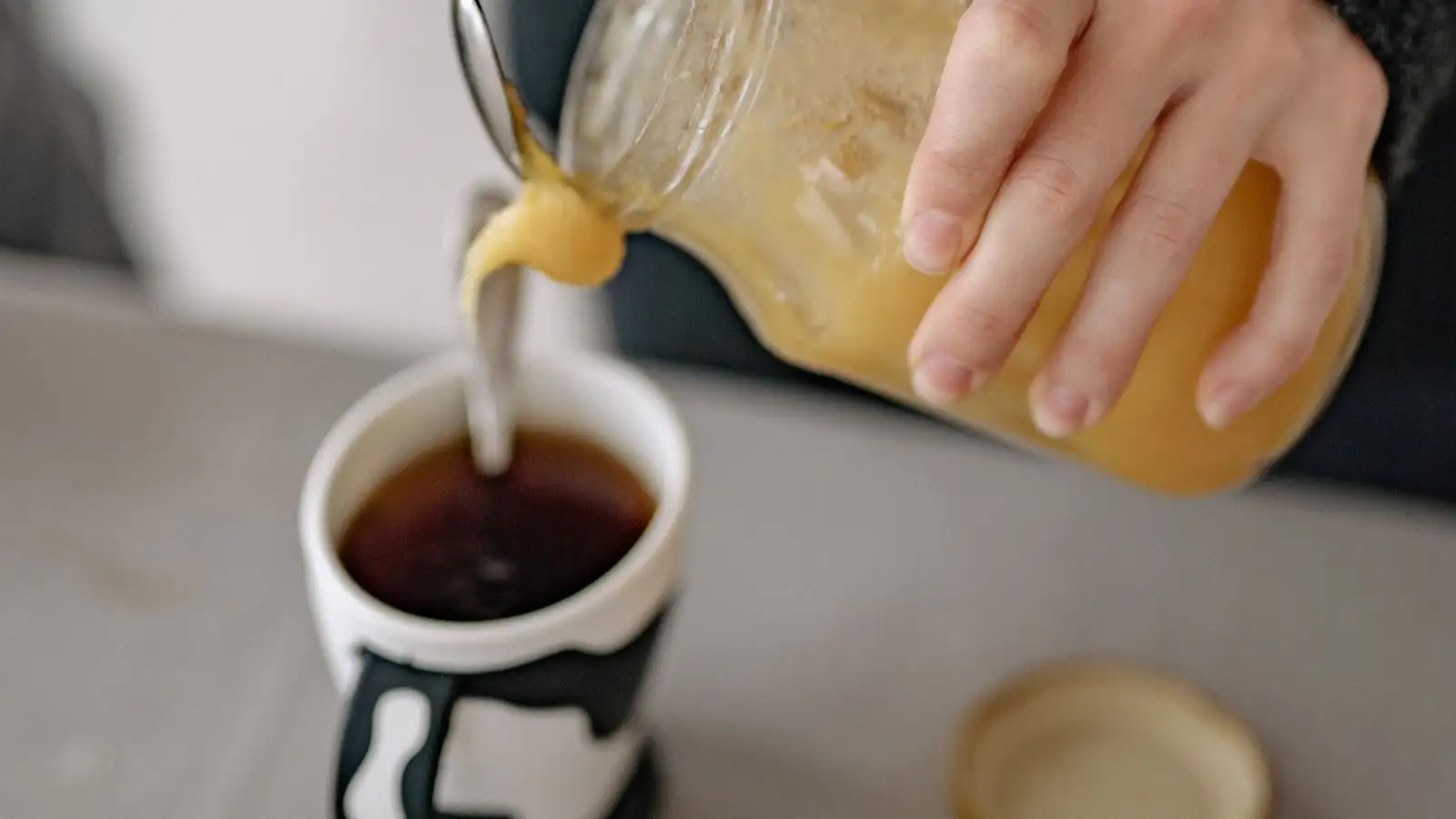
Warm it first. Not hot, just warm, a few minutes under running tap water. Cold honey folds over on itself and leaves a hollow core down the middle of the measuring cup, and a hollow core is honey you never measured. Once it moves, either spray the cup with a neutral oil or, better, put the bowl on a scale and skip the cup entirely.
Set both measurements side by side sometime and watch how far apart they drift.
The gap between the cup and the ounce
One cup of granulated sugar weighs about 7 ounces. One cup of honey weighs about 12. So three-quarters of a cup of honey, the amount that stands in for a cup of sugar, comes to roughly 9 ounces against the 7 you took out.
Say that slowly, because it inverts the picture most people carry around. By volume you're using less. By weight you're putting about two extra ounces of sweetener into the bowl. That is why a recipe converted on a scale and the same recipe converted with measuring cups can land as two noticeably different cakes: the weighed version is heavier, wetter, and slower to set in the middle.
Where the quarter cup of liquid goes
The quarter cup you remove isn't a separate ingredient you add to the shopping list. It comes out of whatever wet thing the recipe already has: the milk, the water, the coffee, the buttermilk, the applesauce. It does not come out of the eggs. Eggs are structure. Pull liquid from them and you've changed the recipe in a direction you didn't intend.
The subtraction is not fussiness. Honey is somewhere around 17 to 18 percent water on its own, and you're pouring that into a formula written for a dry sweetener. Skip the subtraction and the batter tastes correct but bakes wet, with a sunken middle and a gummy band just above the bottom crust.
Now the case where the arithmetic fails. Some recipes have no liquid to give. A cookie dough built from butter, sugar, egg, and flour has nowhere to take a quarter cup from. That's the signal to do a half swap instead: drop half the sugar, put in three-eighths of a cup of honey, and leave the liquid alone. Half swaps are how you keep a cookie from spreading into a lace doily.
The pinch of soda is doing a job
Honey is acidic. Baking soda is a base. A quarter teaspoon per cup of honey neutralizes that acid, and the reaction throws off carbon dioxide that lifts the batter in the oven.
Do not reach for baking powder to fill that quarter teaspoon. Baking powder arrives with its own acid and its own starch, so you'd no longer be correcting the honey, you'd be rewriting the leavening.
Leave the soda out and nothing catastrophic happens. The cake still bakes. It rises a little lower and sets a little tighter, and the crumb turns fine and close, more like a quick bread than a layer cake. Most people can't name what's off. They just say the slice is heavier than last time.
What sugar does that honey cannot
Sweetness is only part of what sugar contributes, and this is the part the three numbers can't repair.
When you cream butter and sugar, the sharp edges of the crystals carve small pockets of air into the fat. That's a genuine source of a cake's lift, and honey can't replicate it, because honey is a liquid and liquids slide. Sugar also takes up room. A cup of it holds the batter apart and gives the crumb something to set around. Three-quarters of a cup of honey occupies less space and stays wetter, so an all-honey cake comes out denser and moister even when the sweetness is right where you want it.
I also knock the oven down 25°F and start checking five minutes early, because honey darkens faster than sugar does and the top will go before the center is done.
Then there's the honey itself. A pale, gentle honey and a dark, assertive one are not interchangeable spoon for spoon; the dark one will walk all over a vanilla cake. Three-quarters of a cup is a starting ratio, not an exact sweetness match. The first batch is the calibration. If the flavor reads thin, add a tablespoon next time. If the honey is the loudest thing in the room, take one out.
Brown sugar and corn syrup move, but not cleanly
Brown sugar and corn syrup will sometimes travel in either direction with honey, and it's tempting to treat all three as one ingredient. They aren't.
Brown sugar already carries molasses and moisture, so it behaves closer to honey than white sugar does, but it still creams like a crystal. Corn syrup is mostly sugar and water with almost no flavor of its own, and it resists crystallizing in a way honey doesn't. Swap honey into a recipe that called for corn syrup and you change both the flavor and the browning. Swap corn syrup in for honey and you keep the moisture while losing the flavor entirely. Either direction works, but neither is automatic, and the liquid adjustment still has to be recalculated rather than copied.
The tape on the cabinet door has a fourth line now. Three-quarters of a cup. A quarter cup less liquid. A quarter teaspoon of soda. And underneath, in smaller letters: start with half if the recipe has no liquid to spare. The arithmetic gets you close. The first batch tells you the rest.