The oven takes the aroma and leaves the sugar. That is the entire transaction. Raw honey's floral volatiles begin leaving the batter the moment it hits heat, and they keep leaving in proportion to how long and how hot the bake runs. What survives is sugar, acid, and water, which is precisely what an ordinary grocery-store jar brings to the same bowl. So raw honey folded into a 375°F muffin batter lands close to indistinguishable from the squeeze bottle, while that same raw honey drizzled over a warm biscuit or whipped into a no-bake filling does something the squeeze bottle cannot. There is a second, quieter difference heat does not touch: raw honey varies more from jar to jar in water content, which makes measuring it by volume unreliable in a delicate batter. Weigh it and that problem disappears too.
Two tins, one afternoon
I've run this comparison more times than I'd like to admit, and the setup matters more than people expect.
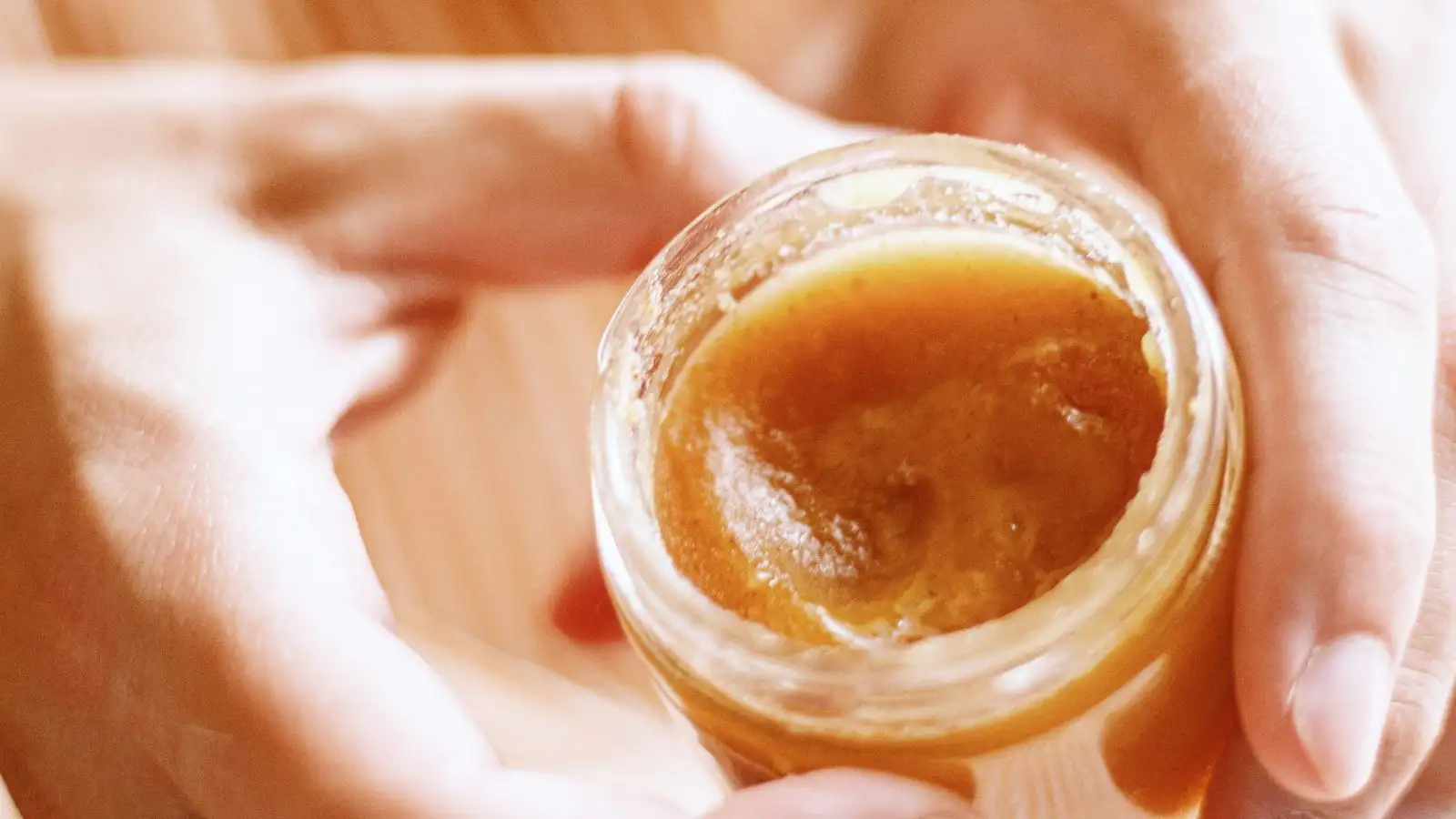
Two identical muffin tins. One batter, split in half down the middle. In the left bowl, a raw wildflower honey I'd picked up at a farmers market two weeks earlier, still pourable, still smelling like clover and something faintly citrus underneath. In the right bowl, the grocery-store bottle, the kind that's been warmed to about 150°F during bottling so it stays liquid on the shelf indefinitely.
Same 168 grams of honey in each, because a half cup of honey is not a volume I trust. Same flour, same butter, same eggs, same salt, same oven, same rack position.
And here is the part that took me years to get right: I bake them one batch at a time, not two pans at once. A home oven with two tins in it has a hot spot, and I'd rather remove a variable than argue with it. I also let the oven sit at temperature a good fifteen minutes past the beep. Most ovens overshoot the setpoint on the first bake after preheat, climbing well past 375 and then settling back down. If the raw-honey batch goes in first and the regular batch goes in second, you have just compared two different ovens, and you will write yourself a very confident, very wrong note.
So: preheat, wait, then first batch. Then let the oven recover fully before the second. It eats an afternoon. It also means the only thing different between the two tins is the honey.
What my nose told me before my mouth did
Open the door at the ten-minute mark and the raw batch smells like honey. Distinctly. Sort of a warm floral cloud coming off the pan. Open it at twenty and the smell has thinned out. Open it at twenty-five and there's almost nothing there.
The other tin never smelled like much of anything, at any point.
That's the whole finding, delivered through a nose in about thirty seconds. Everything else I'm about to say is just bookkeeping around that one observation.
Out of the oven and cooled, both batches had the same dome, the same crumb, the same golden edge. I handed chunks to family members without telling them which was which. Guesses ran about coin-flip, with the most common answer being some version of "they're the same." One person insisted the left one was sweeter, then changed her mind when I swapped the plates on her.
What the heat genuinely takes
The aromatics
The compounds that give honey its varietal character are volatile. That word is doing real work here. Volatile means they evaporate at temperatures far below baking range, which means they are not being destroyed so much as leaving. They leave the batter in the same way they'd leave an open jar on the counter, just enormously faster once the whole thing is 350 degrees.
This is why the same jar behaves completely differently depending on how it's used. Whipped into cold butter for honey butter, every volatile stays put. Folded into a no-bake cheesecake filling, they stay put. Drizzled over a scone after it comes out of the oven, they stay put. Baked into a honey sponge that spends forty-five minutes in the oven, most of them are gone.
The loss is not a switch. It's a slope, and the slope is governed by total time at temperature. That's the single most useful thing I know about baking with raw honey.
The enzymes
People bring this up constantly, so let's be clear about what it is. The enzymes in honey are proteins. Proteins lose their structure and their activity as temperature climbs, and a batter on its way past 300 degrees internally finishes the job thoroughly.
But the piece people miss is that even before any of that, those enzymes were not doing structural work in your batter. They don't build crumb. They don't lift. They don't brown. They don't thicken. If you are imagining a functional reason to babysit a jar of raw honey through a bake, that isn't where it lives.
The moisture lottery
This is the one that actually bites people, and it has nothing to do with the oven.
Raw honey is filtered lightly and blended barely, so a jar from one producer in one season can carry noticeably more water than the next. That's not a defect. It's just what happens when you don't standardize a blend to a target moisture spec.
The consequence is small in absolute terms and large in relative ones. If your raw honey is on the runny end, a half cup by volume is carrying a few grams more water than the recipe writer assumed. In a muffin, nobody will ever know. In a honey-sweetened sponge, a macaron shell, or a meringue where honey is doing double duty, a few grams of extra water is the difference between a shell that sets and one that stays tacky. I have made that mistake and I have thrown out that tray.
Weigh it. A half cup of honey is around 168 grams. A tablespoon is around 21. Get on the scale and the whole lottery disappears.
The crystals
Lighter filtering leaves more microscopic seed crystals behind, which is why raw honey tends to crystallize faster than the blended grocery-store stuff. Grainy honey is not spoiled honey, and it's fine in a bake, but two things are worth watching.
First, if you scoop crystallized honey by volume, you're scooping air pockets along with it. Your half cup is not a half cup. Second, and more annoying, crystals don't dissolve in a short bake. Into a fourteen-minute scone, a scoop of gritty honey leaves hard specks that never fully melt. Warm the jar gently in a bowl of tap-hot water until it's clear again, let it come back to room temperature, then measure.
What the oven does not change at all
Structure. Rise. Browning. Whether the crumb sets soft or dry.
Raw and pasteurized honey come out of the jar with essentially the same sugar profile and roughly the same acidity. The pasteurization step is a warming and filtering step, not a chemical rewrite. It doesn't swap out the sugars or neutralize the acids. It just makes the jar boring and stable, which is the whole point of it.
This is where most home bakers go wrong, and I say that as someone who went wrong there for years. Honey browns faster than granulated sugar. Honey pulls moisture out of the air and keeps a crumb softer for longer. Honey is acidic enough that a recipe built around it usually leans on baking soda for lift rather than baking powder. All of that is true. All of it is equally true of the cheap bottle. If your honey cake came out dark and stayed moist for four days, that's honey doing that, not raw honey.
Where the expensive jar actually earns its keep
Glazes, and anything that sees heat for a very short time or none at all.
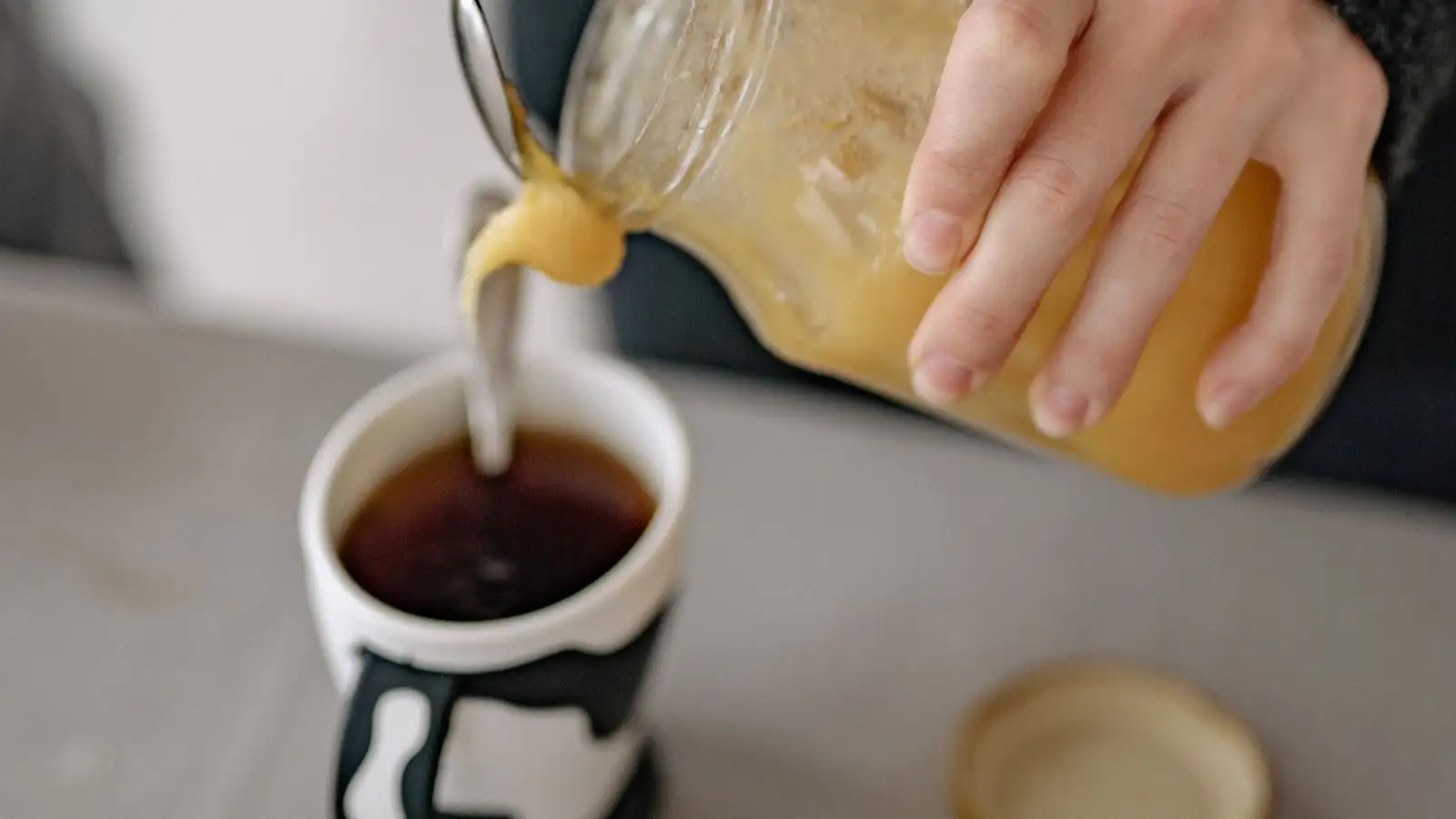
Honey butter. A no-bake filling. A drizzle over hot cornbread, over a scone, over pavlova, over yogurt. A vinaigrette. A cup of tea. A finishing glaze spooned onto a roast in the last two minutes under the broiler. In every one of those, you are tasting the thing you paid for.
If you do want to bake with it, you can buy back some of what you lose. Whatever shortens total time at temperature helps. A quicker bake holds more than a long slow one. Adding honey later in the process, when a recipe allows it, holds more. A lower finishing temperature holds more than a hard blast at the top of the range. And if a recipe calls for honey, uses heat, and lets you finish it after the oven, take that option every time.
Measuring, once, cleanly
Use a scale and stop thinking about it. Weigh the honey into the bowl with the wet ingredients. If it's crystallized, liquefy it first and cool it back down. If your recipe was written by volume and the batter looks looser than usual, the jar was a wet one, and that's your answer.
The tradeoff, stated plainly
Raw honey is not wasted in a baked recipe. It sweetens, it browns, it holds moisture, it brings acidity. It's honey. It works.
What it doesn't do is bring the specific thing you paid a premium for, once the oven has had forty minutes with it. The aromatics fade in proportion to time and heat, and nothing about the raw label changes that math. So the honest position is this: use it in the bake if you like it, just know that in there it's honey, and honey is the whole story. Save the jar with the remarkable smell for the places where remarkable smells survive.