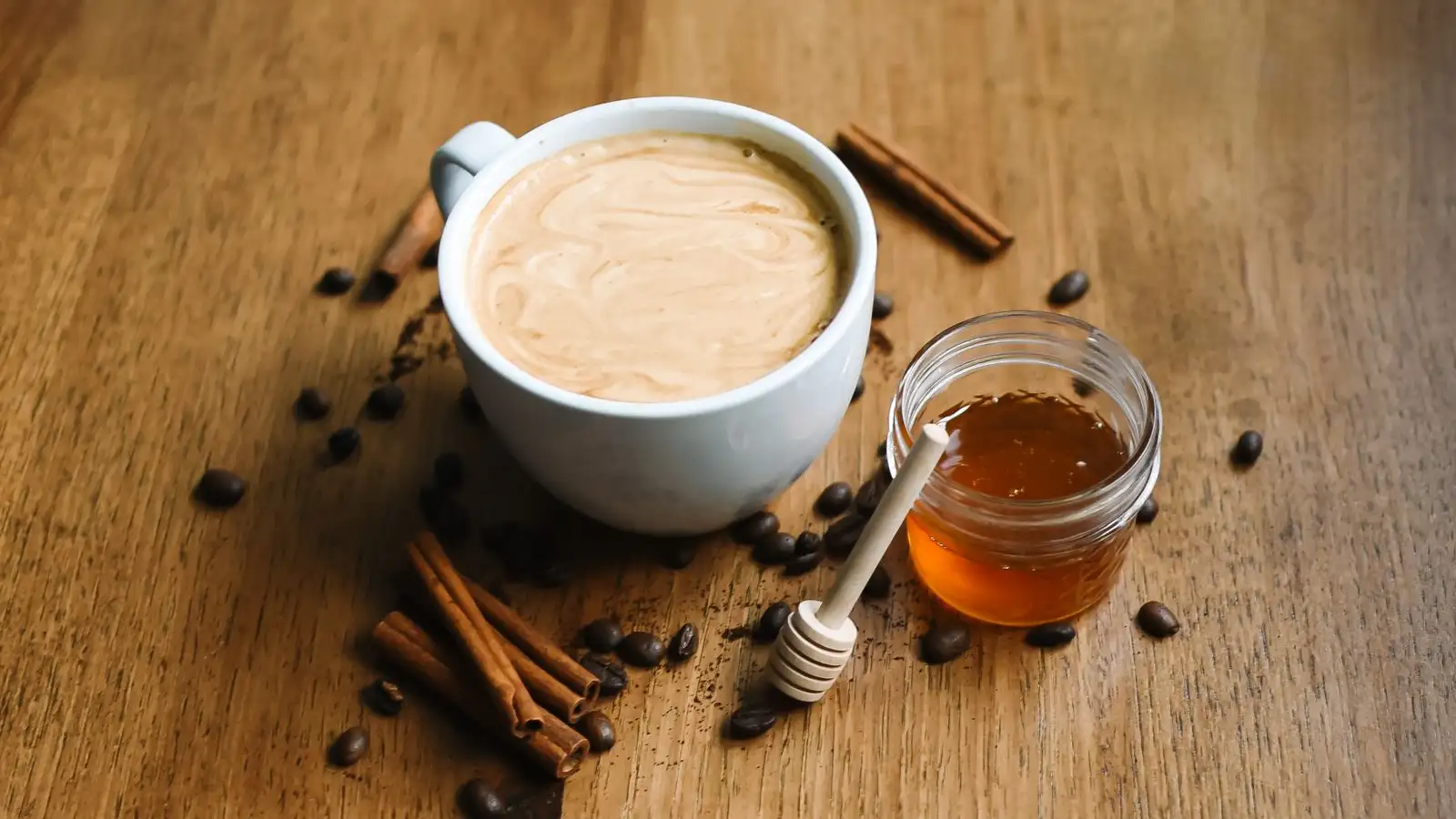
Three-quarters of a cup of honey stands in for one cup of granulated sugar, and that swap never travels alone. Honey carries roughly seventeen to twenty percent water by weight and it tastes sweeter than sugar, so three other numbers in the formula have to move with it: pull about a quarter cup of liquid for every cup of honey you introduce, add about a quarter teaspoon of baking soda per cup of honey so its acidity works with the leavening instead of against it, and drop the oven about 25 degrees Fahrenheit because honey's sugars color the crust long before the middle is done. Reverse the swap, honey out and sugar in, and the liquid adjustment flips: you add water back rather than taking it away.
I had a recipe card on the counter with one cup of sugar written on it, a jar of honey that had gone grainy at the bottom, and no strong plan. What I did first was not scoop. I got the scale out, because honey is the one ingredient in a home kitchen where the cup measure reliably lies to you. A level cup of granulated sugar weighs about 7 ounces. Three-quarters of a cup of honey weighs about 9. The bowl gets heavier even though you are adding less. Eyeball it and stop at the three-quarter line and you have probably put in more honey than the recipe wanted. The batter tells you a few minutes later, thinner than it should be, sliding off the spatula instead of holding a soft mound.
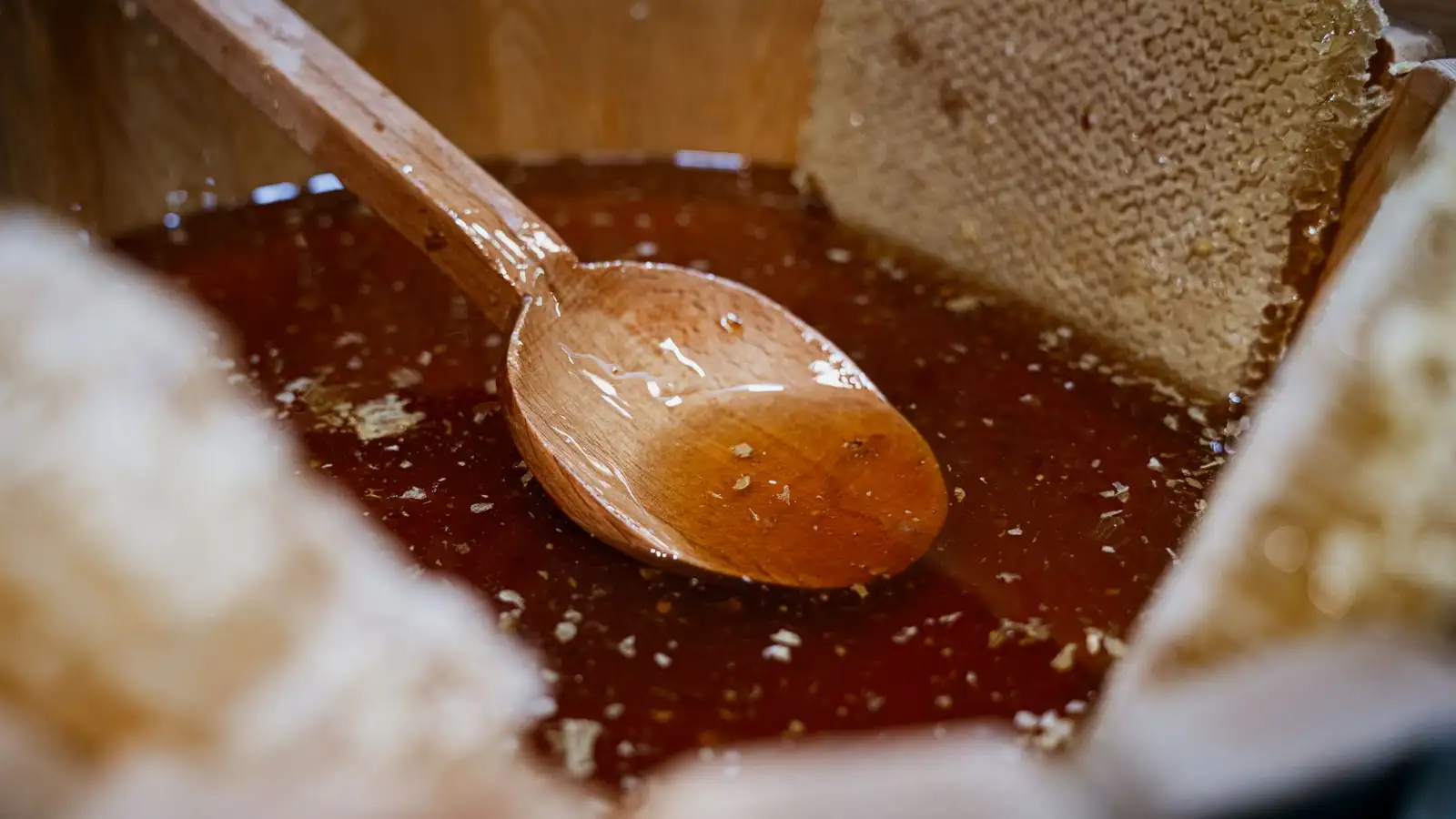
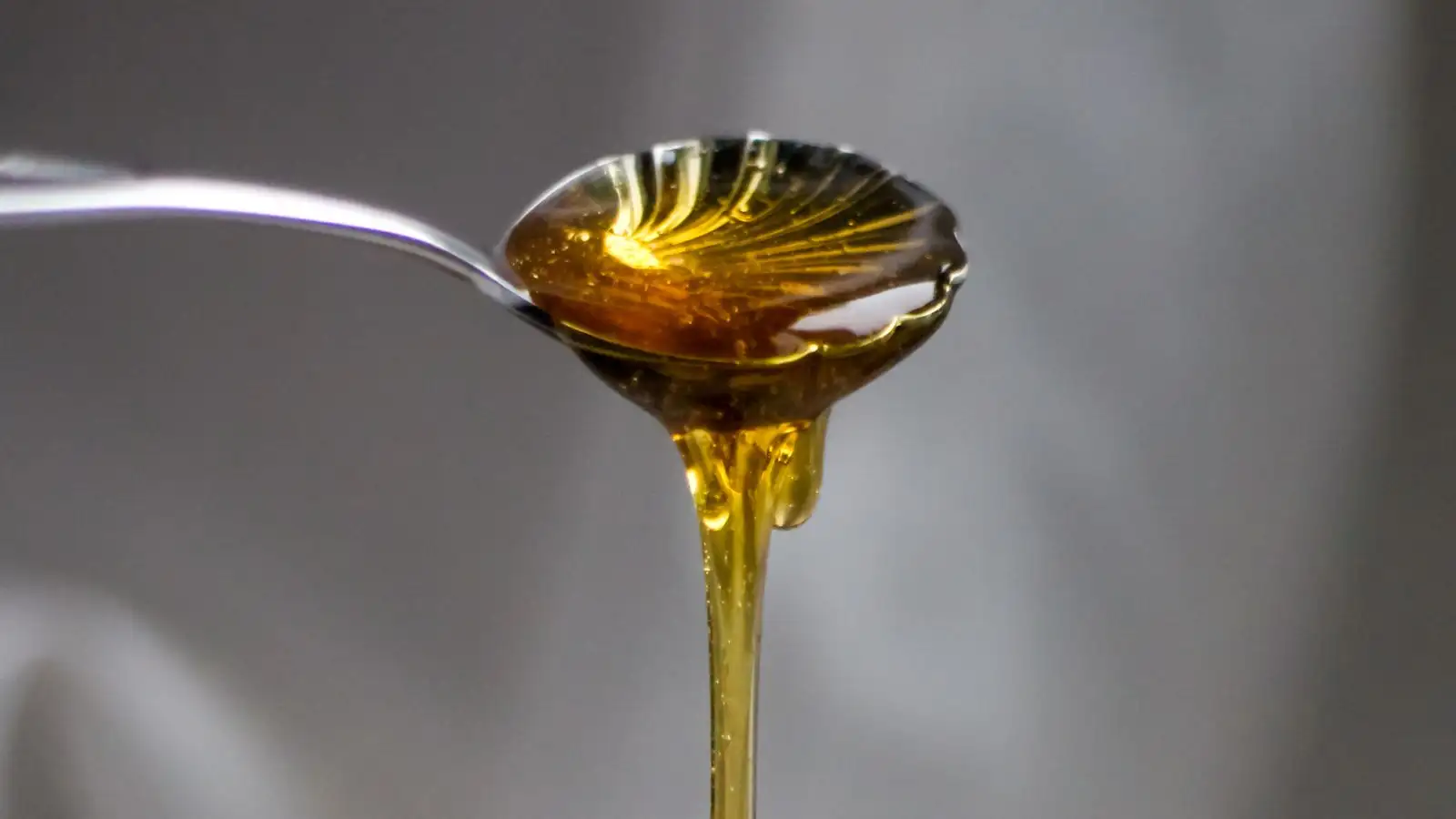
Then the measuring itself. Honey grabs the cup. What I do is measure the oil or the melted butter first in the same cup, or give the cup a light film of neutral oil spray, and the honey slides out clean. If the jar has crystallized, set it in a bowl of warm water for ten or fifteen minutes. Warm is enough.
What the ratio does and does not cover
Three-quarters of a cup per cup is a starting point, not a law. If the honey is dark and assertive, buckwheat say, two-thirds may taste closer to right, because the flavor carries further than sugar's does. If it is a light clover, three-quarters reads as barely sweetened. The recipe matters too. A pumpkin bread or a bran muffin has enough structure and spice to absorb the swap without complaint. A sponge or a delicate white cake does not. Honey weakens the crumb there, and no amount of arithmetic fixes that. I leave those alone.
Worth knowing as well: honey is not a fixed ingredient. Its water content drifts with the season and the source, anywhere from about 15 to 20 percent. A runny honey is carrying more water than a thick one. That is why the liquid adjustment below is also a starting number rather than a rule.
Taking liquid out, and what counts as liquid
For every cup of honey, pull back about a quarter cup of the liquid already in the recipe. That is the standard move and it is driven by a plain fact: you just added a quarter cup of water to the bowl, disguised as honey.
The mistake I made the first time was only looking at the milk. Liquid in a cake or a quick bread is not just the milk or the water. It is the yogurt, the sour cream, the applesauce, the mashed banana, the pumpkin puree, the juice, the coffee. If the recipe has half a cup of sour cream in it, that sour cream is fair game, and taking two tablespoons from it disrupts far less than pulling a quarter cup of milk out of a batter that needed the milk.
If there is genuinely nothing to take, a lean recipe with one egg and two tablespoons of liquid, you have two options and neither is elegant. Add a tablespoon or two of flour to tighten the batter back up, or reduce the honey instead and accept a less sweet result. Flour dilutes the leavening and firms the crumb. Adding nothing gives you a batter that spreads. I add flour by the tablespoon and stop when the spatula starts to drag.
One honest caveat. If you are swapping honey for brown sugar rather than white, cut the liquid reduction roughly in half. Brown sugar already carries a few percent of its weight in moisture from the molasses, so the bowl is not as dry as the white sugar version was, and a full quarter cup back leaves you with something closer to a pourable batter than a scoopable one.
One note on batch size
Everything above multiplies. Double the honey, double the liquid you remove. That part is linear and forgiving. Leavening in very large batches is a different story, since a quadruple batch does not behave like four single batches, but for anything a home oven can hold, treating it as linear is close enough.
The quarter teaspoon of baking soda
Honey is acidic. Granulated sugar is not. In a recipe that rises on baking soda and baking powder, that acid has to be answered or the lift comes out uneven and the crumb tight.
The usual fix is a quarter teaspoon of baking soda per cup of honey. It neutralizes the acid, and it does a second job, pushing browning along. That is exactly why the crust on a honey cake looks so dark so quickly.
Two places I hold back. If the recipe already carries a lot of baking soda, adding more can tip the batter alkaline, and you will taste it, a faint soapy edge and a slightly coarse crumb. And if the recipe uses baking powder only, with no baking soda at all, the addition is a judgment call. A quarter teaspoon will help with browning and structure, but the cake will rise without it. What you may lose is evenness.
Some bakers trade a little baking powder for baking soda rather than adding soda on top. One teaspoon of baking powder minus a quarter teaspoon, plus a quarter teaspoon of soda, is roughly equivalent in lift and handles the acid. Either approach works. What does not work is ignoring the acid entirely and then wondering why the loaf slumped in the middle.
Twenty-five degrees, and the pan underneath
Honey's sugars brown faster than granulated sugar's. Set the oven to the temperature on the card and the top of the loaf will be mahogany before the center is set. So the standard adjustment is 25 degrees Fahrenheit lower than the recipe calls for, and I start checking for doneness at about three-quarters of the stated time.
The pan matters here. If you are already using a dark metal pan, you have two things pushing the crust darker at once. Lowering the temperature handles it. I do not lower it further to compensate, because then the middle takes so long the crumb dries out. I check early instead, and if the top is coloring faster than I want, a sheet of foil laid loosely over the top does more good than another 25 degrees would.
When the toothpick comes out clean, the crust on a honey loaf will still feel tacky after it cools. That is normal, and it is the same property seen from the other side: honey pulls moisture from the air and holds onto it, so the top stays slightly sticky and the loaf keeps longer than a sugar version would.
Running it backward: honey to sugar
The reverse gets less attention and trips people up more, because the instinct is to take something away, and here you have to put something back.
One cup of honey becomes about one and a quarter cups of granulated sugar, and you add roughly a quarter cup of liquid, water or milk or whatever suits the flavor. Without it, the batter is stiff and the baked result is dry within a day.
The acidity needs replacing too. If the recipe leaned on honey's acid to activate baking soda, sugar will not do that job. A teaspoon of lemon juice or vinegar stirred in with the liquid, or trading a quarter teaspoon of the baking soda for baking powder, restores the reaction. Skip it and the lift comes out flat.
One more thing changes. Honey keeps a baked good soft for days. Sugar does not. A quick bread converted back to sugar is at its best the day it is made and noticeably drier by the third day. That is not a flaw in the conversion. It is the thing you gave up.
Where the three adjustments run out
Cookies are where the arithmetic stops being enough. Honey makes cookie dough looser, so it spreads further in the oven and colors faster at the edges. Lowering the oven 25 degrees helps the browning and cutting the liquid helps a little, but the spread is mostly about the dough's structure. Chilling the dough for half an hour before it goes in is the thing that actually works, and it is not one of the three adjustments.
Meringues, candies, and anything where sugar is doing structural work rather than just sweetening are the other edge. There the sugar is holding a crystal structure or a foam, and honey will not do that job. The swap there is not an adjustment. It is a different recipe.
Everything else, quick breads, muffins, coffee cakes, most simple cakes, oatmeal cookies if you are willing to chill the dough, takes the swap with the four numbers: three-quarters of a cup of honey, a quarter cup less liquid, a quarter teaspoon of soda, and 25 degrees off the oven. The first time, write the new amounts on the card in pencil. The second time you will not need to.