Honey and granulated sugar behave differently in a bowl for two reasons, and nearly every surprise a cook runs into traces back to one of them: honey is a liquid that carries 15 to 18 percent of its own weight in water, and honey is a mixture — mostly fructose, some glucose, a little acid, and a lot of aroma — where granulated sugar is a single, nearly pure, dry crystal of sucrose. One difference is physical state. The other is composition. Everything downstream, from how far a drop cookie spreads to how fast a glaze darkens under the broiler, is those two facts working their way through the recipe.
So when a conversion chart tells you to use three-quarters of a cup of honey in place of a cup of sugar and pull a quarter cup of liquid out of the formula, understand what you are holding. That is a bandage. It covers the wound in some recipes. It does nothing in others, and in a few it makes the damage worse. I learned that the way most people learn it, standing in front of a sheet pan of cookies that went flat and dark in nine minutes while the middles stayed raw.
Start with the jar, not the recipe
There is a scale on my counter and a jar of honey that has gone cloudy at the shoulders. Before I touch a recipe, that jar goes into a bowl of warm tap water — warm, not hot — and sits there until the crystals melt back into the body of the honey. Fifteen minutes, usually. If the jar is further along, longer.
This step is not optional, and it is the one people skip. Crystallized honey does not pour, does not level in a measuring cup, and does not weigh out the same as honey that has gone clear. Scoop a lumpy half cup and you have quietly changed both the sugar and the water going into your dough, and you will not find out until the bake is already in the oven.
Comparing honey to sugar starts here, with the physical reality of the two ingredients: one is a powder that pours and levels, one is a viscous liquid that has to be warmed, weighed, and scraped. They are not two versions of the same thing.
The two differences, one at a time
The water it carries
Honey runs roughly 80 percent sugar and 15 to 18 percent water. That water is not a trace. It is a real fraction of the liquid in anything you bake, and it arrives inside the sweetener, already committed.
Granulated sugar is dry. So when you swap honey in and then try to take the water back out by cutting the milk or the eggs, you are negotiating with a formula that was never built for the trade. In a loose muffin batter, nobody notices, and the crumb comes out a little softer for it. In a shortbread, or a cookie with a serious butter ratio, the dough goes slack, the shape sags outward, and the edges set before the center does. Same recipe, same oven, different physics.
There is a weight problem hiding inside the volume problem, and it is worth knowing. A cup of granulated sugar weighs about seven ounces. A cup of honey weighs close to twelve. If you bake by weight and you swap three-quarters of a cup of honey for a cup of sugar, you have not just traded sugar for sugar. You have added roughly two ounces that did not exist before, and about an ounce and a half of that is water — three tablespoons of extra liquid, near enough. That is why the charts round to "reduce liquid by a quarter cup." It is not wrong. It is just rounded, and it tells you nothing about whether your particular formula can absorb the difference.
The fact that it is not one sugar
Sucrose is one molecule, and it is the same every time you buy it. Honey is fructose and glucose in a ratio that depends on which flowers the bees worked, which means a jar of tupelo and a jar of buckwheat are not the same ingredient wearing different labels. They are different ingredients.
Fructose dominates in most honeys, and it tastes sweeter than sucrose at room temperature. That is a taste observation, not a table value, and the gap shifts from jar to jar. But it is real enough that a spoonful of honey usually reads sweeter than the same weight of sugar, which means a straight weight-for-weight swap often lands sweeter than the original recipe intended. If you want to keep the sweetness where it was, you generally start a little under and taste as you go.
Then there is the acid. Honey sits around pH 3.9 — somewhere in the neighborhood of tomato juice, well below neutral. In a recipe leavened with baking soda, that acid is not a bystander. It reacts with the soda, and the soda produces lift. So a honey swap in a soda-leavened quick bread can actually improve the rise, which is the opposite of what most people expect, and which is why the standard advice includes a quarter teaspoon of baking soda per cup of honey. That pinch is not there to fix the sweetness. It is there to give the acid something to spend itself on, so the browning does not run away and the flavor does not turn sharp.
The acid does quieter work too. It is part of why honey in a marinade or a vinaigrette tastes like more than plain sweetness.
What the swap math actually does
Four adjustments usually show up together: use three-quarters of the volume in honey, cut liquid by about a quarter cup per cup of honey, add a quarter teaspoon of baking soda if the recipe has no other acid, and drop the oven by 25 degrees.
Every one of those numbers compensates for something specific. The volume reduction accounts for fructose tasting sweeter. The liquid reduction accounts for the water in the jar. The soda accounts for the pH. The oven temperature accounts for browning, which is its own story: fructose caramelizes sooner than sucrose does, and honey's amino acids take part in browning reactions that pure sugar does not have available. A honey-sweetened cookie or bread will go from pale to deep amber in a window that feels too short if you are not expecting it. Twenty-five degrees is not superstition. It buys you a couple of minutes.
What the chart does not tell you is which recipes can survive all four corrections at once. Some can. Some cannot, ever, and no amount of adjusting will get you there.
Where honey does a job sugar cannot
This is the half of the map most substitution advice ignores, because it stays busy treating honey as a sugar source instead of as an ingredient.
Honey holds water. It is hygroscopic, meaning it pulls moisture from the air around it and keeps it. That is why a honey-sweetened loaf is still tender on day three when a sugar-sweetened one has gone dry and crumbly. In a cake or a quick bread where you want a soft crumb that lasts, honey is doing structural work that sugar will not do.
Honey keeps frozen things scoopable. Fructose gets in the way of large ice crystals forming, so a honey-sweetened sorbet or a batch of no-churn ice cream stays soft and spoonable instead of freezing into a brick. The sugar-sweetened version of the same recipe comes out harder at the same freezer temperature.
Honey interferes with crystallization in candy. Candy makers add invert sugar or corn syrup to keep sucrose from forming crystals in a syrup, and honey already contains sugars that do the same job. It also brings water, which in candy is the enemy and has to be boiled off. So honey in candy is a genuine trade: you gain a crystallization guard, and you pay with boiling time and a darker finished color.
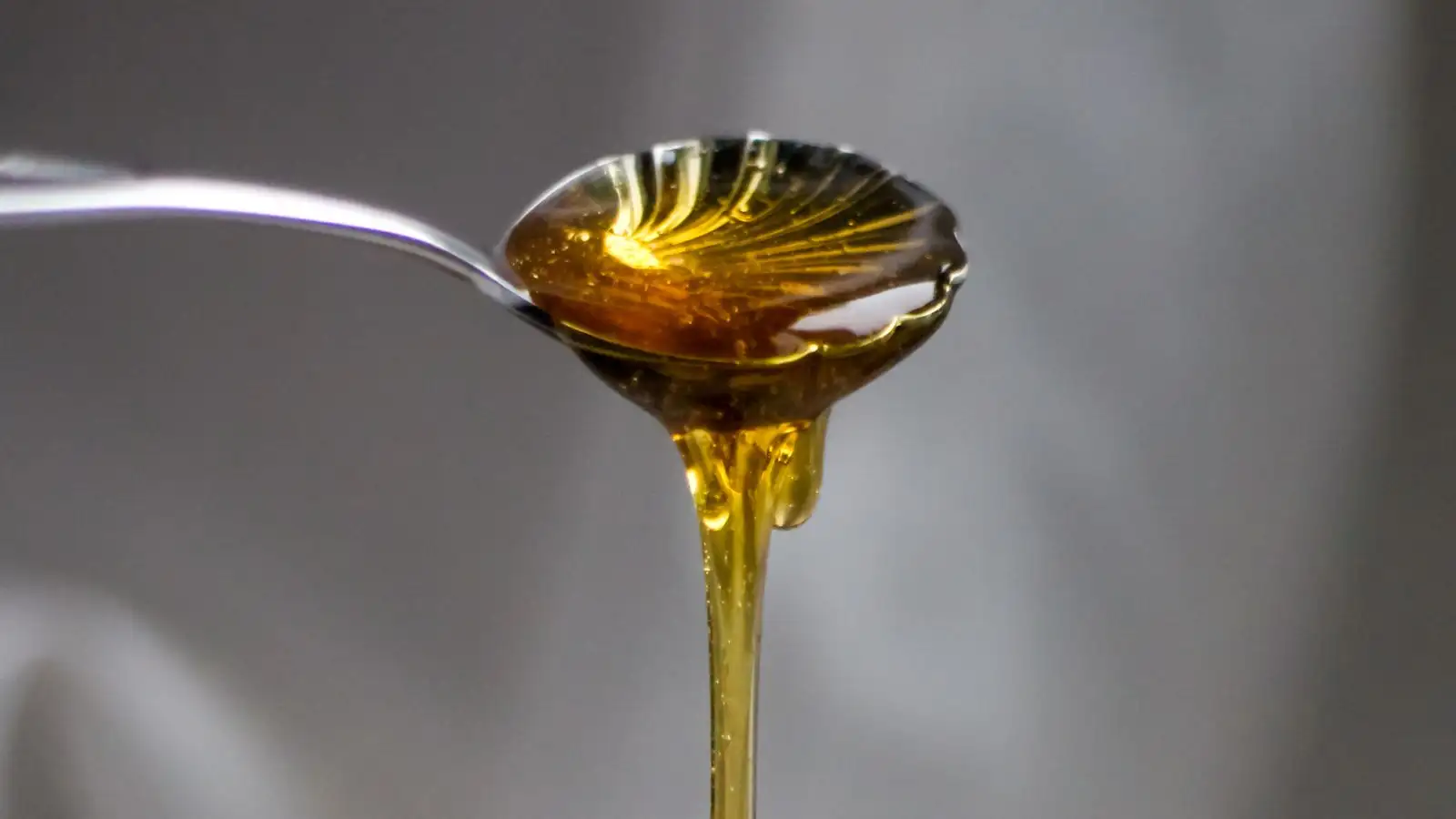
Honey clings. A glaze made with honey stays where you put it on a roast or a bun, while a thin sugar syrup runs off. And honey carries flavor from its nectar source — those aroma compounds survive into the finished dish, and they are not subtle once you know to look for them.
Where sugar does a job honey cannot
Sugar is not the boring one. It just does jobs that require it to be dry and crystalline, and honey cannot fake those.
Sugar creams with butter. The crystals cut into the fat and drag air into it, and that trapped air is a big part of what makes a butter cake or a chocolate chip cookie rise and lighten. Pour honey in with the butter and you get something denser and greasier — pleasant in a chewy bar, wrong in a cake that needed the aeration.
Sugar makes meringue. Whipped egg whites need dry sugar added gradually to build a stable, glossy foam that holds a peak and survives the oven. Honey brings water and acid into that foam, and the result is softer, stickier, and much harder to dry into a crisp shell. Excellent honey meringues exist. They are a different dessert, not a substitute for the one you were making.
Sugar caramelizes into hard candy and spun sugar. Honey will brown, but it will not give you a clean, glassy, snappable caramel. It has too much water and too many other sugars standing in the way.
And sugar is flavor-neutral and free-flowing. It thickens, sweetens, dusts, and stores without adding a personality of its own. When you want sweetness and nothing else, that neutrality is the whole point.
Two different ways to fail in the pantry
Neither one stores badly, but they fail in opposite directions. Sugar hardens. Leave a bag open in humid air and it turns into a brick you have to chip at. Honey crystallizes. The glucose comes out of solution over months and settles into a grainy solid, faster in some varieties than others, faster in a cool cupboard than a warm one. Crystallization is not spoilage and it reverses in a warm water bath. It is just a texture change you have to plan around.
Honey also takes on whatever is around it. It absorbs moisture and odors from the air, which is a good reason to keep the lid tight and not park the jar next to something pungent. And honey's flavor drifts over time — darker, deeper, less of whatever it started as. Sugar tastes like sugar in ten years.
The question to ask before you open the jar
When I am looking at a recipe and deciding what goes in the bowl, I do not ask which sweetener is better. I ask what the sweetener is doing in this specific formula.
Is it there for sweetness alone, in a loose batter with room to spare? Honey will work, and it may improve the crumb. Is it there to cream with butter, build a meringue, or become candy? That is sugar's job, and honey will not do it. Is it there for a soft crumb that lasts, a scoopable frozen dessert, a glaze that holds, or a crust that darkens early? That is honey's territory. Is it there to be neutral, predictable, and identical every time? That is sugar.
Two sweeteners, two sets of jobs. The conversion chart is where you start. Knowing what the sweetener is for is where you stop guessing.