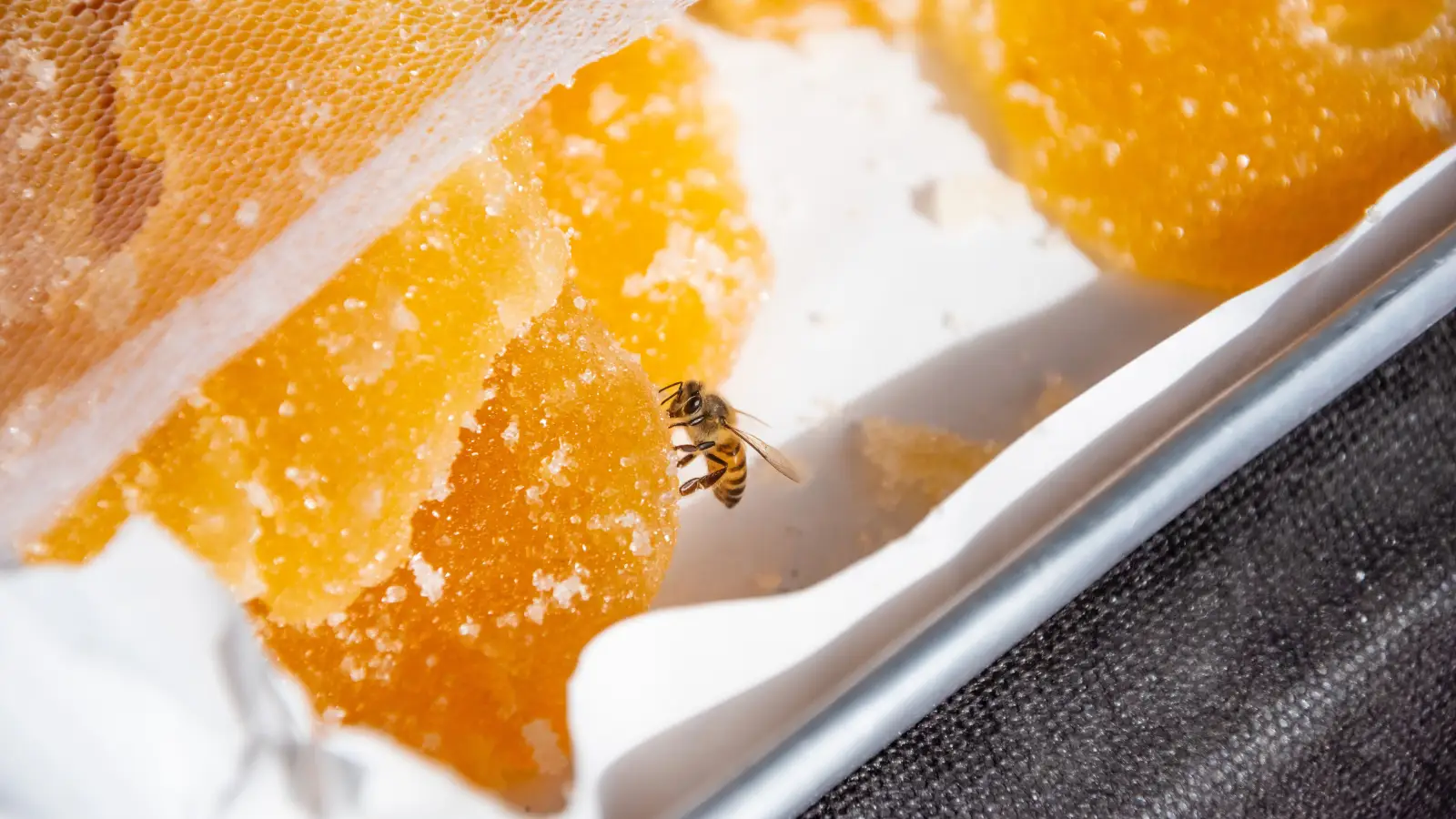
Crystallized honey isn’t a sign of spoilage—it’s a supersaturated sugar solution doing exactly what physics dictates. Glucose, less soluble than fructose, separates from the water and forms solid crystals once the temperature drops enough. That’s all. No bacteria, no decay. The jar is still safe, and nothing about the honey’s nutritional value has degraded. A cloudy, granular mass is the result of predictable variables, not a kitchen mistake.
When a Cloudy Jar Gets Mistaken for Spoilage
A baker finds a jar of wildflower honey turned grainy and opaque. The instinct to discard it comes from a reasonable but incorrect mental model—that a change in texture equals spoilage. The real story is a physical transformation governed by nectar composition and temperature. This misreading leads to a lot of needless waste and repeat purchases. For anyone who keeps raw honey in the pantry, understanding crystallization shifts the response from suspicion to recognition of an unprocessed, honest product.
Glucose, Pollen, and Temperature: The Trio That Sets Crystals in Motion
Why Glucose-Rich Honey Solidifies Faster
Honey is a supersaturated solution of sugars, primarily fructose and glucose. Fructose remains comfortably dissolved at high concentrations; glucose does not. When the glucose-to-fructose ratio tilts toward glucose—as it does in canola, clover, and alfalfa honeys—crystallization unfolds rapidly, sometimes within days. The absolute water content matters too: lower moisture forces glucose out of solution sooner, which is why raw honey, often slightly less watered down than heavily processed versions, will firm up more readily. The ratio is set by the plant source, making crystallization speed a botanical fingerprint rather than a defect.
The Role of Pollen and Tiny Particles as Seed Crystals
Dissolved glucose doesn’t spontaneously snap into a crystal. It needs a nucleation site—a microscopic speck of pollen, wax, or even an air bubble—to start the lattice. Each particle acts as a seed. The more pollen a honey carries, the more nucleation sites exist, and the faster crystals spread. Ultra-filtered honey, stripped of these particles, can sit on a shelf looking pristine for ages, but that clarity is the result of removing the very markers that identify a honey’s floral origin. Graininess, in contrast, signals that these natural seeds were left intact.
How a Cool Shelf Speeds Up the Transformation
Temperature is the kinetic throttle. Around 57 °F (14 °C), glucose molecules move slowly enough to lock into an orderly lattice yet fast enough to keep encountering nucleation points. A pantry that dips into the low 60s in winter or a jar left in a cool basement will crystallize much faster than one stored on a warm counter. Refrigeration accelerates it sharply. Above about 77 °F (25 °C), glucose solubility rises enough to slow or even reverse nucleation, but once a stable crystal mass has formed, simply raising the ambient temperature won’t reliably return it to a smooth liquid without active, gentle warming.
Three Persistent Myths About Crystallized Honey (and the Facts)
Confusing Crystallization with Spoilage
The most basic error is treating a grainy texture as evidence of rot or contamination. Honey’s low water activity and acidic pH make it a poor medium for microbial growth. Crystallization is a purely physical rearrangement of glucose molecules; the honey is just as safe and the flavor profile remains intact, even if the mouthfeel shifts.
Assuming Only Adulterated Honey Crystallizes
A common but inverted idea is that pure honey never solidifies, so a cloudy jar must be cut with corn syrup or other adulterants. The opposite is closer to the truth. Many commercial blends stay liquid precisely because they are formulated with high-fructose syrups or are heavily filtered. Raw, unfiltered honey reliably crystallizes because it retains its natural sugar balance and pollen load. A sudden case of graininess is often a signal of minimal processing, not a reason to doubt the label.
Believing Heat Destroys All Honey’s Value
The concern that warming honey ruins it entirely overlooks the temperature window that preserves its character. Prolonged heat above about 120 °F (49 °C) can degrade enzymes and subtle floral volatiles. But a gentle immersion in warm water (95–110 °F) melts the glucose crystals without stripping what makes the honey distinct. Quick stints in a microwave are riskier because they create uneven hot zones that easily overshoot safe limits.
A Field Guide: Which Honeys Turn Solid First
The timeline of crystallization is built into the nectar. High-glucose honeys set earliest: canola often within days, goldenrod and clover within weeks, sunflower over a couple of months. Medium-speed varieties like orange blossom and many wildflower blends stay fluid for a few months before clouding over. Low-glucose honeys—acacia, tupelo, sage—resist crystallization for years, sometimes indefinitely. This gradient turns a seemingly random annoyance into a clear varietal signal, mapping directly back to the botany of the hive’s foraging range.
Questions People Ask About Crystallized Honey
Is crystallized honey safe to eat?
Yes. The process is physical, not microbial, so the honey stays safe and its nutrient profile doesn’t change.
Why does honey crystallize in the jar?
Dissolved glucose precipitates out of the supersaturated solution, aided by pollen-based nucleation sites and cooler storage temperatures.
How do you turn crystallized honey back to liquid?
Place the closed jar in a bowl of warm water (about 100°F) and let it sit, stirring occasionally. Keep water temperature well below boiling, and avoid the microwave to prevent local overheating.
Does crystallized honey have the same health benefits?
Antioxidants, enzymes, and sugars remain as they were; only the texture changes.
Is crystallized honey a sign of high-quality honey?
Generally, yes. It indicates minimal filtration and a natural glucose-fructose balance, both hallmarks of raw, authentic honey.
Can you prevent honey from crystallizing?
Storing honey at room temperature (above 70°F) slows the process, but raw honey will eventually crystallize. Keeping it in a stable, slightly warm spot delays but doesn’t stop the physics.
The next time a jar thickens and turns cloudy, keep it. The crystals are a map of the flowers the bees worked and a marker of gentle handling after extraction. Use the honey exactly as it is—spread on toast while grainy, stirred into tea, or gently warmed back to liquid—and you’re working with a product that nature designed, not one that failed. That shift in perspective converts what feels like an annoyance into a reliable sign of authenticity.