A clover honey label features several words that sound definite—Grade A, pure, raw—but their legal meaning is far narrower than the marketing implies. The USDA grades honey on a handful of physical traits; a pure label simply means no additives were introduced. After that, the burden shifts to you. By the time you finish this article, you will be able to separate the claims that carry enforceable definitions from those that rest on a producer’s say-so.
Federal honey regulation has a marked gap: the USDA honors a Grade A seal for clarity and low moisture, while completely ignoring whether the honey was ever heated or filtered. Meanwhile, terms like “raw,” “unfiltered,” and “organic” lack any binding federal definition for honey. This guide maps each phrase to what it legally obligates—and what it simply allows—with clover honey at the center of the analysis.
USDA Grading: What ‘Grade A’ Means for Clover Honey (and What It Doesn’t)
The USDA sorts honey into four categories: Grade A, Grade B, Grade C, and substandard. For Grade A, the honey must have a moisture content below 18.6%, show no visible defects such as air bubbles or excessive pollen grains, and score favorably on flavor and aroma—clover honey should present a mild, sweet, clean taste. The standard was built for shelf appeal and stability, not for nutritional completeness or gentle handling.
What the Grade Actually Measures
A Grade A score is, in effect, a cosmetic rating. It confirms the honey looks clear, resists fermentation, and is free of off-flavors like scorched or fermented notes. It does not indicate whether the honey spent time at pasteurization temperatures of 160°F or higher, was forced through a pressure filter that removes pollen, or was blended from multiple floral sources to hit a uniform color. For clover honey, whose floral delicacy is easily smothered by heat, the grade stays silent on the very processing steps that can strip away the honey’s character.
The Limits of a Grade A Claim
Two jars labeled Grade A clover honey can be entirely different products. One might be a low-temperature bottling from a single apiary, still carrying its natural pollen. The other could be a heated, ultra-filtered blend of domestic and imported honeys, adjusted for appearance with added pollen or enzymes. The grade gives no means to distinguish between them.
The “Pure” Promise: What It Guarantees and What It Sidesteps
“Pure honey” is one of the few claims with a fixed federal meaning: the jar contains nothing but honey—no syrups, no extra water, no additives—and the honey must not have been caramelized or damaged by overheating to the point of forming hazardous compounds. That protection is real, but it stops there.
A pure clover honey can legally undergo pasteurization, fine filtration, and pollen removal. It can also be a blend sourced from several countries, as long as the final flavor fits the clover description. While FDA guidance says the named floral source should predominate, no minimum percentage is enforced. So a jar labeled “pure clover honey” might hold mostly alfalfa or canola honey, with just enough clover to pass a casual taste check. The word “pure” is a necessary baseline, but it offers no indication of origin or handling.
Raw Honey: Why That Word Is a Manufacturer’s Interpretation
Among all label terms, “raw” is both the most sought after and the least anchored to any legal benchmark. The USDA and FDA have no federal standard for raw honey. Some states have written their own, but they do not agree on a temperature ceiling. A producer can call honey raw after exposing it to 120°F, 100°F, or ambient hive heat; there is no consistent threshold. For clover honey, where a fresh, light profile is the point, the absence of a definition means the consumer relies entirely on the brand’s integrity.
How to Spot a Meaningful Raw Claim
Since no government test exists, a more reliable approach is to look for producers who publicly disclose their process. A label that specifies a maximum temperature—commonly under 105°F—or describes cold extraction carries more weight. Visible pollen and a tendency to crystallize quickly are practical indicators; raw honey usually solidifies faster because it retains fine particles that seed the process. Third-party schemes like True Source Honey verify country of origin and supply chain ethics, but they do not define or certify raw. A raw claim on its own is a placeholder, not a proof point.
Unfiltered Honey: The Pollen Question
“Unfiltered” likewise lacks federal standardization. Generally, it means the honey was not run through a pressure filter or diatomaceous earth—the methods that strip out pollen, propolis particles, and volatile aromatics. Most honey is still strained to remove bee parts and large wax bits, and that step is frequently still sold as unfiltered.
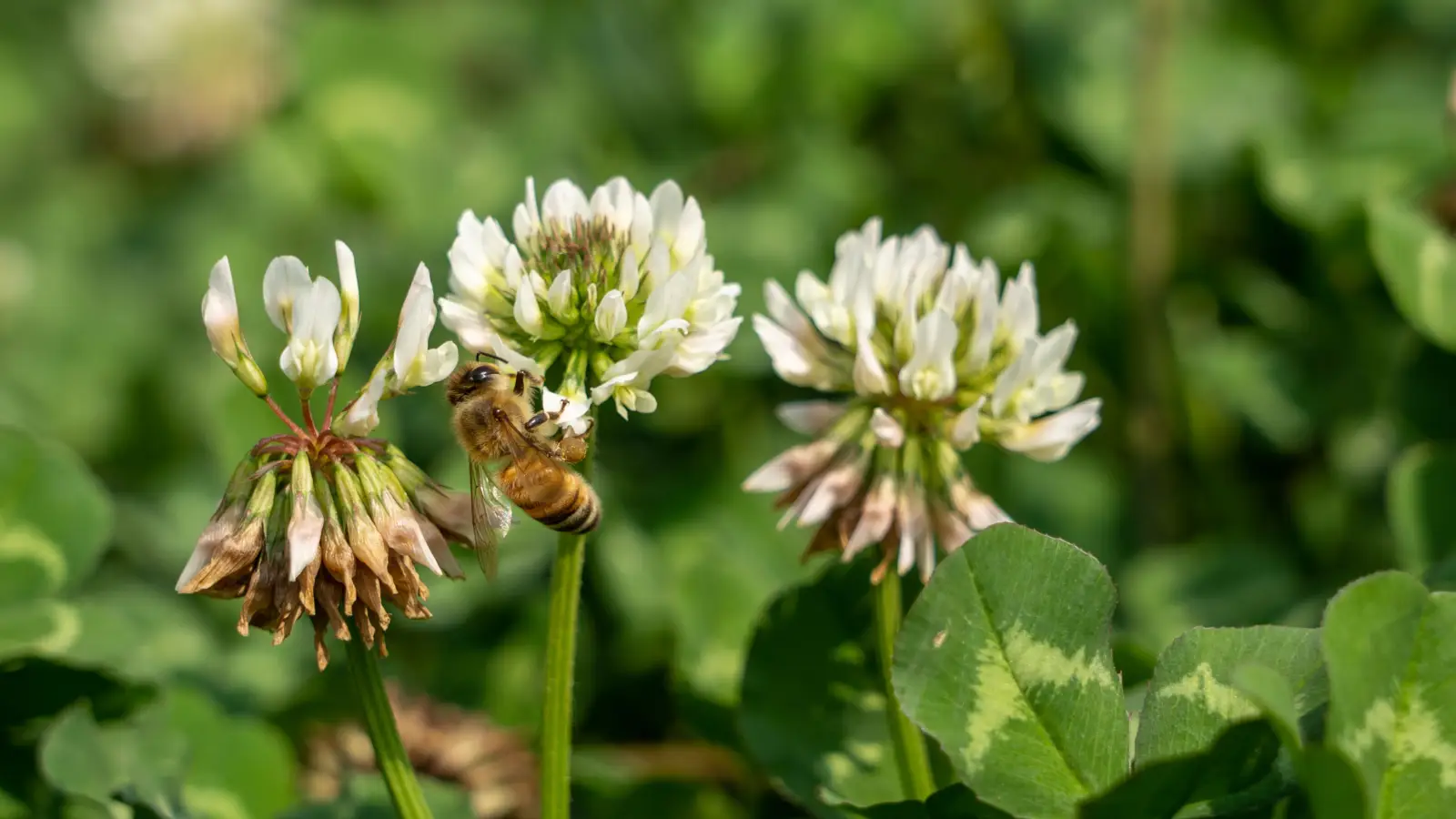
For clover honey, pollen serves as a practical authenticity check. Clover pollen has a distinct shape under a microscope, and its presence supports the claim that the honey came from clover-heavy forage. However, pollen can be reintroduced into filtered honey, and some producers use a coarse filter that passes pollen while trapping only the largest debris. The term “unfiltered” is most informative when paired with “raw,” because the combination narrows the range of possible processing.
Organic Clover Honey: What the USDA Seal Can—and Can’t—Do for You
The USDA organic seal on honey means the beekeeper followed the National Organic Program’s rules. Those rules cover the forage area (free from prohibited pesticides and synthetic fertilizers for at least three years), hive management (no synthetic miticides or antibiotics outside narrow exemptions), and record-keeping. It is a verified, enforceable claim.
But the organic standard is about agricultural inputs, not post-harvest handling. An organic clover honey can be pasteurized, filtered, and blended—provided all honey in the mix is organic. Moreover, bees routinely forage up to five miles, making an ironclad guarantee that every visited flower is organic genuinely difficult in most landscapes. For clover, the large monoculture plantings common in conventional agriculture would disqualify the crop, so organic clover honey typically arises from mixed pasture, wildflower meadows, or deliberately managed organic fields. The seal tells you the forage and hive practices were clean; it does not report what temperature dial was set at the bottling line.
Country of Origin: When “Product of USA” Is a Loophole
U.S. law demands that honey labels state a country of origin, but the provision leaves room for blending. If several countries’ honey is combined and packed in the United States, the label may say “Product of USA” as long as the processing here is deemed transformative. Recent regulatory changes have narrowed that path somewhat, but the clearest indicator of domestic honey remains a label that says “100% USA honey” or names a state, apiary, or region.
Clover honey is especially vulnerable to blending because its mild, predictable character is easy to match with cheaper imports. Many supermarket brands mix U.S. and foreign honey to manage cost. Unless the label explicitly claims a single origin or carries a batch-specific traceability mark, you cannot assume the jar’s contents are wholly American.
Key Takeaways: What Your Clover Honey Label Actually Promises
- USDA Grade A measures clarity, moisture, and flavor—it says nothing about whether the honey was heated or filtered.
- “Pure” guarantees no additives, but it is silent on pasteurization, pollen removal, and botanical identity.
- “Raw” and “unfiltered” have no federal standard; the producer alone assigns meaning to those words.
- The USDA organic seal certifies forage and hive management, not the handling that occurs after extraction.
- Country-of-origin labeling can disguise blending unless it states “100% USA” or identifies a single source.
- The strongest signal of quality is a transparent producer—one that discloses heating temperature, filtration, and floral source.
Common Questions About Clover Honey Label Claims
Does raw clover honey crystallize faster than processed honey?
Yes. Natural pollen and enzymes act as seed crystals, causing raw honey to turn grainy and solidify sooner than pasteurized, filtered varieties. Crystallization is a physical change, not spoilage; gentle warming reverses it.
Is Grade A clover honey healthier than Grade B?
Not in a way the grade measures. Grade B may have higher moisture or a darker shade, but the scoring ignores antioxidant levels, pollen, or enzymes. A raw Grade B clover honey could contain more bioactive components than a pasteurized Grade A.
Can clover honey be certified organic if bees forage on non-organic clover fields?
No. Organic standards require the forage area to have been managed without prohibited substances for at least three years. Zones near intensive agriculture rarely qualify. Verify certification through a USDA-accredited agency to be sure.
What does “True Source Certified” mean on honey?
True Source Certified is a third-party audit that checks the honey’s country of origin and ethical supply chain, confirming it has not been adulterated with syrups or transshipped to obscure its source. It does not certify raw, unfiltered, or organic status.
A clover honey label is a set of starting clues, not a guaranteed description. The single most effective next move is to look past the catchy front-panel words and seek out concrete details—a stated maximum heating temperature, a region-specific floral claim, or a batch number tied to a harvest. When a producer offers that level of specificity, the honey inside is far more likely to match the story on the glass.